

Question
I had root canal treatment on a front tooth, and the opening was filled with resin only. I'm worried the tooth might crack when I chew or bite into something. Would asking my dentist to place a post make the tooth stronger?
Short Answer
A post is not a device that strengthens the tooth itself; it is a device that helps retain the core (the central structure that supports the restoration) when the remaining tooth structure alone cannot hold the restoration securely. If enough tooth wall remains beyond the small opening made for root canal treatment, a resin filling alone can complete the restoration, and adding a post in that case does not make the tooth any stronger. In fact, creating space for a post requires removing more of the canal wall, which can weaken the root. Whether a post is needed for this particular tooth depends on directly examining the location and amount of remaining wall, so the accurate approach is to tell your dentist about your concern and have it checked during the visit.
Why Is That?
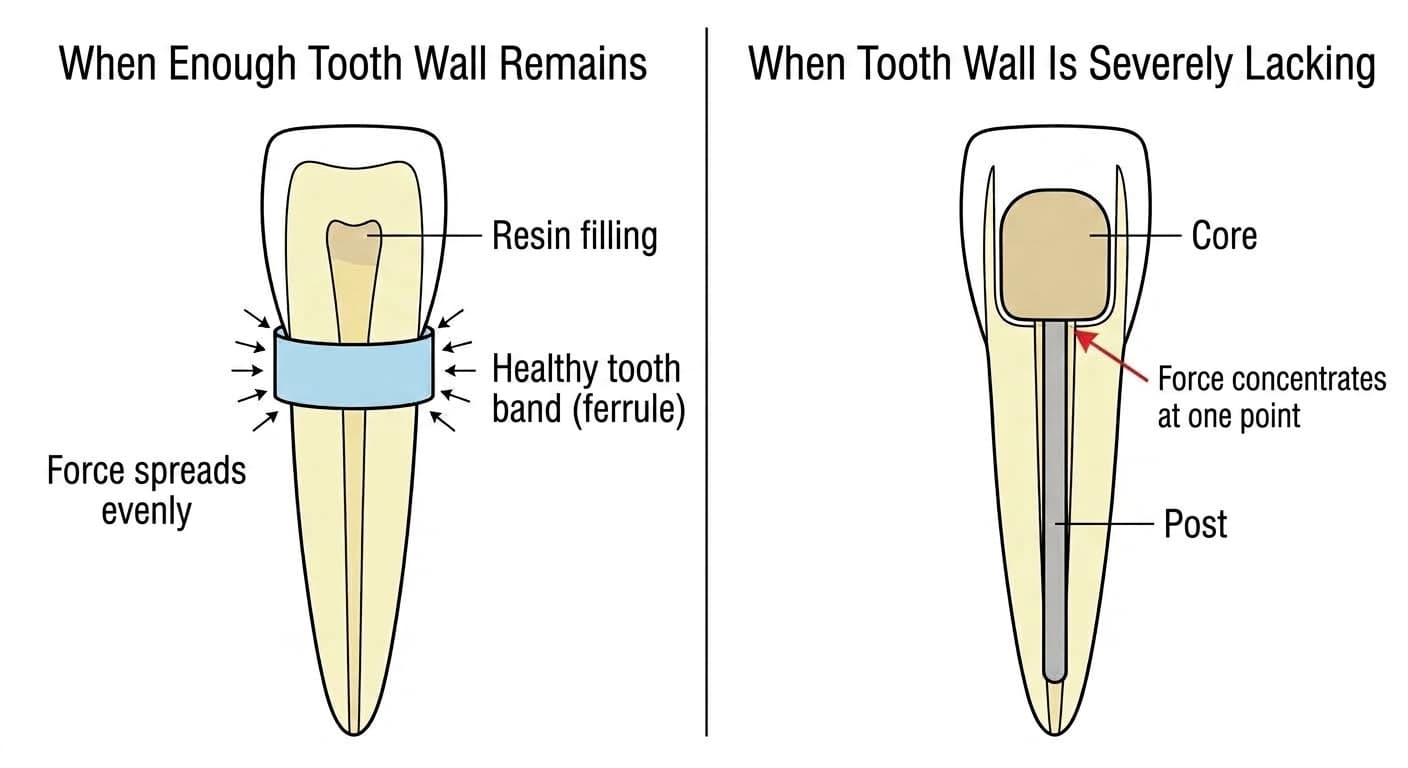 When healthy tooth wall wraps around the margin like a band, force spreads evenly; but when the wall is insufficient and only a post is present, force concentrates where the post meets the core.
What a Post Does Is "Retention," Not "Reinforcement"
When a tooth that has completed root canal treatment has extensive crown damage such that the restoration alone cannot withstand forces, a post-shaped structure is sometimes placed inside the canal and a core is built up on top of it. The role of the post here is clear: the post itself does not increase the strength of the tooth. Its role, in a situation where there isn't enough remaining tooth structure for the core alone to be retained, is to help the core stay anchored toward the canal.
This becomes clearer when you consider what actually weakens a tooth. The root canal procedure itself reduces tooth strength by only about 5%. The main cause of a weakened tooth is not the root canal treatment but the amount of tooth wall lost to decay or damage. When tooth structure is lost across multiple surfaces together, tooth strength can drop by as much as 60%. Because a post is a structure placed inside the canal, it cannot restore the amount of the outer wall that has already been lost.
What Actually Protects a Tooth from Fracture Is the Remaining Tooth Wall
What allows a tooth to withstand chewing forces is not the post but the healthy tooth wall surrounding the margin. This is called the ferrule, a band-like structure in which the restoration margin sits on at least 2mm of height and 1mm or more of thickness of healthy dentin, encircling the root. When this band is present, chewing forces and lateral forces spread evenly across the whole tooth; but when this band is insufficient and the tooth relies on the post alone, force concentrates at the single point where the post meets the core, making fracture more likely to start there. In data observed over three years, teeth where this band was less than 2mm failed 26% of the time, while teeth with 2mm or more failed only 7% of the time, a substantial difference. In other words, what protects a tooth is determined not by whether a post is placed but by how much of this healthy wall remains.
When a Post Is Needed and When It Is Not
If the loss of tooth wall is not extensive beyond the opening made for root canal treatment, the restoration can be completed with resin filling alone, without a post or crown. Resin itself can be retained without a separate post if at least 2mm of healthy tooth structure remains at the margin to which it bonds.
Conversely, if only one or two cavity walls remain, if the tooth wall is too insufficient to secure the ferrule described above, or if less than half of the crown structure remains, the core alone lacks sufficient retention and a post becomes necessary. The answer to the worry that "resin alone might crack" depends not on the fact that the material is resin, but on the amount and location of the wall currently remaining.
Why an Unnecessary Post Can Actually Increase Risk
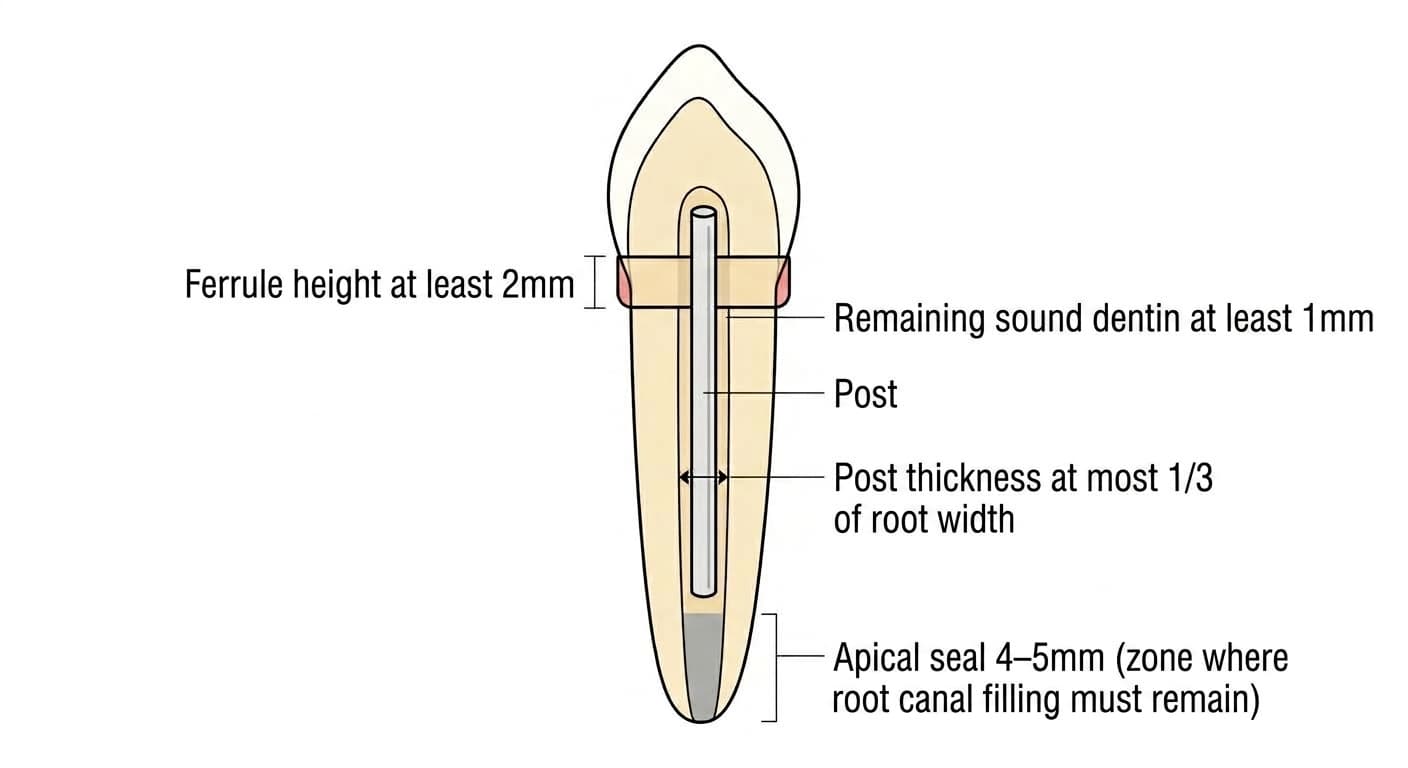 The post space is determined by considering apical seal, post thickness, remaining dentin thickness, and ferrule height together.
Placing a post requires additionally widening the inside of the canal to create space for it. This carries the risk of weakening the canal wall, and if the wall becomes thin and then bears occlusal force, a wedging effect can cause root fracture. For this reason, even when a post is placed, at least 4-5mm of root canal filling seal must be preserved at the apical end, the post's thickness must not exceed 1/3 of the root's width, and at least 1mm of healthy dentin must remain around the post. Creating post space when it isn't needed reduces these safety margins, so adding a post "just in case" is not always the safer choice.
Ultimately, whether the front tooth you're concerned about needs a post is something that must be judged by directly examining the amount and location of remaining tooth wall and the feasibility of securing a ferrule. For a broader discussion of whether to finish with resin or to also consider a core and crown, see Does a front tooth also need a crown after root canal treatment?.