Question
I had my tooth prepared for a lab-made restoration like an inlay or crown, and I'm worried that the temporary filling placed until the final restoration is ready might hurt or fall out. I'd like to know what role this temporary material plays in the meantime, and whether it's okay to go a few days if it comes out.
Short Answer
The temporary filling (temporary restoration) protects the dentin and nerve (pulp) exposed by tooth preparation from irritation and bacteria, and it holds the space for the final restoration as well as the position of the neighboring and opposing teeth. Because it's only meant to protect the tooth during the fabrication period, a poor seal or a dislodged temporary can lead to sensitivity or let bacteria back in. Even if it comes out without pain, that doesn't mean it's safe to leave it that way for several days, so if it falls out, have it checked at the dental office rather than leaving it alone.
Why Is That?
What Does the Temporary Restoration Protect?
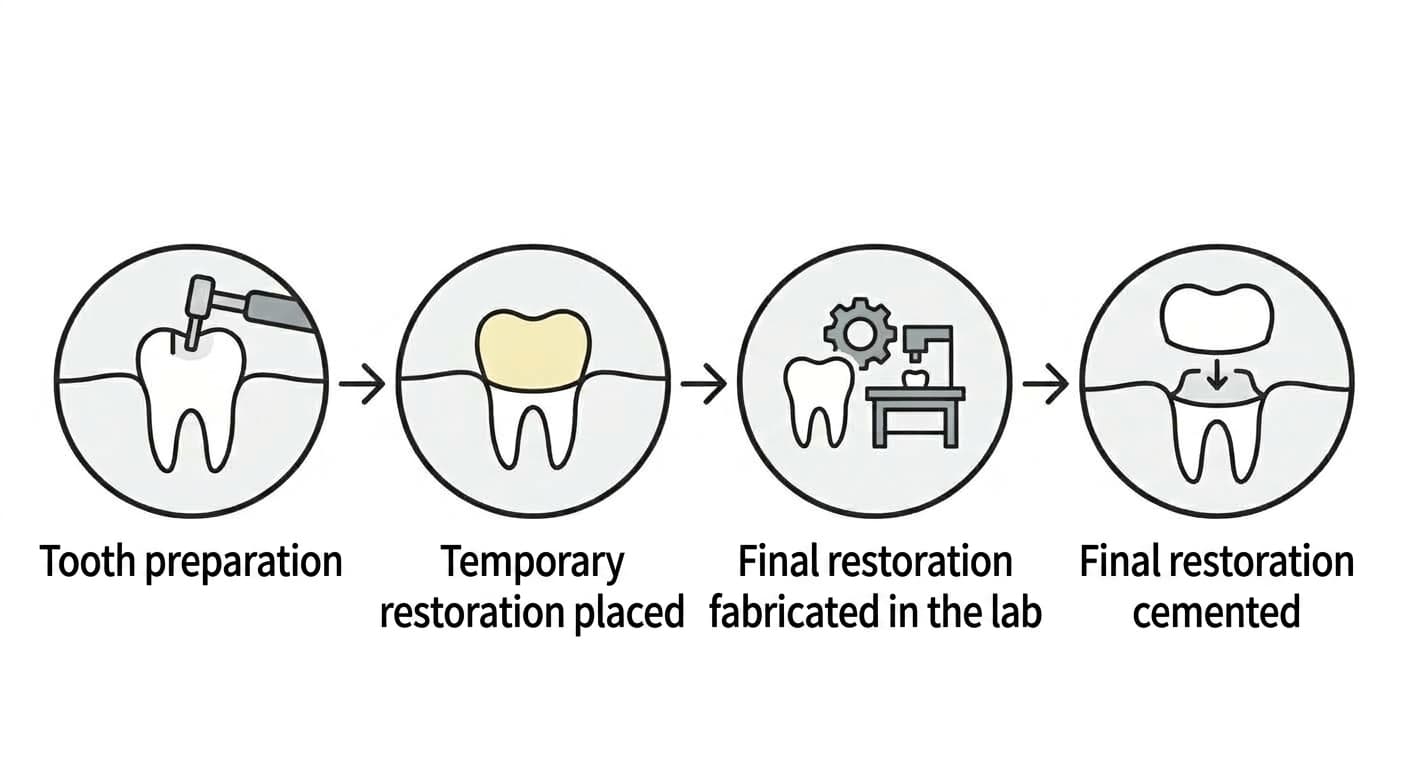
Indirect restorations such as inlays and crowns aren't made directly in the mouth; they're fabricated separately in a dental laboratory. Because they're made precisely to match a model of the prepared tooth, the process takes several days even when rushed. The prepared tooth can't simply be left as is during that time, so a temporary restoration is placed.
When a tooth is prepared, the enamel that once covered it is removed and the dentin beneath is exposed. Dentin contains microscopic channels (dentinal tubules) that lead all the way to the pulp, where the nerve is, so if left uncovered the tooth becomes sensitive to temperature and other stimuli and bacteria can enter easily. The temporary restoration covers these channels to protect the dentin and pulp from irritation and bacterial invasion, and it also helps maintain the health of the gum (periodontal tissue) and the position of the neighboring and opposing teeth. Keeping the prepared tooth surface from constant exposure to saliva serves the same purpose.
The Bonding Method Differs Between the Temporary and the Final Restoration
A temporary restoration is made either directly in the mouth using a self-curing resin (a plastic material that hardens at room temperature) or made in advance on a model taken from an impression, and then it's attached with temporary cement. The cementation of the final restoration, by contrast, involves treating both the tooth surface and the restoration surface and bonding them precisely (for ceramic or resin-based restorations), or, for a material with no adhesive bond such as a gold inlay, shaping the preparation from the start so the restoration locks into place mechanically.
Because the bonding method itself is different, a temporary restoration isn't designed to last a long time from the outset; it's made only to hold the tooth's position during the fabrication period. Repeated chewing force can cause it to come off earlier than expected, and this reflects the nature of a temporary restoration rather than a defect in the material.
Why Does a Poor Seal Cause Sensitivity?
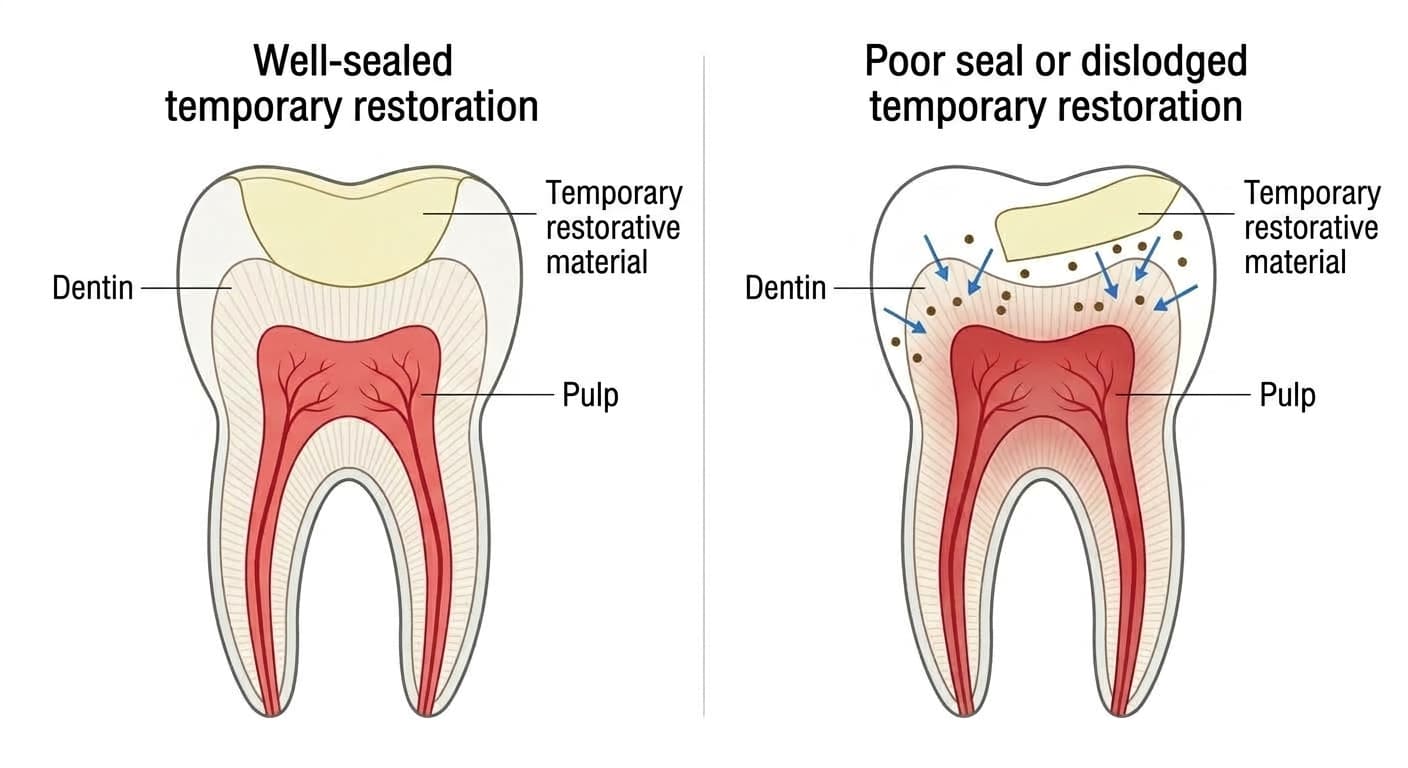
The dentinal tubules exposed by tooth preparation are filled with fluid. When a stimulus such as a temperature change or an osmotic pressure difference is applied, the fluid inside these channels moves rapidly, and that movement stimulates the nerve endings on the pulp side, producing a sensation of sensitivity or pain. This is known as the hydrodynamic theory.
If the temporary restoration doesn't adequately support the prepared tooth surface or its margin doesn't seal tightly, a pumping effect and osmotic pressure changes at the dentin cells can occur, leading to pulp hypersensitivity or even pulp necrosis. This means these problems can happen even while the temporary restoration is still in place if it doesn't fit precisely, so if it moves loosely while chewing or the tooth is unusually sensitive to cold, the material may have lifted off its seat and should be checked.
What If the Temporary Material Falls Out?
If the temporary restoration falls out, the protection against irritation and bacteria disappears along with it, and the risk of pulp infection rises. How risky this is depends on the extent of dentin removed and the remaining thickness down to the pulp, so whether it's fine to go several days without it has to be judged tooth by tooth. The absence of immediate pain doesn't mean it's safe, so if it falls out, it's better to let the dental office know and have it replaced or checked sooner rather than deciding to wait it out on your own.
This explanation assumes a vital tooth prepared for an inlay or crown, not one undergoing root canal treatment. If a temporary filling placed during root canal treatment falls out, the situation is different because bacteria can lead directly into the root canal, so it's best to check that case in Is It Okay to Wait If the Temporary Filling or Crown Placed During Root Canal Treatment Falls Out?.