Question
I went to the dentist for a cavity, and I was told that some teeth could be filled right away with resin, while other teeth needed an inlay or a crown. Aren't these all just treatments that remove the decay and fill the space? Why is the recommended method different from tooth to tooth?
Short Answer
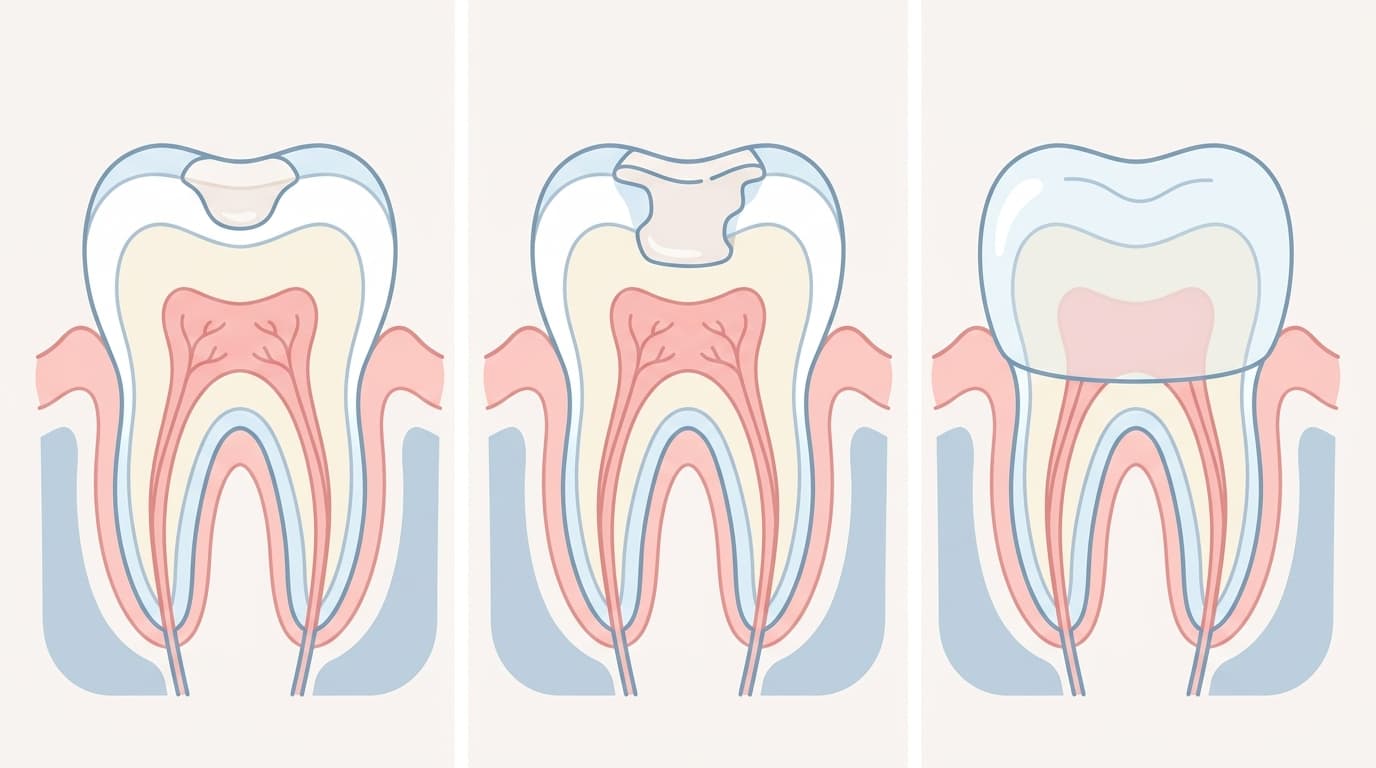
What determines the method is less the material itself than the amount and location of tooth structure lost to decay. A small cavity can simply be filled right where the tooth was drilled, using composite resin (often just called 'resin'), a direct restorative material that is placed and hardened on the spot. But if the cavity is large and much of the tooth wall is gone, an inlay, which is made outside the tooth beforehand and then bonded in as an indirect restoration, reproduces the shape more precisely. If the cusps, the pointed ridges on the chewing surface, have also weakened, a crown (a full crown, a restoration that covers the entire tooth) is recommended to cover and protect them.
Why Is That?
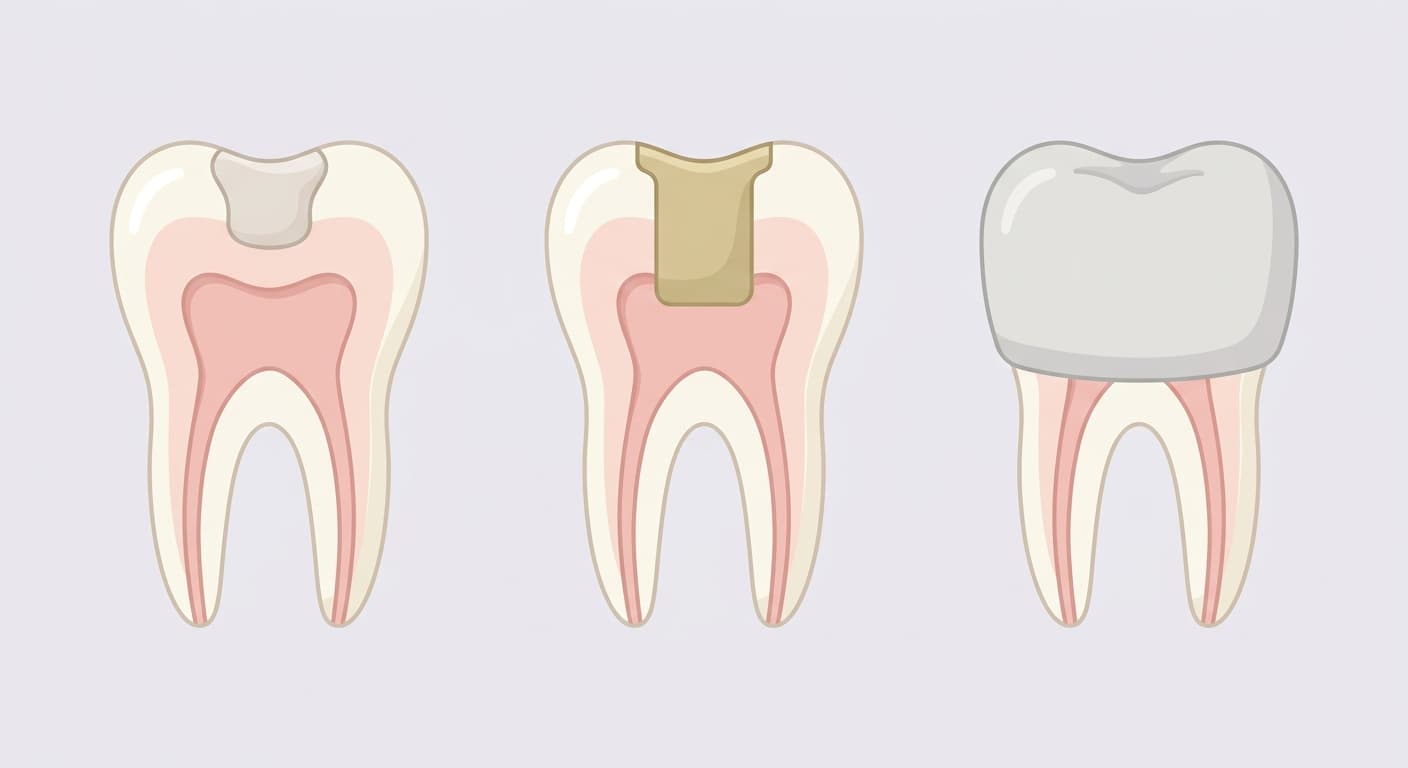
Direct Restoration (Resin) and Indirect Restoration (Inlay) Are Made in Different Places
Composite resin is a material made of organic resin mixed with inorganic filler particles. It is a direct restorative material that is packed straight into the cavity after the decay is removed and then hardened on the spot with light. Because it bonds to the tooth, relatively little tooth structure needs to be removed, and it can be used in cavities ranging from Class I to Class VI. However, as resin hardens it undergoes polymerization shrinkage of roughly 2% in volume, which can leave a gap between the tooth and the resin or cause sensitivity after the restoration. To reduce the effects of this shrinkage, it is essential to place the resin in layers no thicker than 2mm (incremental filling) and to isolate the tooth from saliva, usually with a rubber dam. In large cavities on back teeth that bear heavy chewing forces, resin has limits in wear resistance and durability, so its indications are chosen carefully.
An inlay is an indirect restoration made by taking an impression of the cavity shape and then fabricating it outside the tooth, out of gold, resin, or ceramic, before cementing it in place. It does not cover the cusps; it only fills the cavity inside the tooth. Because most of the hardening (polymerization) of a composite resin inlay happens during lab fabrication outside the mouth, with only a thin layer of bonding resin cement curing inside the mouth, it transmits less polymerization shrinkage stress to the tooth than resin placed directly. Gold or ceramic inlays are also fully shaped outside the tooth beforehand, so they can reproduce the contact point with the neighboring tooth and the complex anatomical shape of the chewing surface more accurately than building it up directly inside the tooth. For this reason, inlays are sometimes chosen over amalgam or direct composite resin filling for mid-sized defects on back teeth.
A gold inlay does not rely on adhesive bonding; it gains retention from opposing cavity walls that face each other, so the cavity must be shaped precisely. CAD/CAM-fabricated resin or ceramic inlays, by contrast, are also held in place by the adhesive strength of the resin cement, so the cavity outline can flare slightly toward the chewing surface. Either way, to keep the cavity from fracturing, the narrowest part of the chewing surface (the buccolingual width) is kept to at least 2mm, and internal corners are rounded so that stress does not concentrate in one spot.
If the Cusps Have Also Weakened, a Crown (Full Crown) Is Considered
If the area removed by decay or a previous treatment extends more than two-thirds of the distance from the central groove (the groove in the middle of the chewing surface) to the tip of the cusp, the remaining cusp is too thin to withstand chewing force. In that situation, 'cusp coverage' (reducing the cusp and covering it together with the restoration) becomes necessary. Because an inlay only fills the inside of the tooth, it cannot cover the cusps, so at this point a crown (a full crown that wraps the entire outer surface of the tooth, including the cusps) comes into consideration.
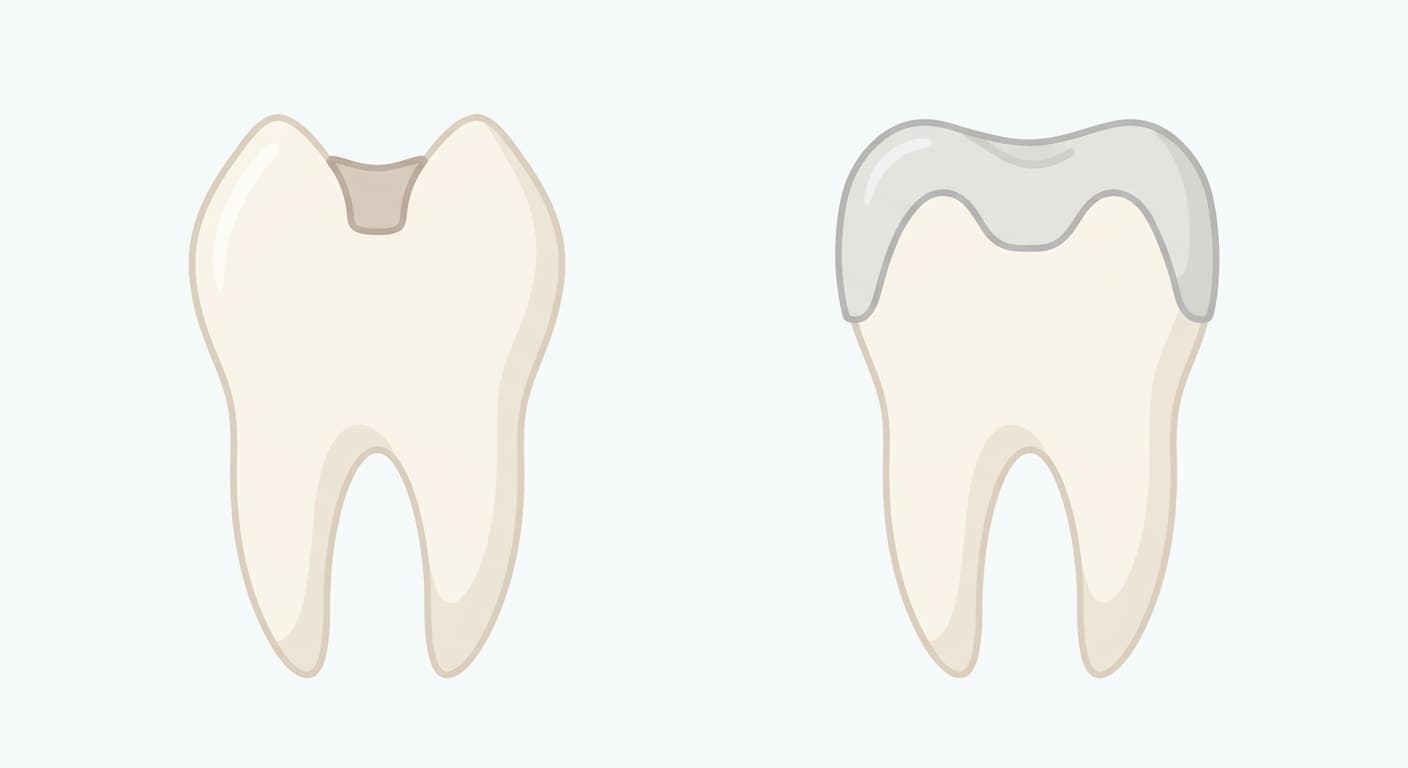
A crown is a restoration that surrounds all the axial surfaces and the chewing surface of the tooth, and it is known to offer the best retention and fracture resistance of any restoration, better than restorations that cover only part of the tooth. It is mainly used on molars, where chewing force is especially high, when decay or trauma has severely damaged the tooth structure or the entire chewing surface needs to be rebuilt. For teeth with even more internal structure lost, such as molars that have had root canal treatment, one report found that teeth restored with cusp coverage had a sixfold higher survival rate over nine years of follow-up compared with teeth restored by filling only the inside of the tooth. This case is covered, along with the criteria for more actively recommending a crown after root canal treatment, in Why a Crown Is Needed After Root Canal Treatment on a Molar.
For a closer comparison of how, even with the same material, the effect of shrinkage on the tooth differs depending on how it is fabricated, as with direct resin versus resin inlay, see Comparing the Durability of Resin and Resin Inlay.
Resin, inlays, and crowns are all treatments that fill the space left after decay is removed, but each is chosen at a different point depending on how much tooth structure remains and whether the cusps retain enough strength to withstand chewing force. If a dentist recommends a different method for different teeth, it is because the amount of remaining tooth structure and the condition of the chewing surface differ from tooth to tooth.