
Question
Many people bring up a concave notch that forms right where the tooth meets the gum, often called the "neck of the tooth." Some clinics fill this spot with composite resin (a tooth-colored filling material), while others use glass ionomer (a cement-type filling material that continuously releases fluoride), and people want to know what determines which material is chosen.
Short Answer
Neither material is fixed as better in every case. When the defect stays on the enamel side and the site can be fully isolated from saliva, composite resin is often used. When the defect extends down to the root surface, or the gum has receded along with it, or isolation is difficult, glass ionomer materials (including resin-modified types) are usually considered first. Which material is used is decided by looking together at the defect's location, the condition of the gum, and whether saliva can be blocked at that site.
Why Is That?
Why the Tooth Neck Gets Notched
A notch where the tooth meets the gum does not have a single cause. It appears from a combination of factors such as abrasion, erosion, and abfraction (tiny flexing of the tooth from chewing forces). The shape and location of the notch differ depending on which forces and irritants acted over time; if you want to look more closely at the causes, you can check the article that covers why teeth wear down overall. Here, we look at what to fill the defect with, once a defect that needs filling has already been identified.
A restoration is decided on when the lesion is deep, when there is sensitivity (dentin hypersensitivity), when the gum is inflamed, or when there is a risk of pulp exposure. Whether any of these conditions are present decides whether to restore at all before the material is even considered, and the material is decided afterward.
The Defect's Location Is the First Criterion
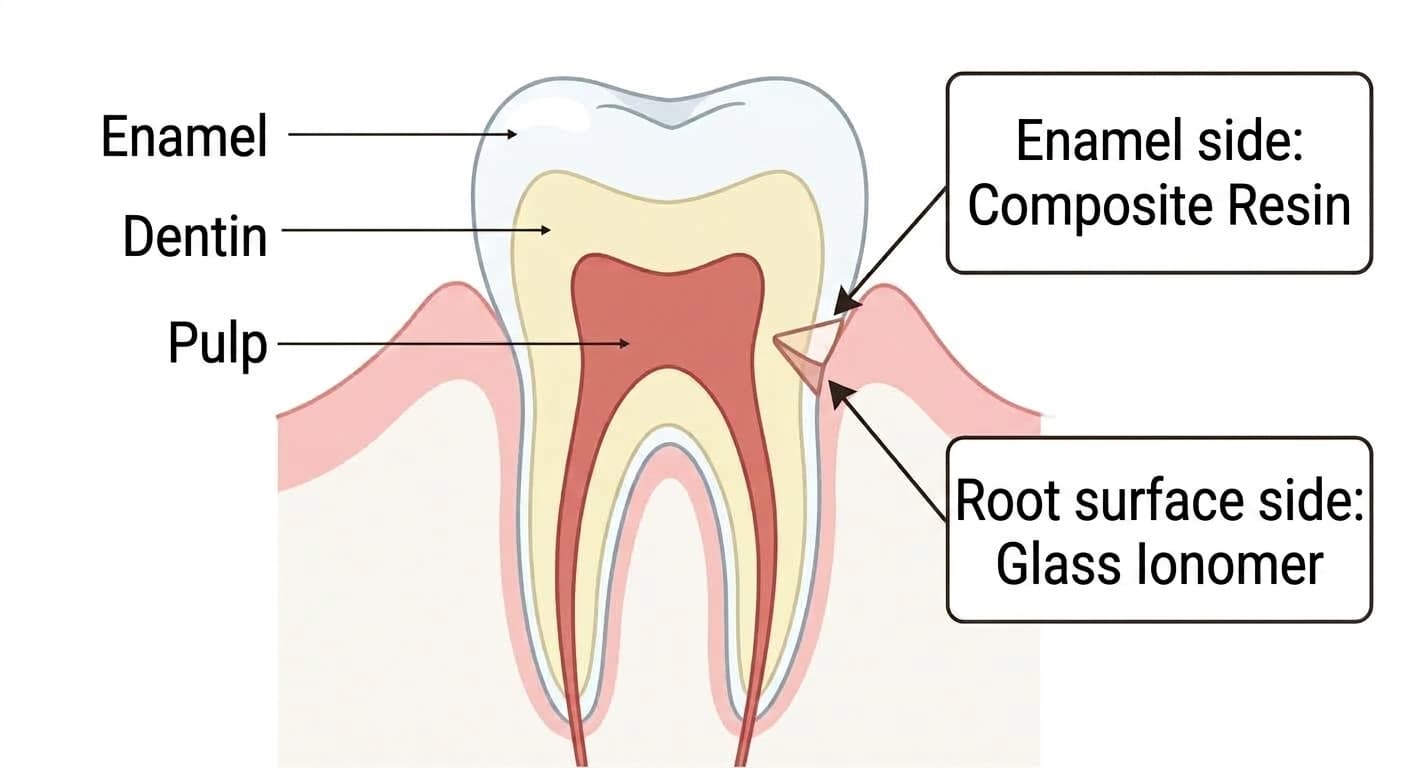
Even for the same tooth neck, how the material is handled differs depending on whether the defect stays on the enamel side (the hard outer layer of the tooth surface) or extends past the enamel down to the root surface. Composite resin can bond to both enamel and dentin, so it is widely used. However, it is not used where the site cannot be completely isolated from saliva or moisture, or where chewing force is strongly concentrated. The shape given when trimming the defect also differs by location: the enamel-side margin is given a beveled edge, while the root-side margin is finished nearly vertical, without a bevel.
Glass ionomer continuously releases fluoride, so it is considered first when caries risk is high, when there is caries on the root surface as well, or for a simple groove-shaped defect that has not widened to the contact area between teeth. Both materials can be used for a tooth-neck defect, but the more the defect widens toward the root surface, the greater the weight given to glass ionomer materials.
The Condition of the Gum Is Checked Too
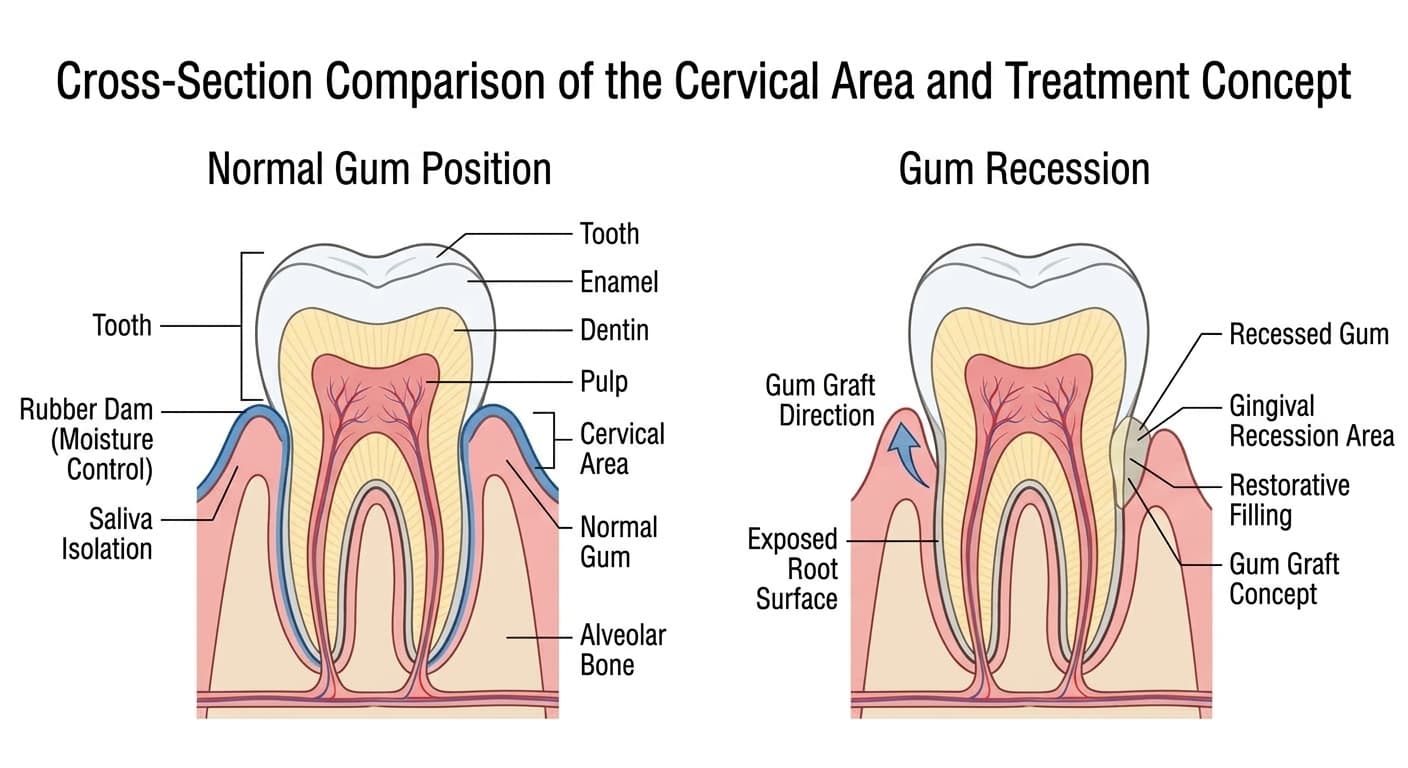
When the tissue covering the gum (attached gingiva) is insufficient, or when the degree of gum recession exposing the tooth root falls into Miller Class I or Class II, combining a gum graft procedure (root coverage) that raises the gum tissue with a resin-modified glass ionomer (RMGI) restoration is considered. Grafting only the area where enamel is exposed is not recommended, since the gum may fail to attach and grow onto that area or blood supply may be hard to reach there, so restoring the defect together is discussed as well.
Whether the Site Can Be Isolated Is Also Checked
Composite resin restoration is carried out with saliva and gingival fluid completely blocked, using a rubber dam (a thin rubber sheet placed over the tooth) with a dedicated clamp, or cotton rolls with a retraction cord that pushes the gum aside. If this isolation cannot be achieved properly at the site, composite resin itself may not be a suitable choice. Because the tooth-neck area is close to the gum, isolation there can be more difficult than at other sites, so the clinic first checks whether isolation is possible at this location.
Also, a tooth-neck defect sometimes has sclerotic dentin remaining at the floor of the cavity (the inner bottom surface of the area to be filled), where the dentinal tubules (tiny channels inside dentin) are blocked with minerals. Sclerotic dentin is harder than normal dentin but responds poorly to acid etching, and this is reported to increase the risk that a composite resin restoration's bonding retention will decrease when using adhesives, especially simplified self-etch adhesives. At such sites, the bonding process is carried out with extra care, or glass ionomer materials are considered together.
In this way, material selection is decided by combining the defect's location, the condition of the gum, whether isolation is possible, and the condition of the dentin at the cavity floor, and no single material is fixed as better in every case.