

Question
A few days after my child had pulpectomy (nerve treatment) on a primary tooth, the cheek on the treated side started to swell. Now the swelling has spread to beside the nose and around the eye, and the skin has turned red. My child seems to be in pain and may have a fever. Is this kind of swelling normal after treatment, or should we go back to the dentist?
Short Answer
You should not wait; get your child seen again as soon as possible. Mild swelling limited to the gum right next to the treated tooth is different from swelling that spreads across the cheek to the area around the nose and eye along with reddened skin. This can be a sign that the infection is no longer confined to the gum or bone and is spreading through the soft tissue beyond it. This kind of swelling can spread faster over time, so a high fever or difficulty breathing or swallowing is an emergency in itself.
Why Is That?
Swelling Confined to the Gum Is Different From Swelling That Spreads Beyond the Cheek
Pulpectomy on a primary tooth removes the infected, dead nerve tissue all the way to the root tip and fills that space with medication. Pus may have already collected at the tip of the treated tooth's root, and this is one form of a pus pocket forming in the gum. This pus is usually confined within the bone and the inside of the gum, showing up as no more than a bulge in the gum.
By contrast, when the infection breaks out beyond the bone and spreads into the soft tissue around the cheek or eye (the soft tissue made up of fat and fascia beneath the skin), the swelling doesn't stay in one place: it spreads widely and often feels firm and stiff rather than soft to the touch. This condition is called cellulitis, and it usually starts from a periapical (root-tip) abscess that forms after the tooth's nerve dies, then spreads rapidly along the spaces between tissues and along the fascia. High fever and chills often come with it.
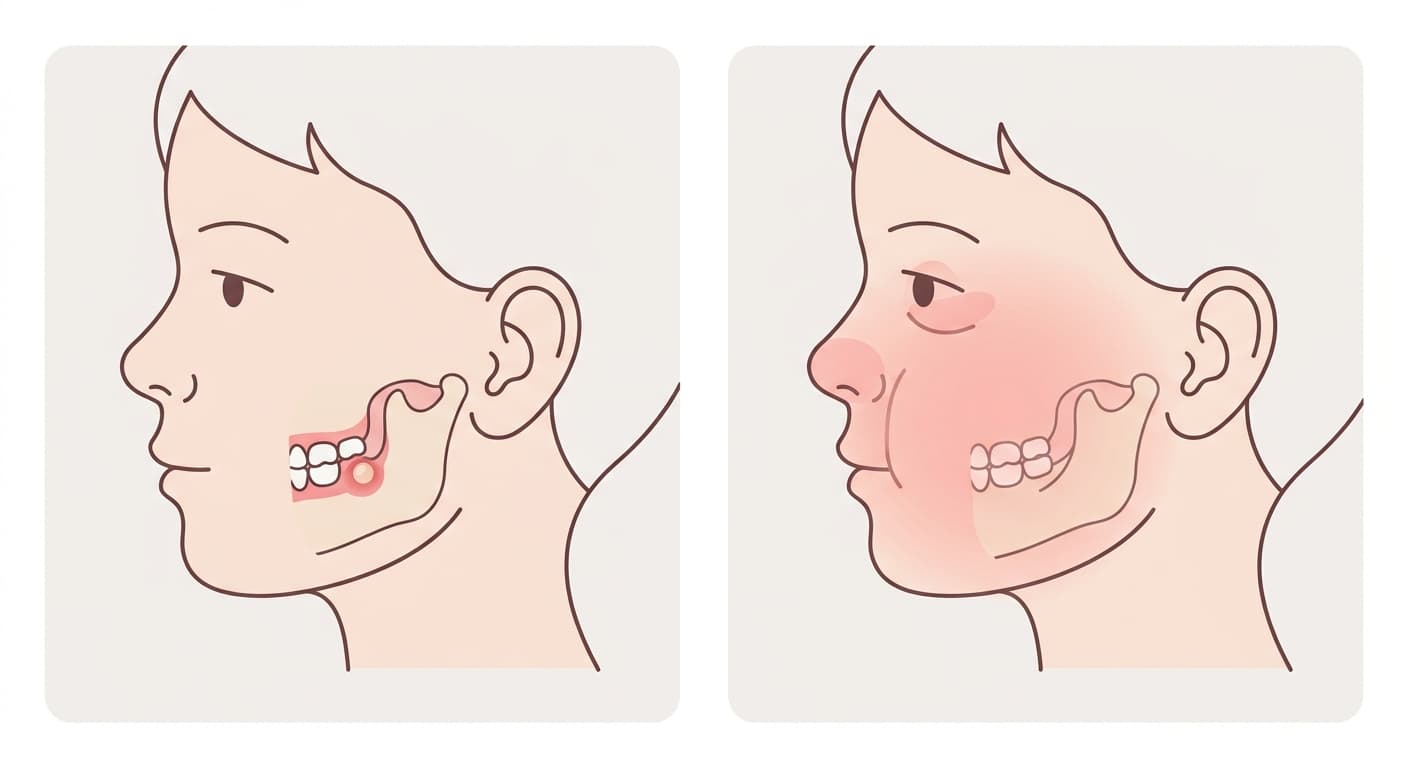
Why Does It Spread All the Way to the Cheek and Eye Area
Inside the cheek there is a tissue gap called the buccal space, through which infections from the molar area can spread. It is bordered on the inside by the cheek muscle (buccinator) and the membrane inside it, and on the outside by the skin of the cheek, extending up to the cheekbone and down to the edge of the lower jaw. When an infection spreads along this space, the entire cheek can swell. Separately from this, there are cases where swelling from a child's tooth infection spreads past the cheek to around the eye, documented clearly enough that clinical photos of such cases appear in dental textbooks.
What's Needed Now Is Re-Evaluation, Not Waiting
If the swelling is confined to the gum and feels soft and fluctuant (like fluid shifting under pressure) when pressed, it's an abscess that can resolve simply by incising that spot and draining the pus. But swelling that has already spread to the cheek or around the eye may not resolve with antibiotics alone, so a dentist needs to check right away whether drainage through the root canal or a direct incision into the soft tissue is needed again.
Rarely, if the infection spreads to involve the space under both sides of the jaw together with the space under the tongue, it can progress to a severe form where the tongue is pushed upward and the airway narrows, a form reported to be life-threatening if left untreated. Progression to this degree is uncommon, but if the swelling is growing quickly, or if the child is having trouble breathing or swallowing saliva, don't wait for an appointment; go to a place that can see your child right away, including an emergency room.
Why Does Swelling Happen Even After Pulp Treatment
The root canals of primary teeth are more complex in shape than those of permanent teeth, with many thin branching side canals, and the root may also be in the process of natural resorption. This makes it difficult to clean them completely with instruments alone, so treatment relies heavily on rinsing with disinfectant solution. Because of this, it's possible that bacteria weren't completely removed during treatment, and it's also possible that inflammation already present before treatment flared up sharply in response to the treatment itself. Either way, the cause can't be determined from visible swelling alone, so it needs to be checked again with an X-ray and an exam.