The Question
At a routine checkup during orthodontic treatment, I was told that the tip of my tooth root has shortened. The tooth also feels a little loose, and I'm worried I might end up losing it or needing root canal treatment.
Short Answer
When sustained pressure, such as orthodontic force, causes the tip of a tooth root to be resorbed, this is called pressure resorption. In this case, the pulp, the nerve tissue inside the tooth, generally stays healthy, and the resorption often stops once the source of the pressure is removed. However, root resorption can also occur when the pulp has died or when there is chronic inflammation in the gums, and in these cases the underlying cause needs to be treated. Dentists assess the strength of the orthodontic force together with pulp vitality tests and imaging studies to determine which type is occurring before deciding on the next treatment.
Why This Happens
Pressure Resorption Caused by Orthodontic Force
When sustained pressure is applied to a tooth, the surface of the root can begin to resorb. A common example is when an orthodontic appliance pushes a tooth and applies excessive force for a prolonged period. The same mechanism can also cause resorption when an impacted tooth, a cyst, or a supernumerary tooth continuously presses on the root of a neighboring tooth.
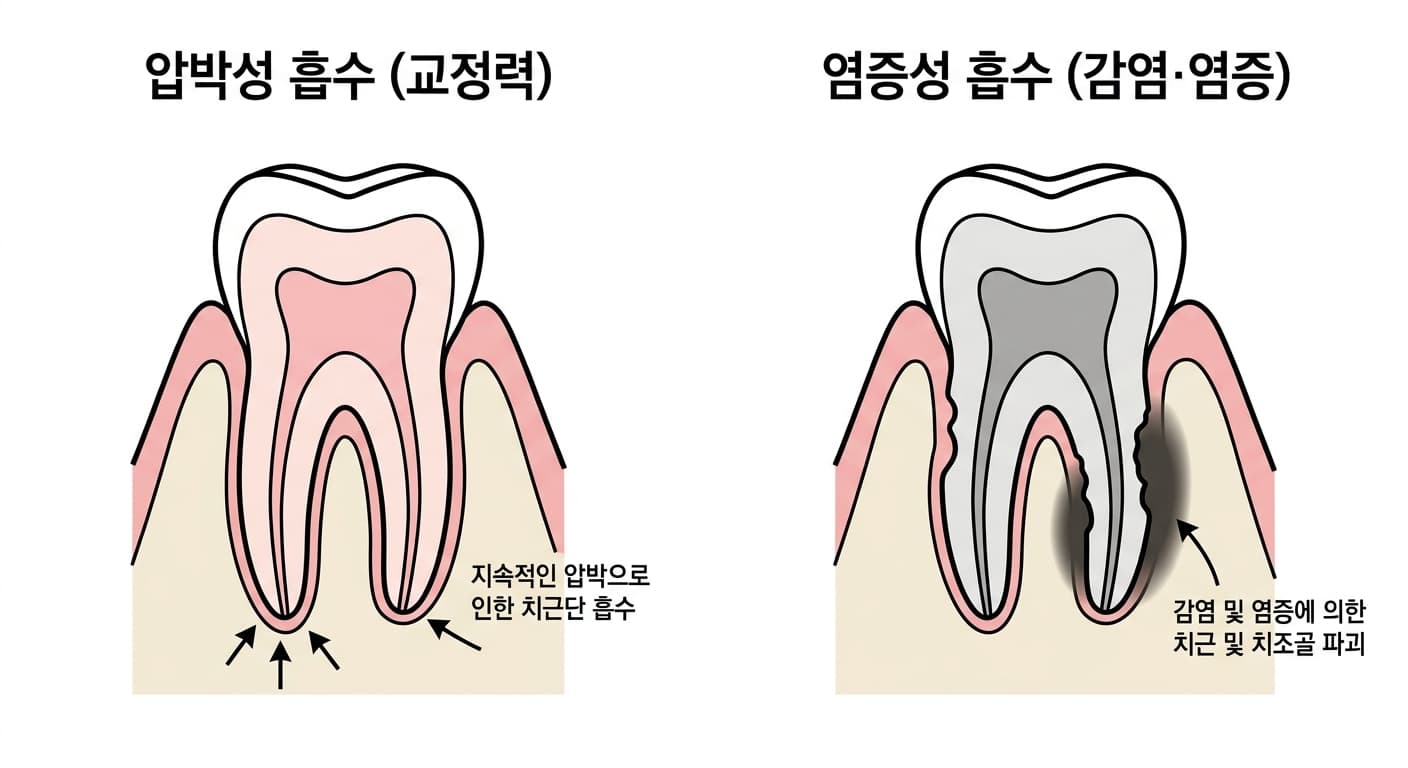
Pressure resorption from orthodontic force is characterized by the root tip losing its pointed shape and wearing down into a blunt form. Once the orthodontic force causing the pressure is adjusted or the appliance is removed, the resorption stops progressing. In this type, pulp vitality is generally reported to remain normal, because the root surface is being worn away by mechanical force rather than by a dying nerve.
How It Differs from Resorption Caused by Infection or Inflammation
Root resorption can also result from infection or chronic inflammation rather than pressure. When the pulp dies (pulp necrosis), the bacteria and breakdown products inside it can spread toward the root surface and cause resorption on the outside of the root. Inflammation from chronic periodontal disease surrounding the root surface can produce a similar type of resorption. This is called inflammatory resorption, and if the underlying cause is not removed, the resorption can continue to progress and even lead to a perforation, a hole through the root.
Unlike pressure resorption, inflammatory resorption often appears on radiographs as a radiolucent area (a dark, translucent region) not only in the root but also in the surrounding alveolar bone, the bone that surrounds and supports the tooth. If the cause is pulp necrosis, root canal treatment (often simply called a "nerve treatment") is started to remove and disinfect the dead tissue, and if needed, a long-term intracanal medication is placed to help slow the progression of resorption. If the cause is periodontal disease, gum treatment takes priority. In other words, what determines whether root canal treatment is needed is not the fact that the root has shortened, but what caused the resorption in the first place.
What Should Be Checked?
Because the approach differs depending on the cause even when the root resorption looks the same, dentists check several things together.
First, the strength and duration of the orthodontic force are reviewed to check whether excessive force has been applied for too long. Next, pulp vitality tests such as electric pulp testing or cold testing are used to check whether the pulp is still alive. With pressure resorption, these tests generally show a normal response, but if the nerve has died, there will be no response or a different result, which provides a clue for distinguishing the cause. Finally, a periapical radiograph, or a three-dimensional CBCT scan if needed, is used to examine the shape of the resorbed root and the condition of the surrounding bone, comparing whether it shows a blunt, worn-down shape or a shape where the surrounding bone is also radiolucent.
It is difficult to make a judgment from just one of these three checks; they need to be reviewed together to determine whether it is pressure resorption or resorption caused by infection or inflammation. Depending on the result, what is needed differs between adjusting the orthodontic force and monitoring, or removing the underlying cause through root canal treatment or periodontal treatment.