
Question
There are times when a resin filling or inlay placed long ago feels like it has come off. Running your tongue or finger over it, you might notice a rough spot or an empty gap, or a small piece may actually have broken off. Before heading to the dentist, you may wonder what to check for, and what criteria a dentist uses to decide whether to fix just that spot or replace the restoration entirely.
Short Answer
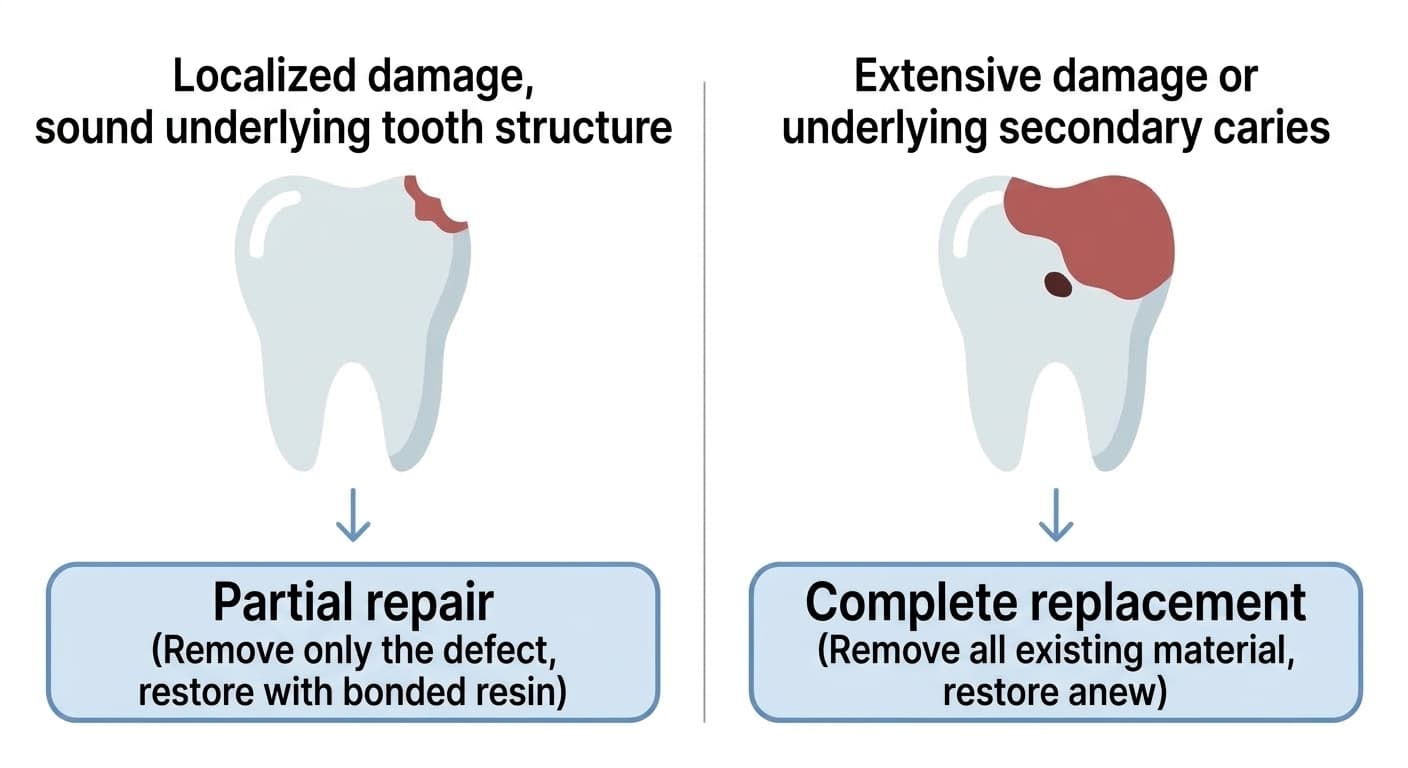
If a resin filling or inlay seems to have come off, you should not try to reattach or fill it yourself; have a dentist check it. The dentist will look at both how extensive the damage is and whether new decay (secondary caries) has formed in the tooth beneath the restoration. If the damage is localized and the tooth structure underneath is sound, the case can often be finished with a partial repair that fills only that area, without removing the entire existing restoration. If the damage is extensive, or if new decay has formed underneath, the existing material must be completely removed and the tooth restored again.
Why Is That?
Resin Fillings and Inlays Are Made Differently
Resin (composite resin) is a material placed directly into the tooth and hardened with light. The tooth surface is lightly etched with acid and then bonded with an adhesive. An inlay, by contrast, is an indirect restoration made outside the mouth from an impression and then cemented in place; besides resin, inlays can also be made of metal or ceramic.
Because they are made differently, how they look when damaged can differ too. With resin, a small piece often chips off at the edge of the filled area or on part of the chewing surface. Because an inlay is fabricated outside the mouth and then bonded in place, it can be harder to judge the extent of the damage from appearance alone. The difference in how direct resin fillings and resin inlays are made can be a useful reference when comparing the two restoration methods.
Dentists Check Both the Extent of Damage and Underlying Decay
Using visual examination and radiographs, dentists check two things together. One is whether the chipped or missing area is a localized defect limited to part of the restoration's surface, or a large defect in which a substantial portion of the restoration is gone. The other is whether new decay, known as secondary caries, has formed at the margin of the restoration or in the tooth beneath it.
Secondary caries is decay that develops again at the margin of an already completed restoration or in the dentin beneath it, and is also called recurrent caries. Its main causes are microleakage (bacteria seeping in through a microscopic gap between the restoration and the tooth wall), incomplete removal of decay during the original treatment, and a poorly formed margin. Why interproximal decay is checked with a bitewing radiograph has more on the exams used to detect this kind of decay.
It is understood that if secondary caries is suspected or confirmed underneath a restoration while it is being examined, the existing restorative material should be completely removed and the tooth restored again. In other words, the decision depends not just on how much has chipped away, but also on whether the tissue underneath is sound.
If the Damage Is Localized, a Partial Repair May Be Enough
If part of an existing restoration has fractured, or if localized secondary caries has developed underneath it, one option is to remove only the damaged area and repair it with bonded composite resin, rather than replacing the entire restoration. Even in this approach, any secondary caries remaining beneath the restoration must be completely removed as a matter of principle, and the cavity in that area is widened slightly if needed for visibility and instrument access. The surface of the existing material, whether resin, metal, or ceramic, is then treated so the new resin can bond to it. This approach can resolve the problem while keeping the amount of tooth structure removed to a minimum.
If the existing restoration is made of resin, the repair process is relatively simple: the damaged surface is roughened with a diamond bur, etched with acid, coated with adhesive, and then filled with new resin and finished. When a defect in a metal or ceramic inlay is repaired with resin, the surface must first receive treatment appropriate to that material before bonding can occur.
A case has been reported in which secondary caries at the margin of a gold restoration used for more than ten years was removed only in that localized area and filled with a different material, and the margin remained healthy 24 months later. When the extent of damage is localized, a partial repair like this can preserve the tooth while lasting long enough.
If the Damage or Underlying Decay Is Extensive, Replacement Is Needed
If the damaged area is extensive, or if the secondary caries found underneath extends beyond a localized area, a partial repair is not enough. In this case, all of the existing restorative material must be removed and the tooth restored again.
This does not end with simply refilling the empty space. It also involves reshaping the tooth to create retention form that holds the new restoration in place against chewing forces. How widely the damaged or weakened tissue must be removed, and whether the remaining tooth walls are enough for a direct resin filling or whether an inlay made from an impression is needed instead, depends on how much tooth structure remains and where chewing forces are concentrated.
When a resin filling or inlay seems to have come off, the first thing to do is not to fill the spot yourself or leave it as is, but to have a dentist directly assess the extent of the damage and the condition underneath. The result determines whether a tooth-preserving partial repair or a full replacement is needed.