
Question
I heard that a resin filling on a front tooth came off not long after it was placed, and I'm worried it might be because the resin wasn't fully cured with light all the way through when it was bonded. I want to understand exactly what role light-curing resin plays and why it's treated as so important.
Short Answer
The process of curing resin with light (light curing, or photopolymerization) works because a specific component in the resin must absorb light of a defined wavelength before the hardening reaction can even begin. If this light doesn't reach deep enough into the material, the surface may look hardened while the inside remains undercured, which can lower its strength. This is why thickness and how well light reaches the material are important conditions that determine the final properties of the resin. That said, whether a bonded resin filling comes loose depends not only on the degree of curing but also on factors such as moisture control at the time of bonding and the amount of force applied to that area, so the fact that it came off alone cannot be used to conclude that the inside was undercured or that something went wrong during treatment. The actual cause can only be confirmed by having a dentist examine it directly.
Why Is This the Case?
How Light Cures Resin
Composite resin (a tooth-colored, adhesive filling material) contains a photoinitiator (a component that absorbs light to start the curing reaction). This component only becomes active once it absorbs the blue light (roughly 400-500 nanometers in wavelength) emitted by a dental curing light, and that activation triggers a reaction that links the liquid-like resin components together into long chains. As this reaction proceeds, the resin changes from a soft state into a hard solid. In other words, resin is not a material that hardens on its own over time; it hardens only when it receives enough light of the right wavelength, and any part the light fails to reach never starts the reaction and stays soft.
The Thicker the Resin, the Harder for Light to Reach the Depths
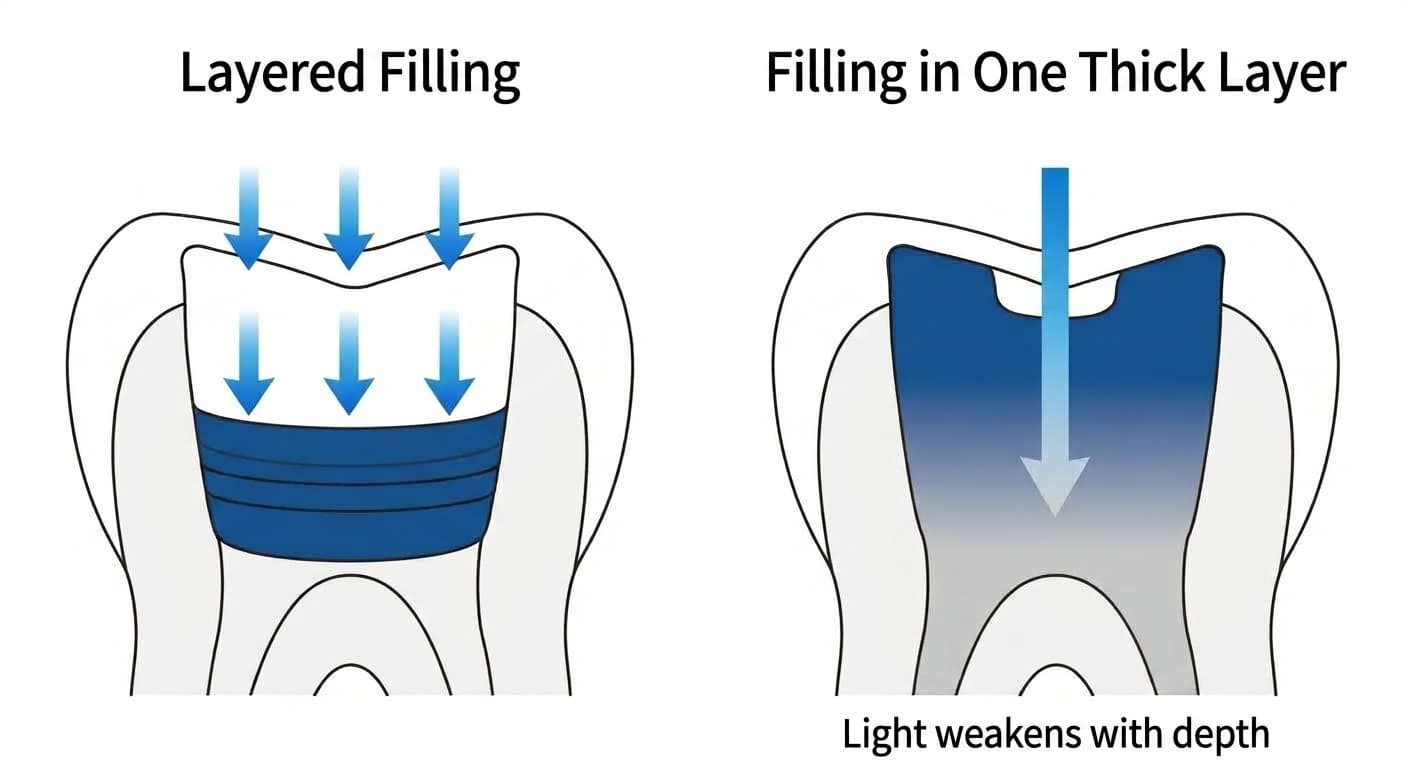
The problem is that this light weakens sharply as it travels deeper from the resin's surface. As the thickness placed at once increases, the amount of light reaching the bottom decreases exponentially, so that even if the area near the surface cures fully, the degree of curing (degree of conversion, a measure of how much the resin has converted into a hardened structure) can drop significantly past a certain depth. For this reason, unless a special product is designed to be placed thickly in a single step, the incremental layering technique is used, which limits the thickness placed at once to within 2mm and cures each layer separately. The closer the tip of the curing light is to the tooth surface and the more perpendicular its angle, the deeper the light penetrates, so if the tip is tilted or held farther from the tooth, less light reaches the depths even with the same exposure time.
In addition, adequate curing requires that the total energy delivered, the light intensity multiplied by the exposure time (radiant exposure), reach a certain minimum level. Properly curing a 1.5-2mm layer requires at least 6-24 J/cm² of energy depending on the product and shade. Darker or more opaque resins scatter and absorb more light, so they require even more energy to cure to the same thickness.
Insufficient Curing Lowers Strength, and Shrinkage During Curing Plays a Role Too
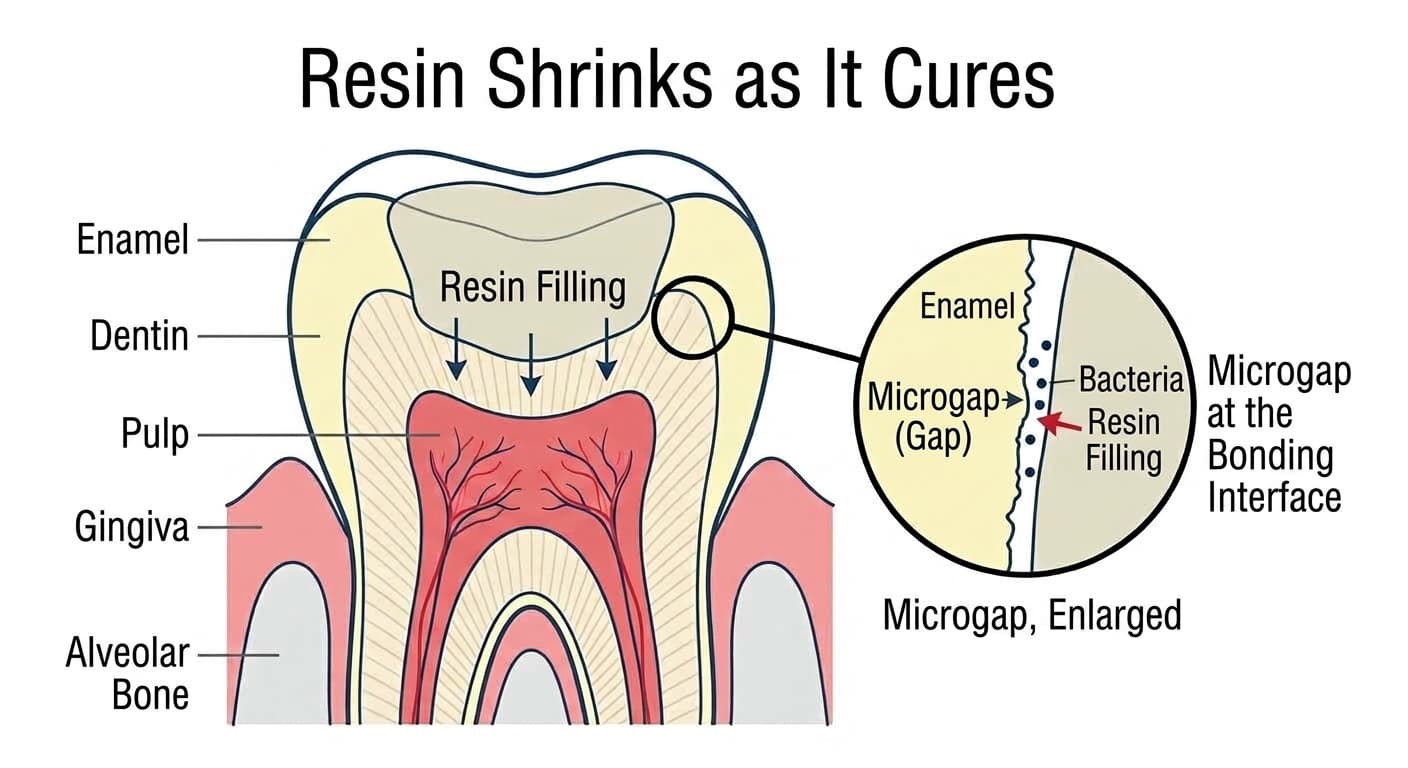
Areas that light fails to reach adequately have a lower degree of conversion (the proportion of monomers converted into a hardened polymer), which can make them less strong than fully cured areas. On top of this, resin itself undergoes polymerization shrinkage as it cures, a volume reduction of about 2-5%, and as much as 7% in some cases, which generates stress of up to 18 MPa at the interface where the tooth and resin are bonded. If this stress exceeds the bond strength, a microscopic gap (microleakage, a narrow gap through which bacteria or saliva can pass) can form at the interface, and in severe cases this can lead to debonding or the resin coming loose altogether. In short, how strong and durable a resin filling is depends on both how deeply the light reached and the shrinkage that occurs during curing.
A Loose Filling Alone Doesn't Confirm the Cause
The fact that a front-tooth resin filling came loose doesn't necessarily mean the cause was insufficient curing. Whether saliva or moisture got mixed in during bonding, whether the tooth surface was adequately prepared, and whether strong, repeated force was later applied to that area can all affect how well the resin stays in place. Indeed, both a case where a gap between front teeth was filled with resin and a case where a chipped front tooth was repaired with resin explain that when force repeatedly concentrates on a single point, the bonding interface can open up or the resin can come loose. Whether the cause was insufficient curing or other factors combined is difficult to tell from appearance alone, so it's necessary to have the dentist directly examine the detached resin and the remaining tooth structure.