
Question
This is about a tooth that had root canal treatment in the past, which has started hurting again after some time. The question is whether a tooth that has already had its nerve removed and treatment completed can hurt again, and if so, whether it can be retreated.
Short Answer
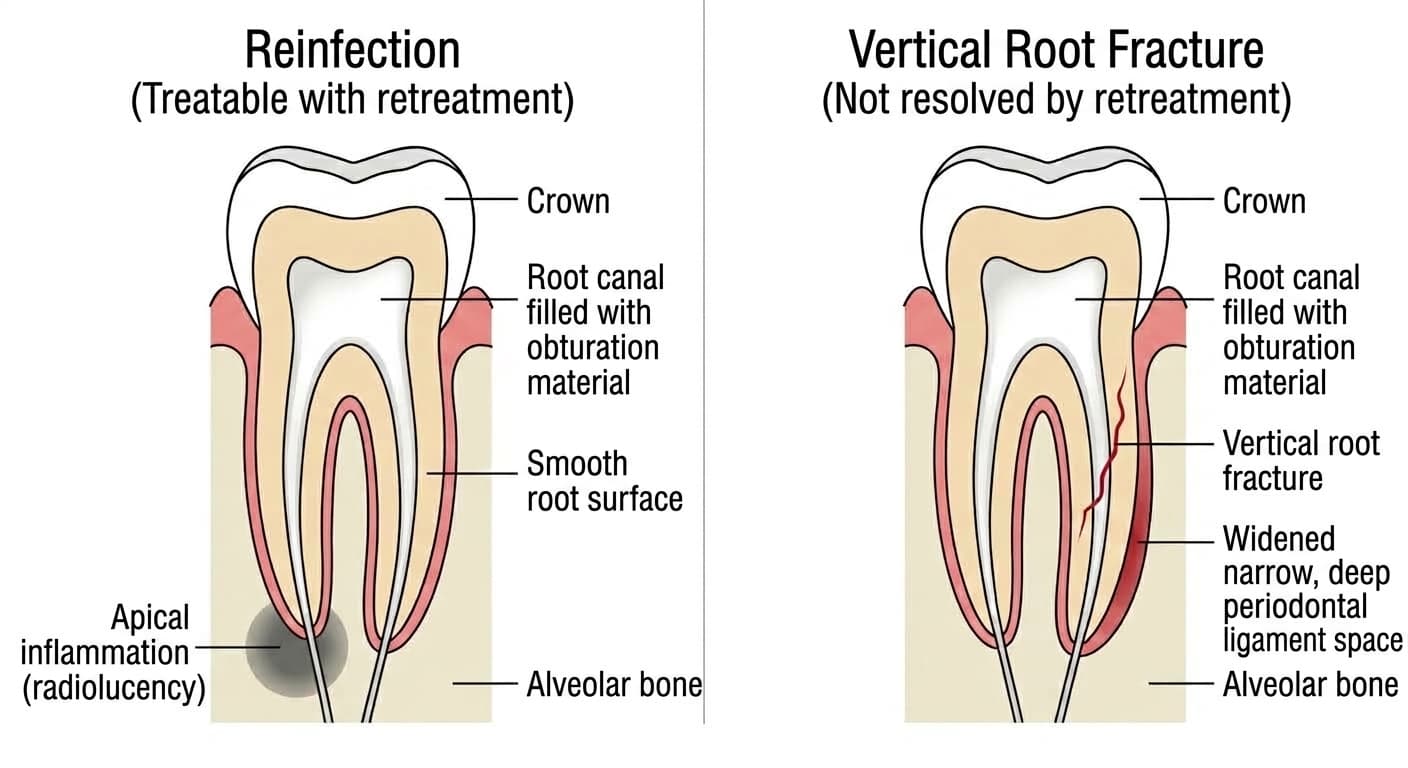
Yes, it is possible. When pain returns in a tooth that has already had root canal treatment, the general principle is to consider nonsurgical root canal retreatment (redoing the root canal procedure) before extraction or surgery. Whether retreatment resolves the problem, however, depends on the cause of the pain. If bacteria remaining inside the canal have regrown, retreatment can address it, but if the tooth's root itself has split lengthwise, retreatment alone often cannot resolve it. So determining whether retreatment is possible requires first identifying the cause of the pain.
Why Is That?
First, Identify Why the Pain Has Returned
Even in a tooth that has had root canal treatment, if bacteria remained somewhere inside the canal or new bacteria invaded after treatment, apical periodontitis, inflammation of the tissue around the root tip, can develop again. Unlike the initial infection, recurrent infections are reported to mainly involve bacteria that resist disinfection well, such as Enterococcus faecalis or Candida albicans.
Symptoms can also return because of a problem that occurred during the original treatment and only shows its effect later. An instrument used to shape the canal that broke off and remained inside, a hole that formed in the canal wall where none should exist, or filling material that leaked out beyond the root tip can all remain as a source of ongoing irritation or a pathway for bacterial invasion. Such problems can go unnoticed at the time of the original treatment and surface as symptoms only after time has passed.
A lesion that had remained asymptomatic for a long time can also suddenly flare up acutely. When a drop in immunity, or the irritation of instrumenting the canal again during retreatment, triggers a chronic lesion to rapidly become swollen and painful, this is called a phoenix abscess. What sets this apart from an acute lesion appearing for the first time is that a radiograph often already shows a lesion with well-defined borders.
On the other hand, the fact that a lesion has not completely disappeared on a radiograph after treatment does not by itself mean the treatment failed. In some cases, the area fills with dense fibrous tissue instead of new bone, leaving only a radiolucency with no symptoms (an apical scar). But if new pain has appeared, as in this case, that is a different situation from such an asymptomatic scar, so reinfection or a structural problem should be examined first.
A crack in the tooth itself (cracked tooth) can also cause symptoms to continue or newly appear before or after root canal treatment. A brief, sharp pain when chewing is a reason to also consider the possibility of a crack.
Approaching It with Nonsurgical Retreatment
If, after examining the cause, the pain is determined to come from a reestablished infection, nonsurgical root canal retreatment is considered before surgical treatment. If the tooth has a crown or a post, its condition is first evaluated, and it is removed if necessary to secure access back into the canal. The previously placed filling material is removed, and if a broken instrument remains, it is either removed or bypassed depending on its position and condition. If a perforation is present, that area is sealed again with a biocompatible material. This sequence, cleaning out the inside of the canal again, then cleaning, reshaping, and refilling it, is the flow of nonsurgical retreatment.
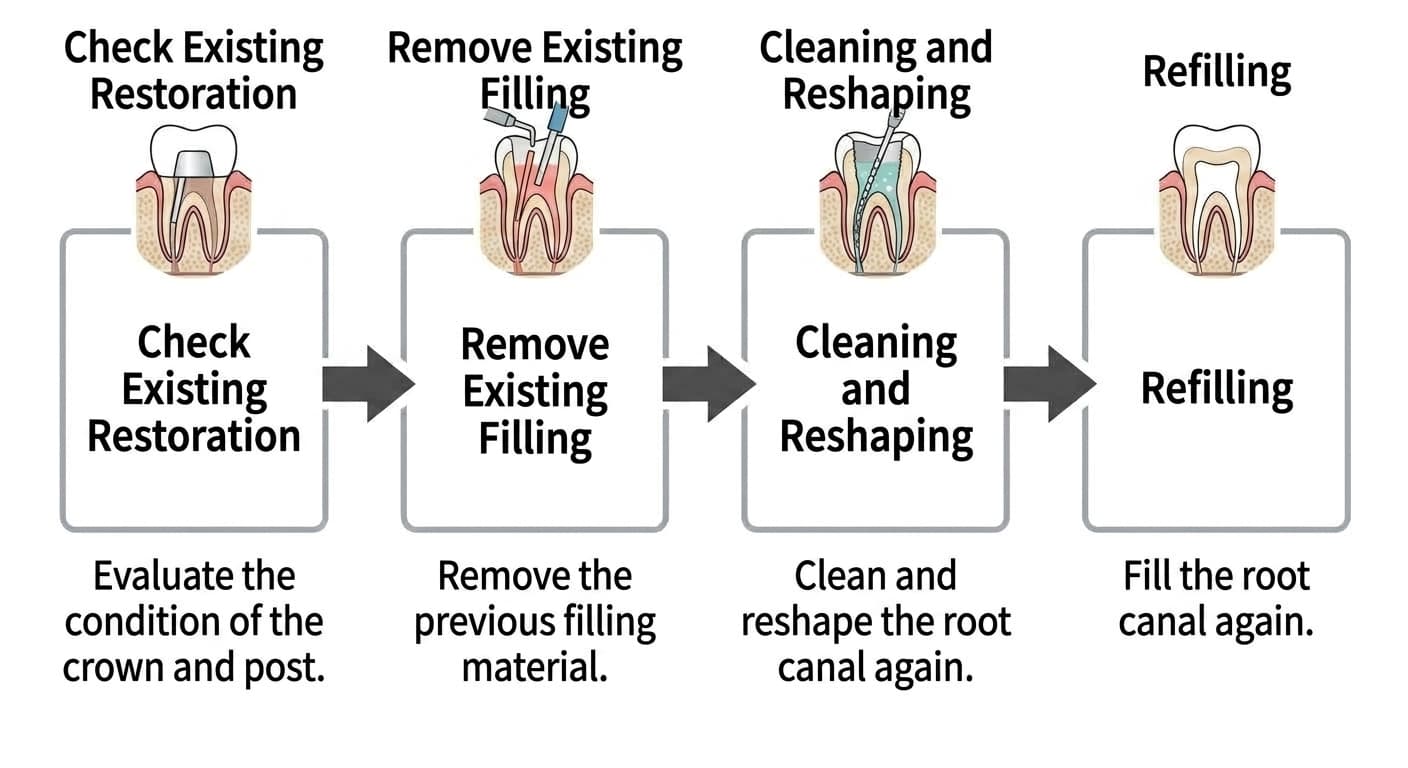
This approach is based on the principle of removing the source of infection inside the canal again and resealing it, making it the first option considered among ways to save the tooth. However, if the problem is located somewhere that is difficult to address from inside the canal, or if symptoms continue even after retreatment, a surgical method such as apical surgery is additionally considered.
It's Different If the Cause Is a Root Fracture
If the cause of the pain is a vertical root fracture, a crack or break running along the long axis of the root, the approach is different. Root canal retreatment aimed at removing infection again does not resolve it, because the essence of the problem is a split in the tooth's structure. A localized narrow, deep periodontal pocket, or a radiograph showing a periodontal ligament space that widens toward the root tip in a characteristic radiolucent shape, are clues that distinguish this from a lesion caused by infection alone.
Once a vertical root fracture is confirmed, the prognosis is poor, and extraction is generally considered as the principal option. However, in a multi-rooted tooth such as a molar, if the bone support around the other roots is good, the gum may be opened to directly examine the crack, and treatment that removes only the affected root while preserving the rest of the tooth is sometimes possible. Which path applies can only be determined by directly checking the location and extent of the fracture and the condition of the remaining roots.