
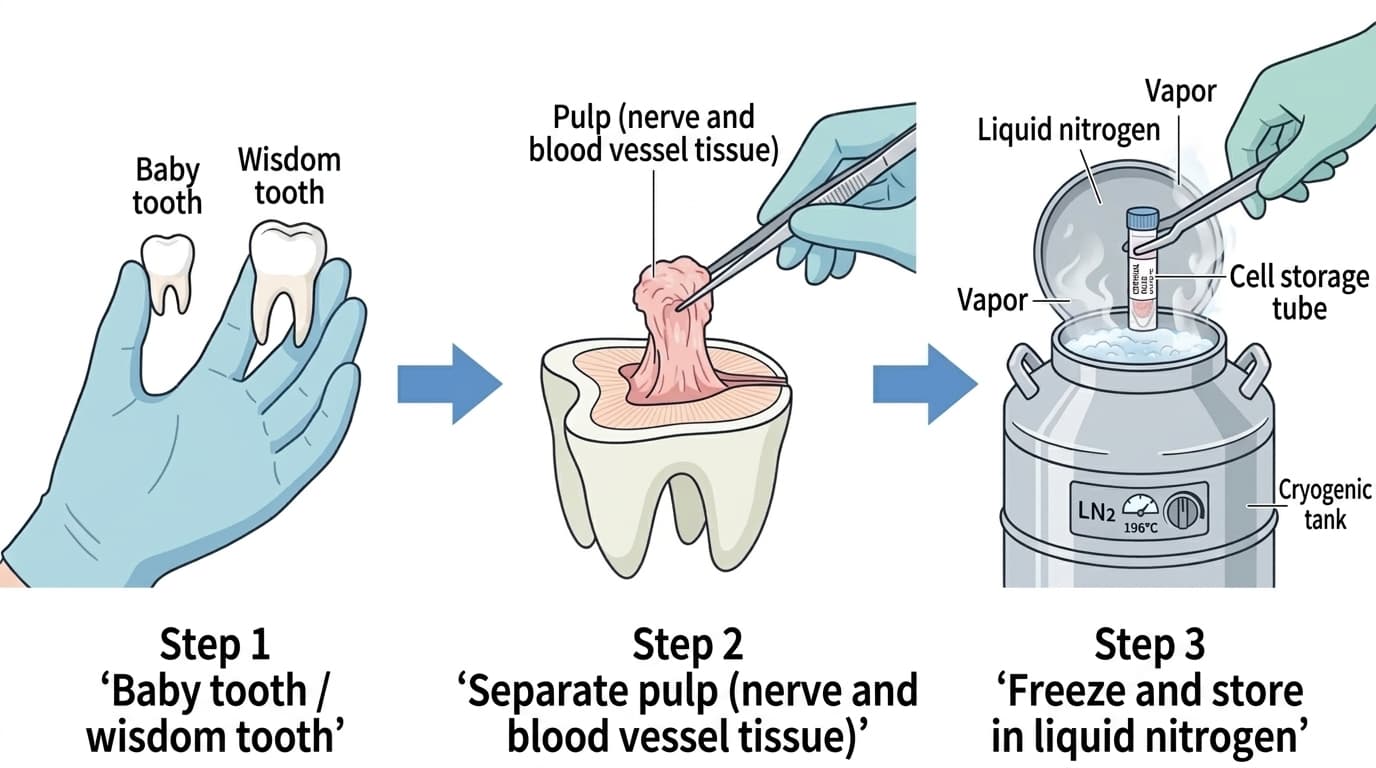
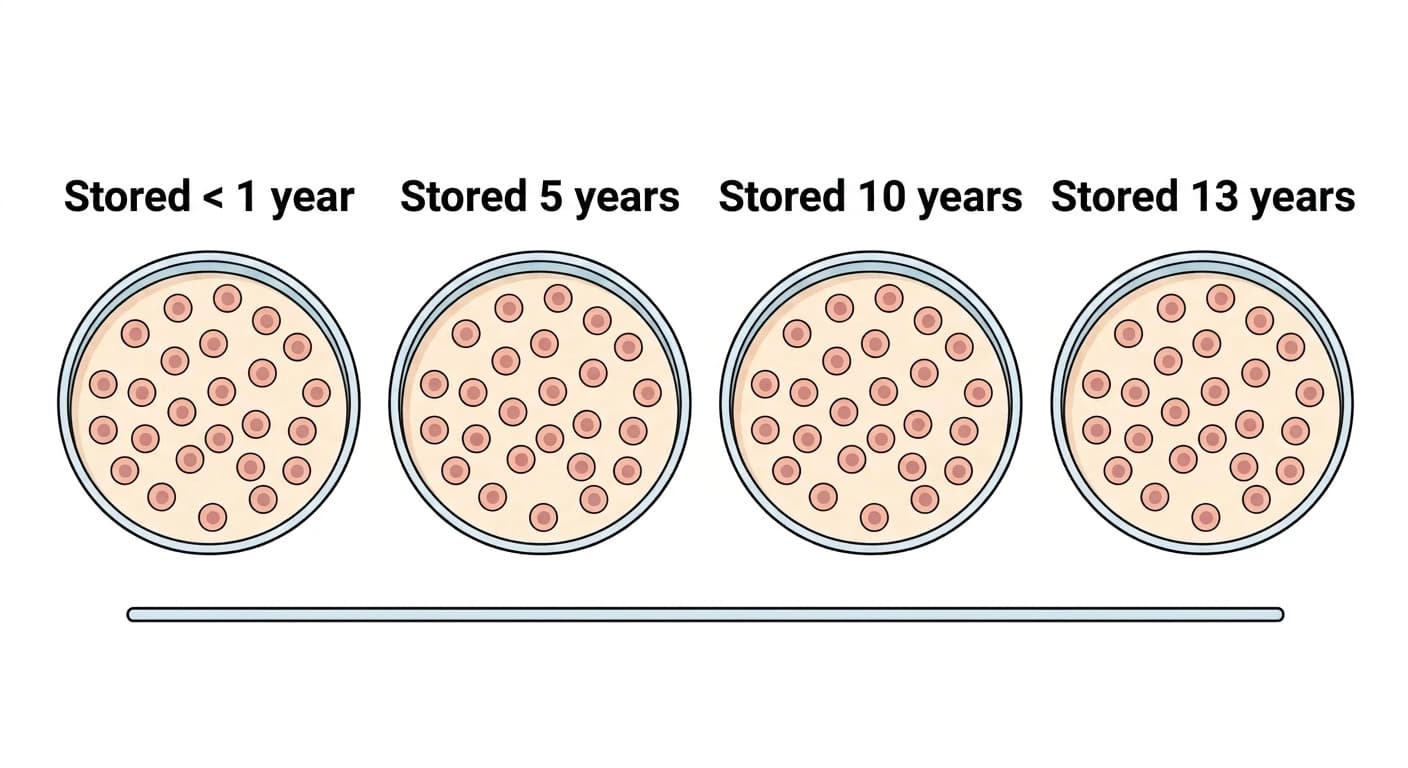
A University of Michigan research team thawed dental stem cells that had been frozen for 5, 10, and 13 years and found they were nearly indistinguishable from freshly frozen cells. Survival rate, expression of stem cell marker proteins, the speed at which cells multiplied, and their ability to differentiate into other cell types were all similar, and no signs of cellular aging appeared. The finding directly tests a premise that must hold for 'tooth stem cell banks' (which freeze pulp cells, the tissue containing nerves and blood vessels inside a tooth, when baby teeth or wisdom teeth are extracted) to be genuinely useful: that the cells must not deteriorate even after long-term freezing.
Why Freeze Cells Extracted From Teeth
Dental pulp contains mesenchymal stem cells that can differentiate into bone, cartilage, fat, and other tissues, and that also have the ability to regulate inflammatory responses. Unlike bone marrow, which requires an invasive procedure to collect cells, pulp cells can be obtained from baby teeth or wisdom teeth that would be extracted or lost anyway, making collection far less burdensome. However, once a tooth leaves the mouth, the pulp tissue begins to die immediately, so the cells must be isolated and frozen right after extraction to remain usable later. Based on this principle, services that isolate cells from children's baby teeth or adults' wisdom teeth and store them frozen in liquid nitrogen are now operating in several countries.
This concept has already led to actual treatments. In 2020, Japan became the first country in the world to approve a treatment that uses stem cells extracted from baby teeth to refill root-canal-treated teeth with pulp-like tissue, and cell banks and treatment hospitals continue to operate together there today. Tooth banks that store baby teeth, wisdom teeth, and teeth extracted for orthodontic reasons also exist in Korea, but they are currently used mainly to make bone graft material from a patient's own ground-up teeth, and services that store the cells themselves are less well known. A team at Ege University in Turkey confirmed that 74 to 99 percent of cells isolated from impacted wisdom teeth survived after being frozen and thawed for up to 12 months. This means the collection and freezing procedures themselves are already well established.
Survival and Stem Cell Traits After 13 Years Frozen
The catch is that these banks store cells for years, sometimes more than a decade. The University of Michigan team thawed pulp cells from several patients that had been frozen for 5, 10, and 13 years respectively, and compared them side by side with cells stored for less than a year. In every time period, more than 90 percent of cells carried the stem cell marker proteins CD73, CD90, and CD105, while cells carrying the blood cell markers CD34 and CD45 stayed equally low, under 4 percent. The time it took for cells to double in number was also nearly identical regardless of storage duration, and the ability to differentiate into bone cells or fat cells was preserved as well. Staining for an enzyme activity that increases in aging cells also showed no senescent cells even after the cells were passaged into new culture dishes six times. That said, this study examined cells from only a small number of patients, and because the oldest sample currently available for testing was 13 years old, it is not yet known whether the same results would hold for even longer freezing periods.
Blood Vessel-Like Tissue From Cells Banked for 7 to 8 Years
A joint research team from the University of Bergen in Norway and Tohoku University in Japan, among others, went a step further and used pulp cells that had been stored in a bank for 7 to 8 years to build tissue resembling actual blood vessels. After inducing the cells to grow similarly to the endothelial cells that line the inner walls of blood vessels, the team combined them with endothelial cells obtained from a human vein in a gelatin-based hydrogel and cultured the mixture for 45 days. This produced blood-vessel-like tissue carrying both a blood vessel cell marker protein (CD31) and a blood vessel wall muscle cell marker protein (αSMA). It is the first report of blood vessel tissue built using only long-term stored cells. Research on pulp regeneration using an oxygen- and glucose-releasing scaffold material, covered previously by this outlet, dealt with a method in which the scaffold material supplies oxygen and glucose so that transplanted cells do not die from nutrient deprivation inside the root canal. This new study has a different focus: it examines whether the cells themselves, and specifically cells that had been stored in a bank for a long time, have the potential to form blood vessels on their own. Still, this result was obtained at the culture-dish stage inside a hydrogel, and it has not been confirmed whether the cells show the same ability in an actual environment such as inside a human root canal.
Transplant Treatment Effects Not Yet Confirmed
Taken together, these three studies paint a picture in which cells extracted from teeth and frozen retain their survival rate and stem cell properties for at least 13 years, with some even retaining the ability to form blood vessels. However, all of these results show only that thawed cells are alive and functional on a culture dish, not that transplanting those cells into people has actually revived a tooth or tissue. The results support the first half of the promise that tooth stem cell banks make, that the cells can last a long time, but whether using those cells in actual treatment produces real benefits remains something that still needs to be confirmed separately.