
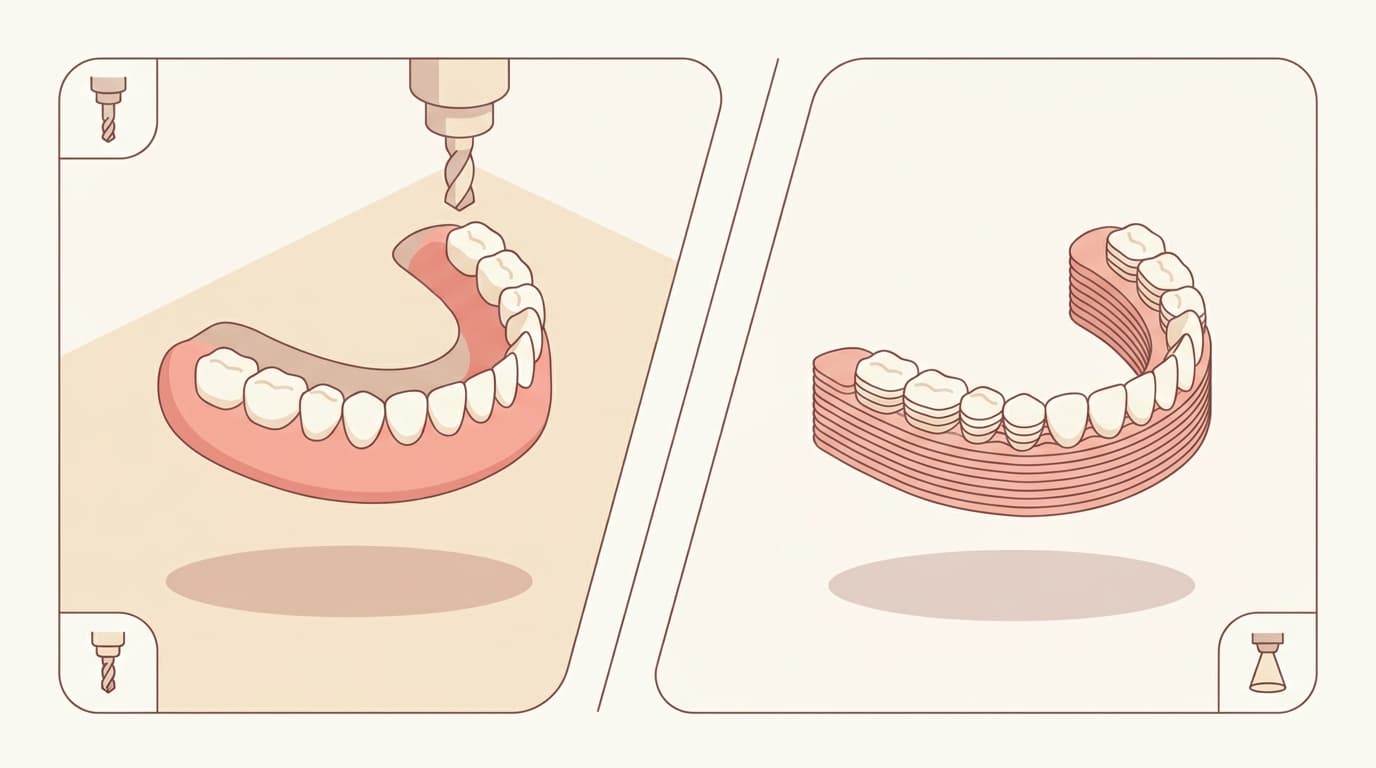
Dentures may look like they're all made from the same material, but how well they withstand chewing force depends on how they were fabricated. Line up recent meta-analyses and the pattern is clear. CAD/CAM milling, which carves a material block after a computer design, scored highest on flexural strength (the force a denture can bend under before it breaks, the kind of stress it takes when chewing), while 3D printing, which builds up liquid resin layer by layer and cures it, ranked lowest on the same measure every time. If you're planning to get a new denture or replace one, it's worth understanding what causes this difference, and where the evidence is settled and where it's still divided.
Carved from a Block, or Built Up Layer by Layer
The gum-facing part of a denture (the denture base) is mostly made from a synthetic resin called PMMA (polymethyl methacrylate). The conventional method takes a wax mold, fills it with resin in a dough-like state, and cures it with heat or a chemical reaction: compression molding, injection molding, or self-curing. This method has decades of clinical experience behind it and remains the standard for complete dentures (resin-base or metal-base) currently covered by national health insurance.
Digital methods split into two branches. After designing on a computer from data captured with an intraoral scanner or from a scan of an existing denture, CAD/CAM milling carves the desired shape out of a PMMA block that has already been fully hardened at the factory. 3D printing, by contrast, builds up thin layers of liquid resin and cures each one with light as it goes.
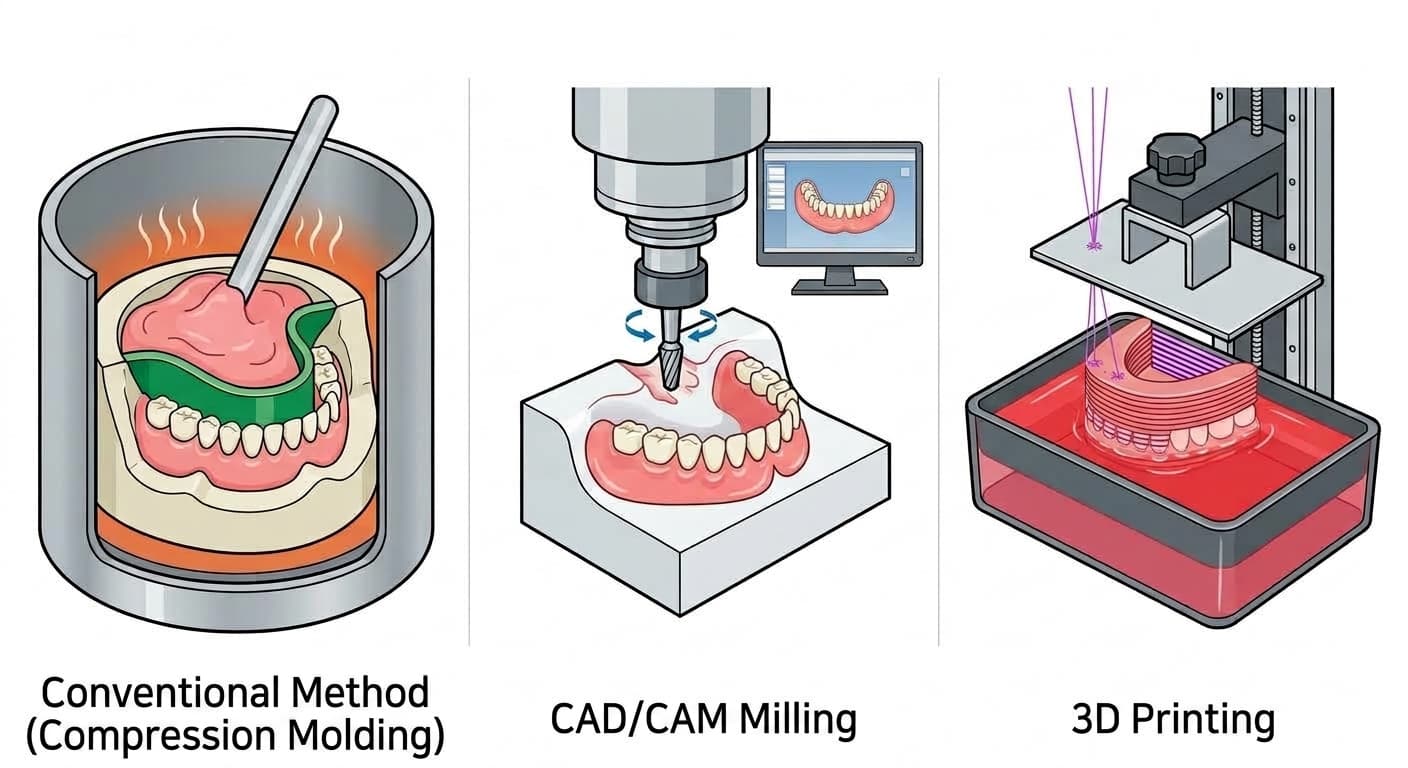
This difference is the clue to the difference in strength. A pre-hardened block is dense inside with few air bubbles, while a result built up layer by layer can leave the boundaries between layers as weak points.
Scores Diverge Under Chewing Force
A meta-analysis comparing all four fabrication methods (compression molding, injection molding, milling, and 3D printing) found that milling ranked first or second on most measures: flexural strength, elastic modulus (resistance to bending stiffly), and surface smoothness. 3D printing scored lowest on most of the same measures, leading the authors to judge it still in need of improvement. Other meta-analyses pointed the same way: denture bases made by milling had markedly higher flexural strength and hardness than those made by 3D printing.
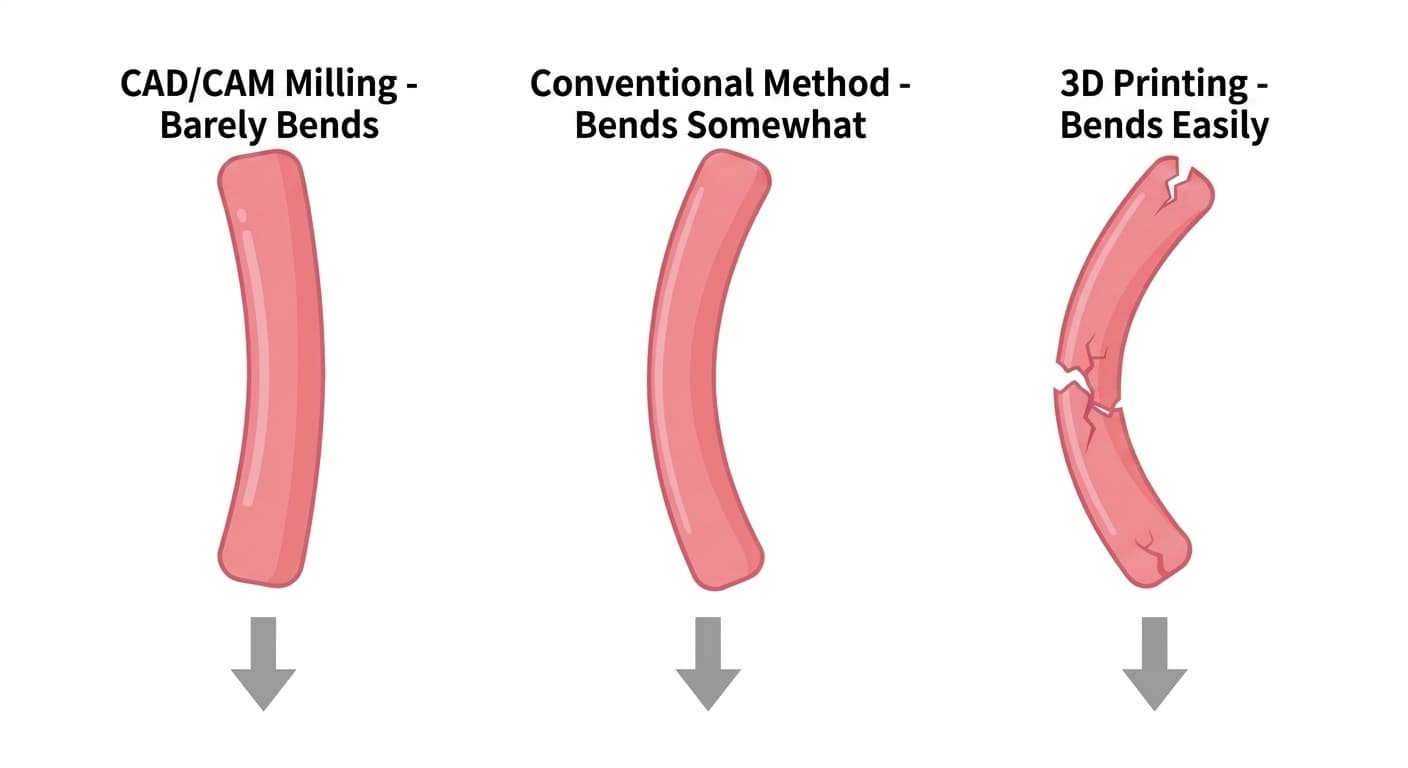
That said, the ranking wasn't the same across every measure. For impact strength (resistance to dropping or striking), the older self-curing method was actually strongest, with milling in the middle and 3D printing weakest once again. In a study comparing only the conventional heat-cured method against 3D printing, water absorption and surface roughness showed little difference, but stiffness (resistance to bending) was higher for the heat-cured method.
The Gap Widens Over Time
The same pattern held in artificial-aging experiments that simulate the oral environment: cycling temperature up and down, or soaking samples in staining liquids like coffee. Milled materials lost the least flexural strength over time, while 3D-printed materials lost the most. 3D-printed materials also absorbed more water; when a material takes up water it swells microscopically, which increases the chance a denture will loosen or discolor. Hardness and surface roughness didn't change much under temperature cycling alone, but results varied across studies under staining-liquid conditions.
Why 3D Printing Is Still Used
On strength alone, milling comes out ahead, but that doesn't push 3D printing out of the picture. As long as the data is ready, a denture can be printed out the same day, so it's still widely used for urgent or temporary dentures. Recent research has also continued to modify 3D-printing resin formulations to improve impact strength, tensile strength (resistance to pulling force), and resistance to bacterial adhesion. But materials with modified formulations have also been reported to show lower flexural strength even as they gain in impact resistance or bacterial resistance, a recurring trade-off where gaining on one front means giving up ground on another.
The complete dentures currently covered by national health insurance are resin-base or metal-base dentures made with the conventional method; digital methods such as milling or 3D printing are not separately listed as covered. If you're planning to get a new denture, it may help to ask your dentist which method will be used and to factor in how long you intend to use it when choosing the material.