
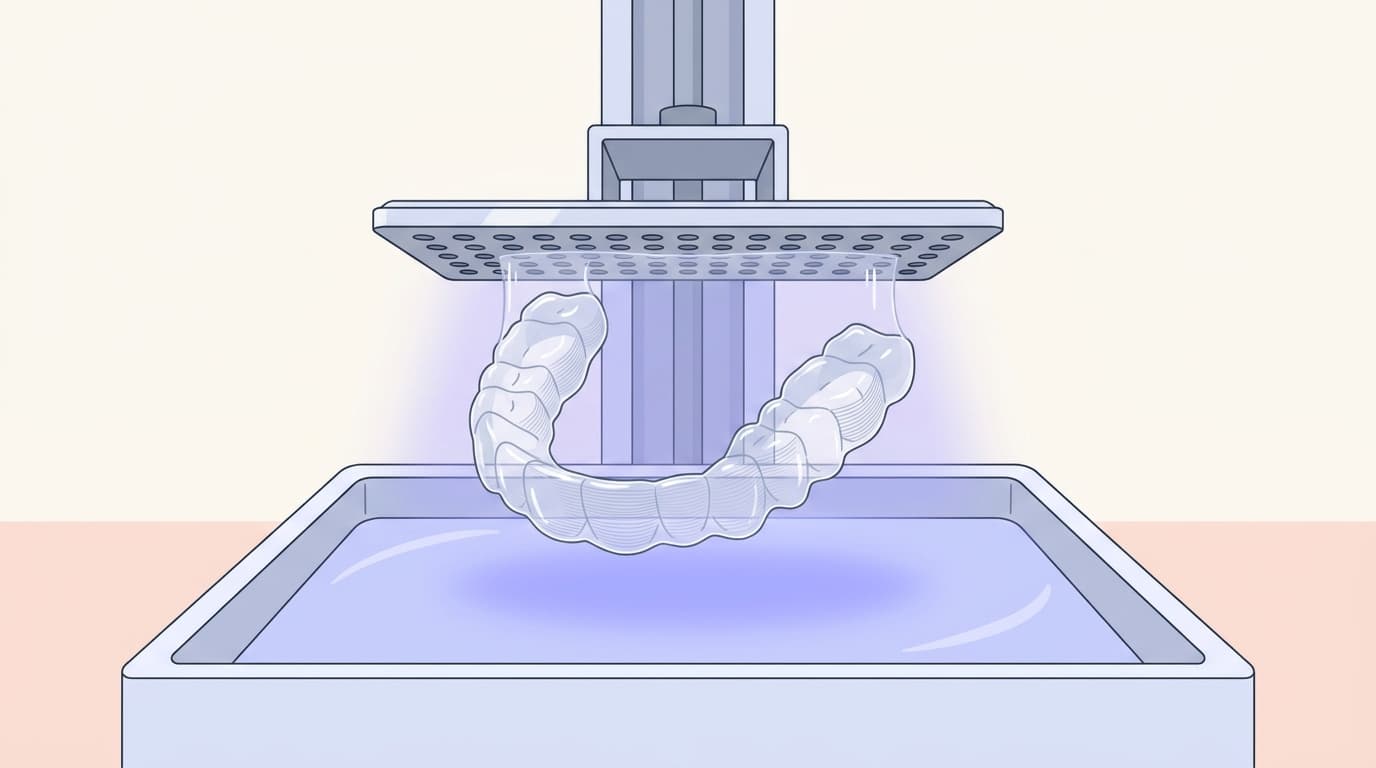
The way clear aligners are manufactured is itself changing. Until now, aligners have been made by thermoforming: scanning the teeth to create digital data, 3D-printing a physical tooth model from that data, then pressing a thin heated plastic sheet onto the model. Recently, a different approach has been spreading that skips the model step entirely and prints the aligner shape itself directly in resin. This approach began in 2019 with a resin called Tera Harz TC-85 from the Korean company Graphy, and it is now used in orthodontic clinics in many countries. An earlier article on whether clear aligners move teeth as planned looked at the gap between the computer's plan and actual tooth movement. This article looks at how the aligner itself is made, and what has changed as the manufacturing method has shifted.
Printing the Aligner Directly, Without a Model
Both methods start with an intraoral scanner capturing a digital impression of the teeth. In thermoforming, this data is used to create a series of models, each showing the teeth shifted a small step further, and a physical model is 3D-printed for every stage. A thin plastic sheet is then heated and pressed onto each model, and the edges are trimmed. One model produces one aligner.
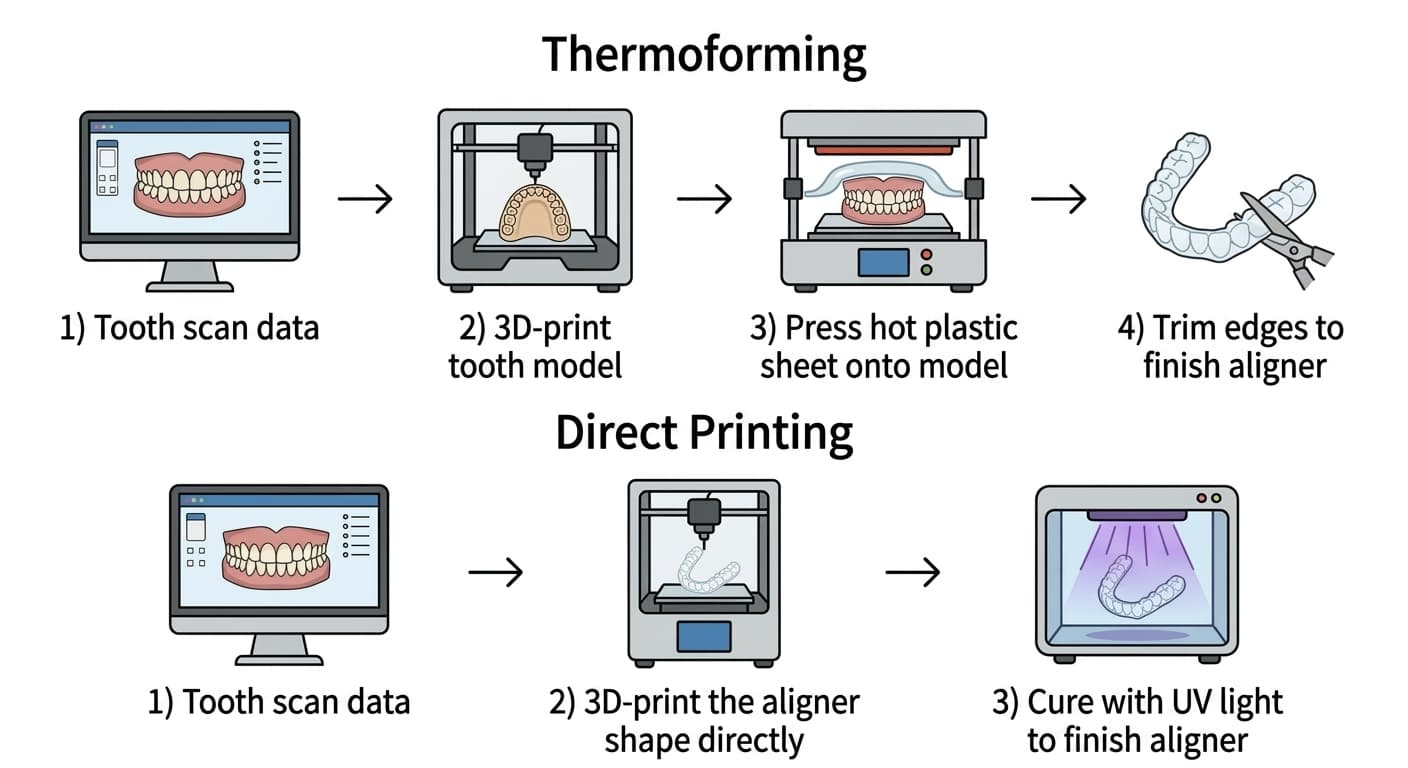
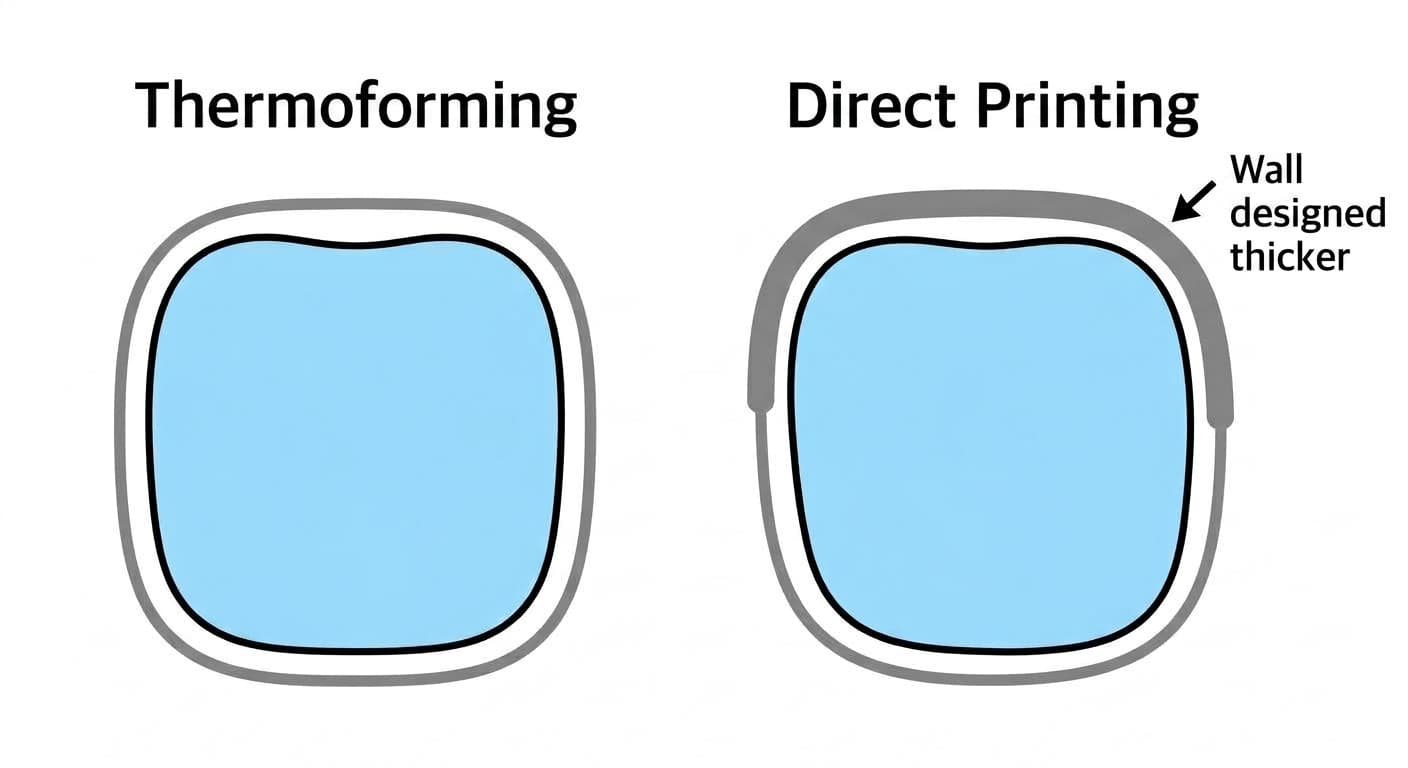
Direct printing eliminates both the model-printing and thermoforming steps. Software plans the tooth movement, then generates a file for the aligner shape itself that matches that plan, and a 3D printer loaded with a light-curing (photopolymer) resin prints the aligner directly. Once printed, the aligner is spun in a centrifuge to shed uncured resin, fully cured under UV light in an oxygen-free nitrogen environment, and finished by trimming away the support structures. Thermoforming produces a uniform thickness that matches the sheet, while direct printing can vary the thickness by area, for example designing a thicker wall only where it needs to push a specific tooth. The angle at which the aligner is oriented on the print bed also affects the outcome: one study found that lying it fully flat (0 degrees) gave both the highest accuracy and the shortest print time.
How Long Does It Hold Its Force? Results Varied by Test Condition
For an aligner to move teeth, the force it applies has to hold up after it is worn. A bench-top study comparing TC-85 with a conventional thermoformed material (Zendura) found that TC-85 relaxed less, losing 27.2% of its force versus 41.3% for Zendura, and still retained 72.8% of its initial force after 180 minutes compared with 58.7% for Zendura. The researchers noted, however, that these results came from bench conditions and could not be directly taken as evidence of better clinical treatment outcomes.
| Measurement (bench conditions) | Direct-printed (TC-85) | Thermoformed (Zendura) |
|---|---|---|
| Force relaxation after 3 hours | 27.2% | 41.3% |
| Force remaining after 180 minutes | 72.8% | 58.7% |
Other conditions produced the opposite result. A study comparing dry versus saliva-soaked states found that the direct-printed resin's elastic modulus dropped sharply from 431 MPa dry to 140 MPa wet, while the thermoformed material barely changed, from 103 to 114 MPa. A study that re-measured the material from 30 patients who had actually worn aligners for a week found that only the direct-printed aligners showed a clear shift in elasticity and force relaxation, while Invisalign and polyester-based thermoformed materials changed little. In other words, the new resin held its force longer under dry bench conditions, but changed more once it was soaked in saliva and actually worn in the mouth.
Human Cases Are Still Few
Clinical cases of moving teeth with direct-printed aligners are also emerging. In one case, a 26-year-old patient with a posterior crossbite and a narrow lower arch was treated over 31 weeks with 26 aligners, and relapse remained under 0.5 mm even a year later. Still, these are case reports covering one or two patients each, and no clinical trial has yet compared multiple patients against thermoformed aligners side by side.
Resin Components and Microplastics Are Still Being Checked
Whether the new resin is safe in the mouth is also still being verified. A study measuring urethane dimethacrylate leaching into the saliva of patients wearing the aligners found the concentration climbing steadily, from 4.04 micrograms per liter at 24 hours to 7.27 micrograms per liter at 14 days. That level stayed well below the threshold at which cytotoxicity appears, and the researchers noted that following the prescribed replacement schedule can keep the cumulative amount down. An experiment comparing microscopic plastic particles released by rubbing the aligners in water found that particles shed from direct-printed aligners were both more numerous and larger than those from thermoformed aligners. A review pooling 14 cytotoxicity studies likewise found mixed results depending on the material and post-processing method, and no clinical trial has yet directly confirmed safety in humans.
Aligner manufacturing is shifting from printing a tooth model and pressing a sheet onto it, toward printing the aligner shape itself directly. This removes the need to make a model and allows the thickness to be varied by area, but force-retention performance has produced different results depending on how it is measured, and confirming the safety of the resin's components and microplastics is still ongoing.