
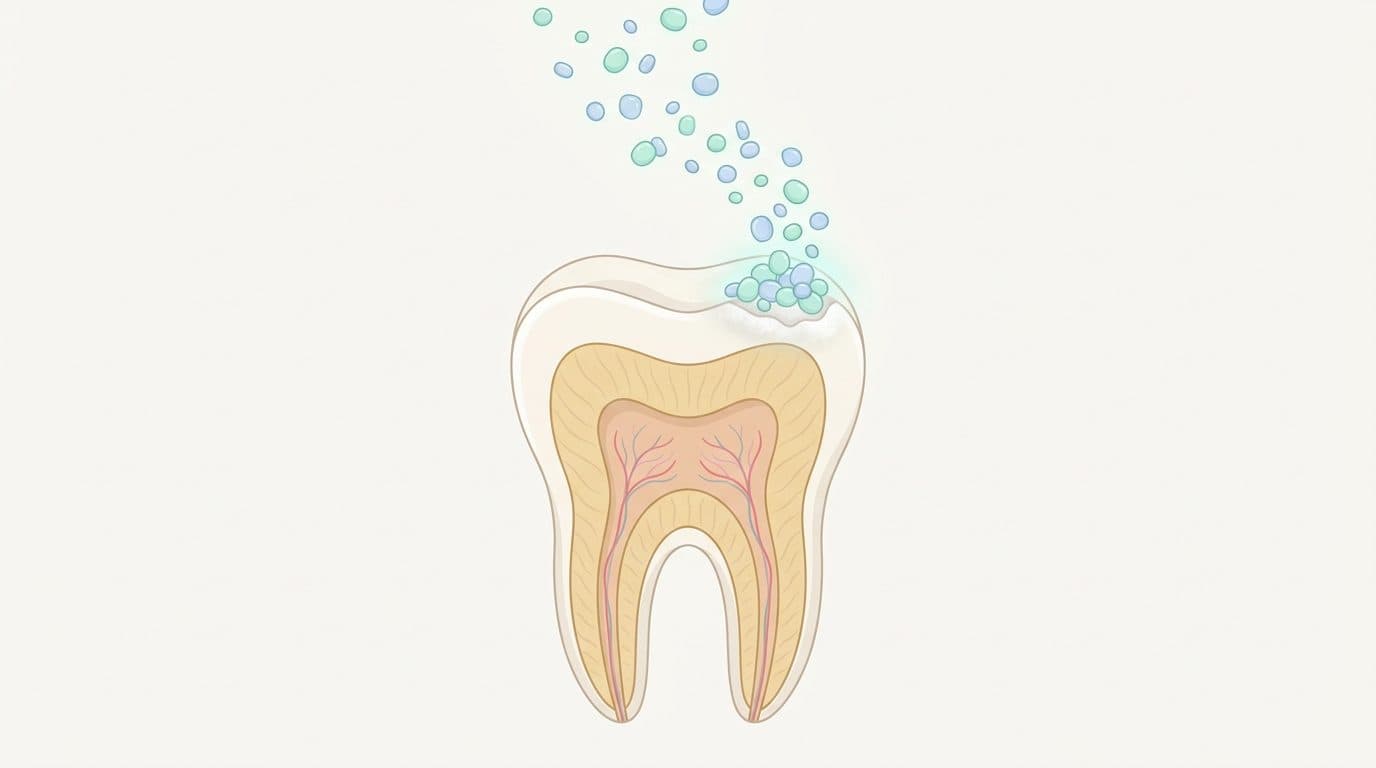
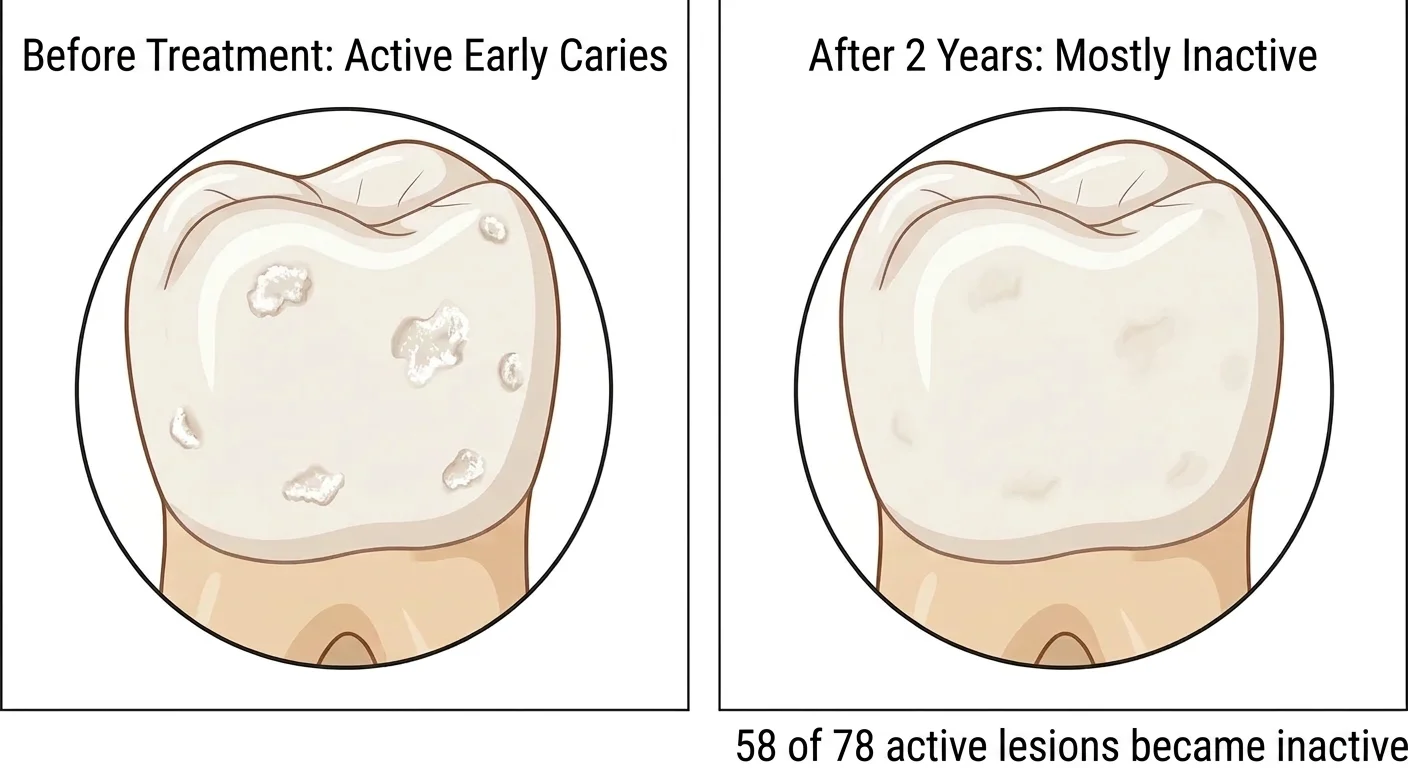
Early caries lesions, white spots where the enamel has demineralized but the tooth hasn't fully decayed, progress if left untreated but can be reversed with timely care. A clinical trial that followed 518 children over two years found that toothpaste combining hydroxyapatite, the mineral that makes up teeth themselves, with fluoride reversed these early lesions in baby teeth more often than toothpaste with fluoride alone. Among children who had active lesions, 58 of 78 lesions became inactive after two years, a rate that was statistically significantly higher than in children who used fluoride-only toothpaste.
How Fluoride and Hydroxyapatite Each Remineralize
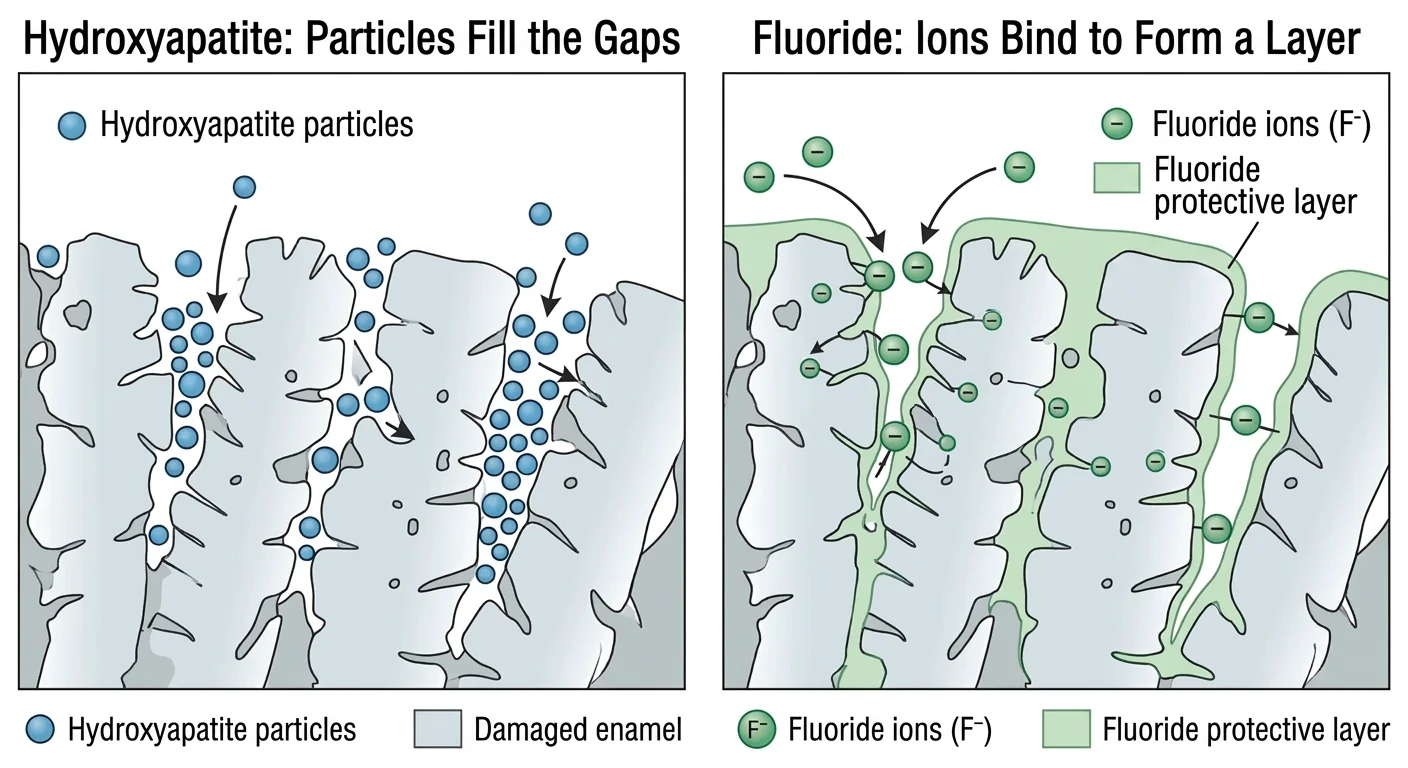
At the tooth surface, fluoride binds with calcium and phosphate ions to form new crystals (fluorapatite) that are more resistant to acid, aiding the remineralization that replaces lost minerals. Hydroxyapatite is another material that supports this remineralization. Unlike fluoride, it is itself the same mineral that makes up enamel, so particles ground down to nanometer scale move directly into the microscopic pores that acid leaves in enamel and fill the spots where mineral was lost. The toothpaste used in this trial combined hydroxyapatite with fluoride and magnesium, strontium, and carbonate ions, and used a polysaccharide called chitosan to help the particles adhere to the tooth surface. The researchers explain the effect as fluoride ions making the hydroxyapatite crystals harder and less soluble in acid, while the nanoparticles simultaneously penetrate deep defects in the enamel.
A Two-Year Effect Seen Only in Baby Teeth
This triple-blind clinical trial recruited 610 children aged 4 to 7 in Italy and randomly assigned them to one of two hydroxyapatite-plus-fluoride toothpastes or one of two fluoride-only toothpastes, used daily for 24 months. 518 children completed the study. At baseline, the two groups showed no difference in caries lesion rates, but after two years the reduction in enamel lesions was statistically significantly greater in the hydroxyapatite group than in the fluoride-only group (P<.01). Of 78 active lesions, 58, nearly three-quarters, became inactive, a rate that was also significantly higher than in the fluoride-only group (P=.04). However, no difference between the groups appeared in permanent teeth that had already fully erupted (P=.57). These results are limited to baby teeth during the period when primary teeth are still present.
Lab Results for Fluoride-Free Toothpaste and Differences Between Products
The product used in the clinical trial combined hydroxyapatite with fluoride, but a recently published laboratory study also examined toothpaste containing hydroxyapatite alone, without fluoride. In an experiment that artificially created early caries lesions in enamel slices from bovine teeth and repeated acid-remineralization cycles for 28 days, a toothpaste containing 30% hydroxyapatite showed no statistically significant difference in surface hardness recovery compared to a fluoride toothpaste (1,100 ppm), and both were significantly higher than an artificial saliva control containing neither. However, this result comes from a laboratory setting that exposed bovine enamel slices to artificial acid cycles, so it does not capture the real oral environment where saliva, plaque, and diet all interact. There have also been attempts to reverse tooth white spot lesions with self-assembling peptides, but this result comes from hydroxyapatite, which uses the same mineral as the tooth itself.
Not all hydroxyapatite toothpastes produce the same effect. Another study that compared eight commercially available hydroxyapatite toothpastes under the same experimental conditions reported that a product (Fygg) combining nano-hydroxyapatite with another particle form (nanoXIM) showed significantly higher remineralization effects than single-ingredient products (Boka, Dr. Jen, Risewell Regular). In other words, results vary by formulation.
Availability in Korea and the Clinical Questions Ahead
In Korea, hydroxyapatite toothpaste is not yet as common as fluoride toothpaste, and most of it reaches consumers through direct overseas purchases or imports. Some domestic brands have also entered the market, such as Sunsoo Baekgwa's fluoride-free "Zero Toothpaste," which is built around nano-sized hydroxyapatite.
This trial shows that hydroxyapatite, rather than fully replacing fluoride, strengthens fluoride's power to reverse early caries in baby teeth when used together with it. The effect of hydroxyapatite alone, without fluoride, remains confined to laboratory results, and since effects differ by product formulation, this is a question that later clinical trials will still need to confirm.