
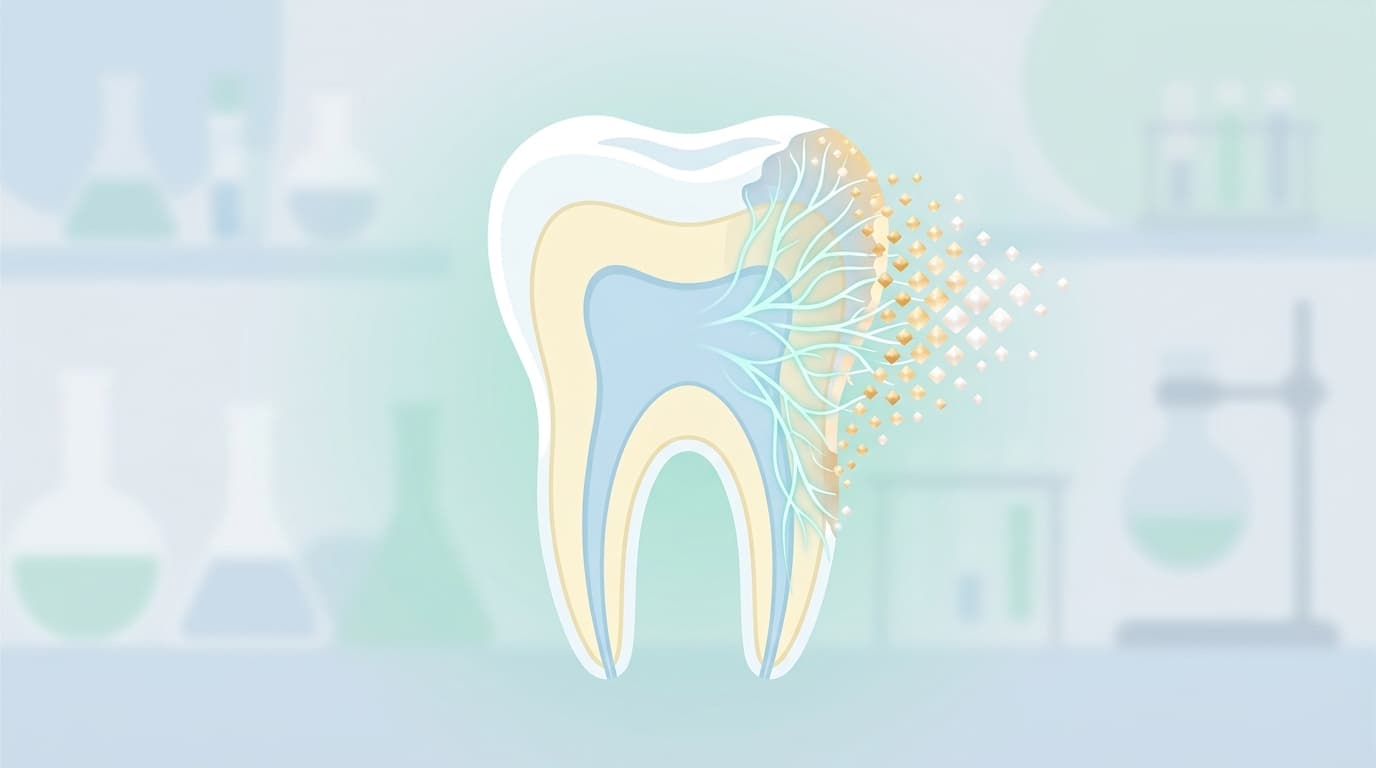
Enamel, the hard tissue covering the outer surface of teeth, does not regrow on its own once it is worn away or dissolved. In a study published in the international journal Nature Communications in November 2025, an international team including the University of Nottingham in the UK coated the surface of extracted human teeth with an artificial protein that mimics how enamel originally forms, succeeding in restoring both the crystal structure and the hardness (strength) of the worn areas. However, these results were confirmed in the lab on extracted teeth, not yet inside a living mouth.
Why Can't Enamel Regrow on Its Own?
Enamel forms when cells called ameloblasts secrete a protein called amelogenin as teeth develop. This protein acts as a net-like scaffold that stacks calcium phosphate crystals tightly in a specific direction, giving the tooth surface the hardest tissue in the body. The problem is that once teeth finish growing and erupt into the mouth, the ameloblasts disappear. After that, even when enamel wears down or erodes from acidic foods, stomach acid, or improper brushing, the body cannot refill it. This is also why current dental treatments for sensitive teeth use desensitizing agents or fillings: they coat the worn surface with another material or block the exposed channels, rather than rebuilding the enamel itself with its original structure. There have also been attempts to address tooth sensitivity from the dentin side: a peptide that regenerates dentin works by waking up dormant cells to produce new dentin. What makes this new enamel technology different is that it rebuilds the structure using only protein and minerals, without cells.
An Artificial Protein That Mimics How Enamel Originally Formed
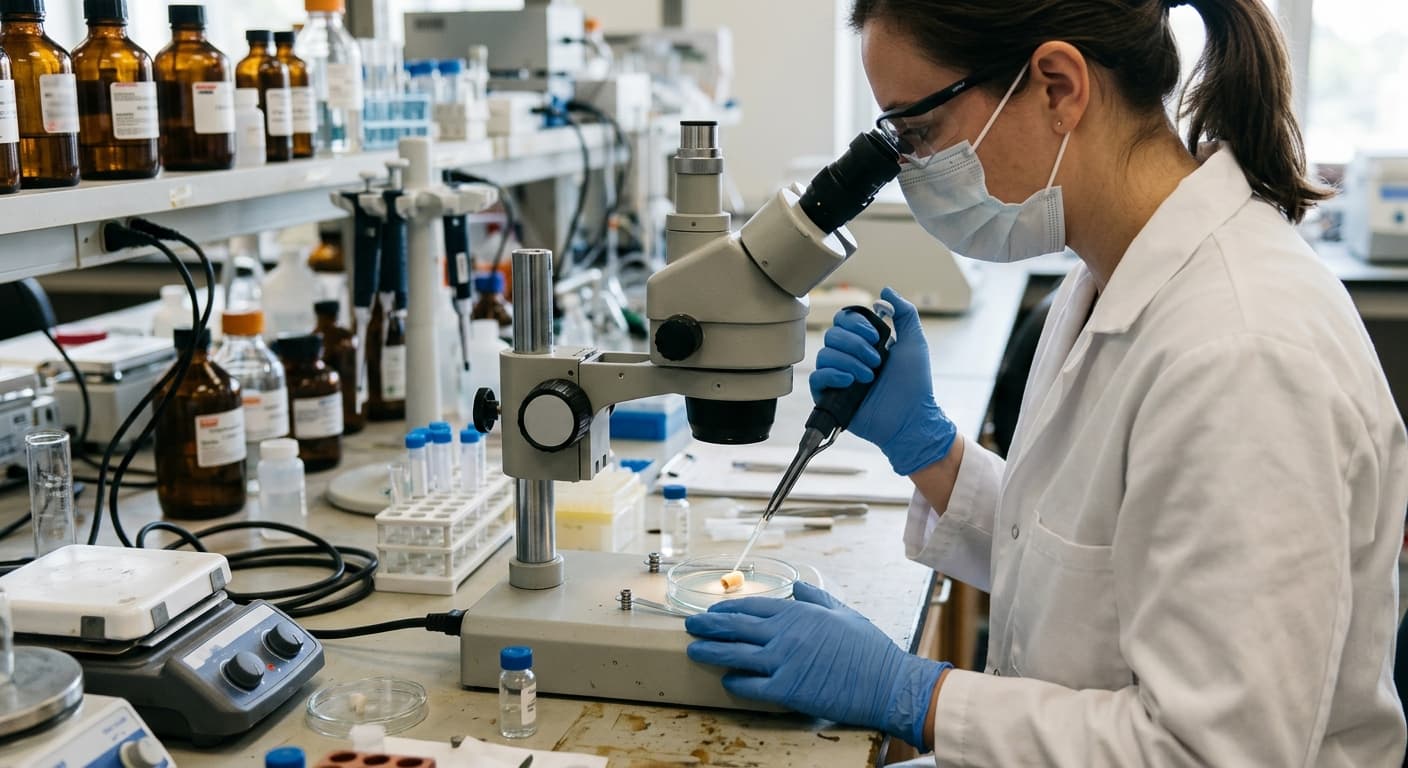
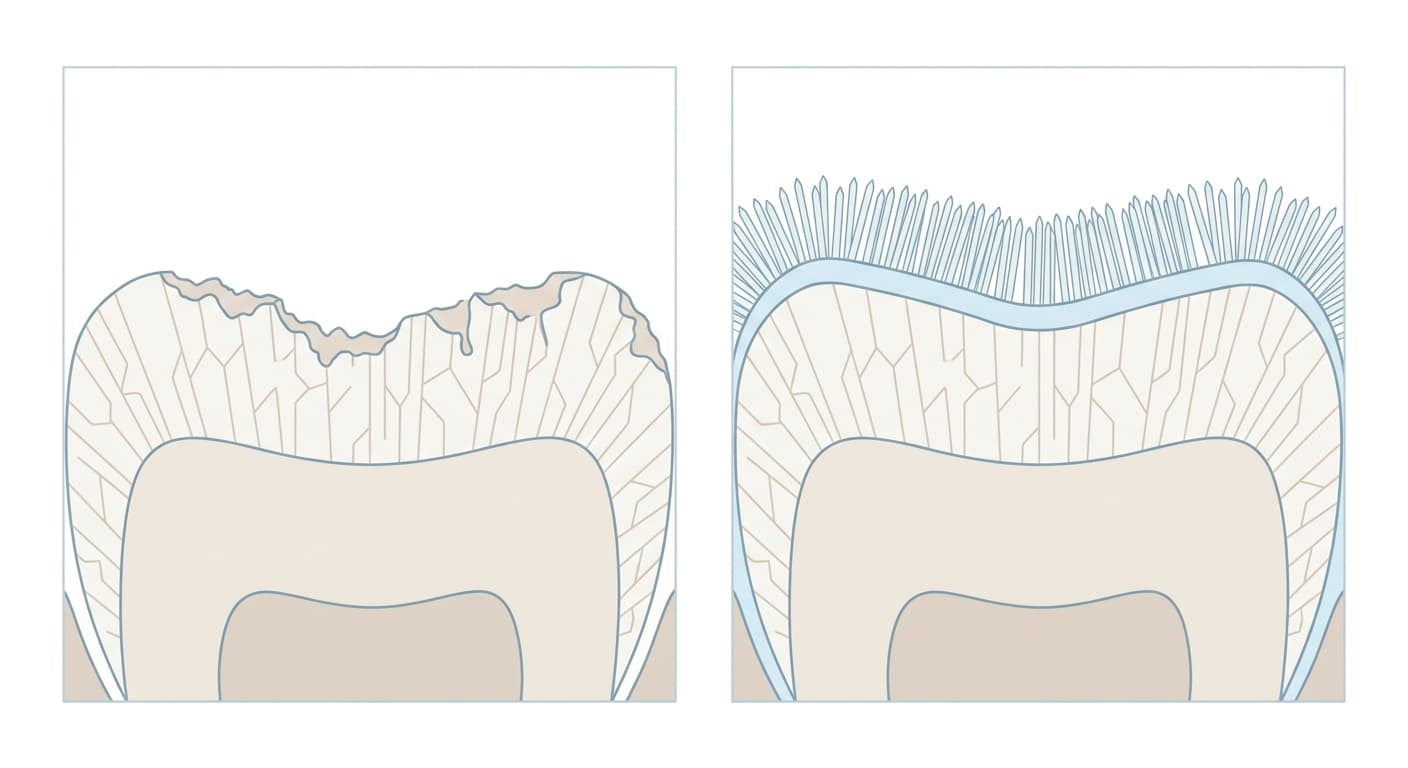
The team designed an artificial protein called an elastin-like recombinamer (ELR) that behaves similarly to amelogenin. When this protein is mixed with calcium ions, applied to the tooth surface, and dried, it self-assembles into thin, elongated fibrous structures just like amelogenin. When this fibrous scaffold is soaked in a mineral solution containing dissolved calcium phosphate and fluoride, calcium phosphate crystals identical to enamel grow, inheriting the orientation of the remaining tooth crystals. Because the minerals attach by inheriting the lattice direction of the original crystals rather than piling up randomly on the surface, the team described this as "epitaxial growth," in which crystals grow in continuity with existing ones. Treating the tooth with acid, rinsing it, then applying and drying this solution takes 3 to 4 minutes, which fits within the typical steps of a standard dental procedure.
Different Structures Grew Depending on How Deep the Wear Was
The team applied the coating to three areas with different degrees of enamel wear: the thin outermost layer, the inner layer made up of columnar crystal bundles, and areas where the enamel had completely disappeared to expose the underlying dentin. After soaking in the mineral solution for ten days, a new mineral layer with crystal arrangements specific to each site grew in all three areas, reaching a thickness of 2 to 10 micrometers (less than a tenth of the thickness of a human hair). Enamel whose hardness had dropped to 1.1 gigapascals after acid erosion rose back to 3.1 gigapascals after coating, close to the 3.4 gigapascals of original enamel. The layer grown on fully exposed dentin reached an elastic modulus (stiffness) close to that of natural enamel (58.3 gigapascals), but its hardness, at 1.4 gigapascals, was lower than the typical range of natural enamel (2.5 to 4 gigapascals). The team attributed this difference to the newly grown crystals being oriented differently from those in natural enamel.
The Structure Held Up Under Chewing, Brushing, and Acid Exposure
The team also tested whether this regenerated layer could withstand real conditions inside the mouth. The microstructure did not break down even after wear equivalent to one year of electric toothbrushing, and after applying chewing and grinding forces equivalent to three and a half years, it wore down only about as much as natural enamel. The layer grown on dentin actually wore down less than bare, uncoated dentin. When exposed to a solution as acidic as vinegar, the regenerated layer retained its hardness better than natural enamel, which the team attributed to fluoride remaining in the coating. The same results were reproduced when the coating was exposed directly to saliva from three different people over two weeks. However, all of these experiments were conducted on teeth removed from the mouth, and the team noted that verification inside a living mouth remains the next step.
This study is the first to demonstrate, across multiple sites with varying degrees of wear, that a protein mimicking the natural growth process alone, without cells, can restore both the crystal structure and the mechanical properties of enamel. Because it regrows the enamel itself rather than simply covering the surface with a coating or filler as existing methods do, the team suggested this technology could become the next step in treating tooth erosion and sensitivity.