
Question
I recently had treatment for a sensitive tooth at the dentist. On one tooth they only applied something like a medication, while on another tooth they filled it with resin. I was told both are treatments for managing sensitivity, but I'm curious what exactly the difference is, and why some teeth only get something applied while others get filled.
Short Answer
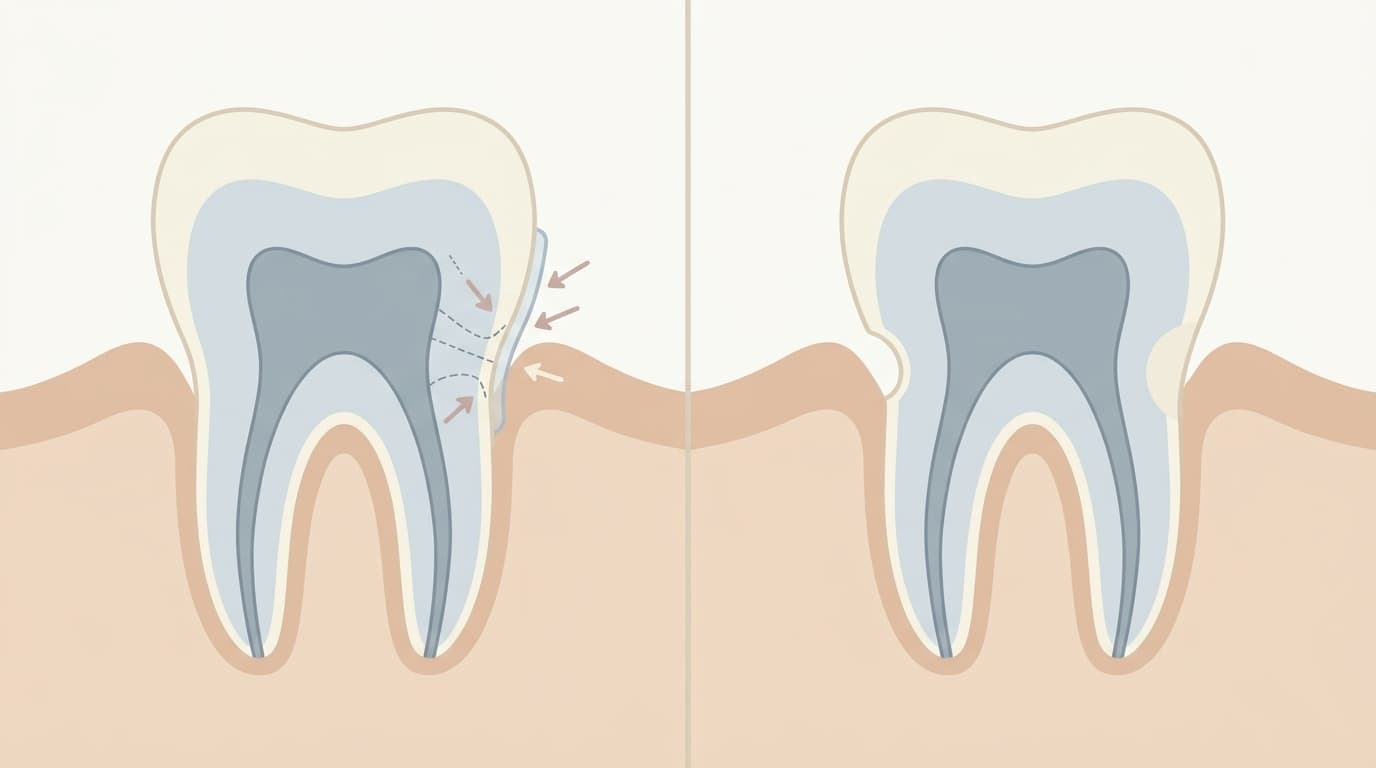
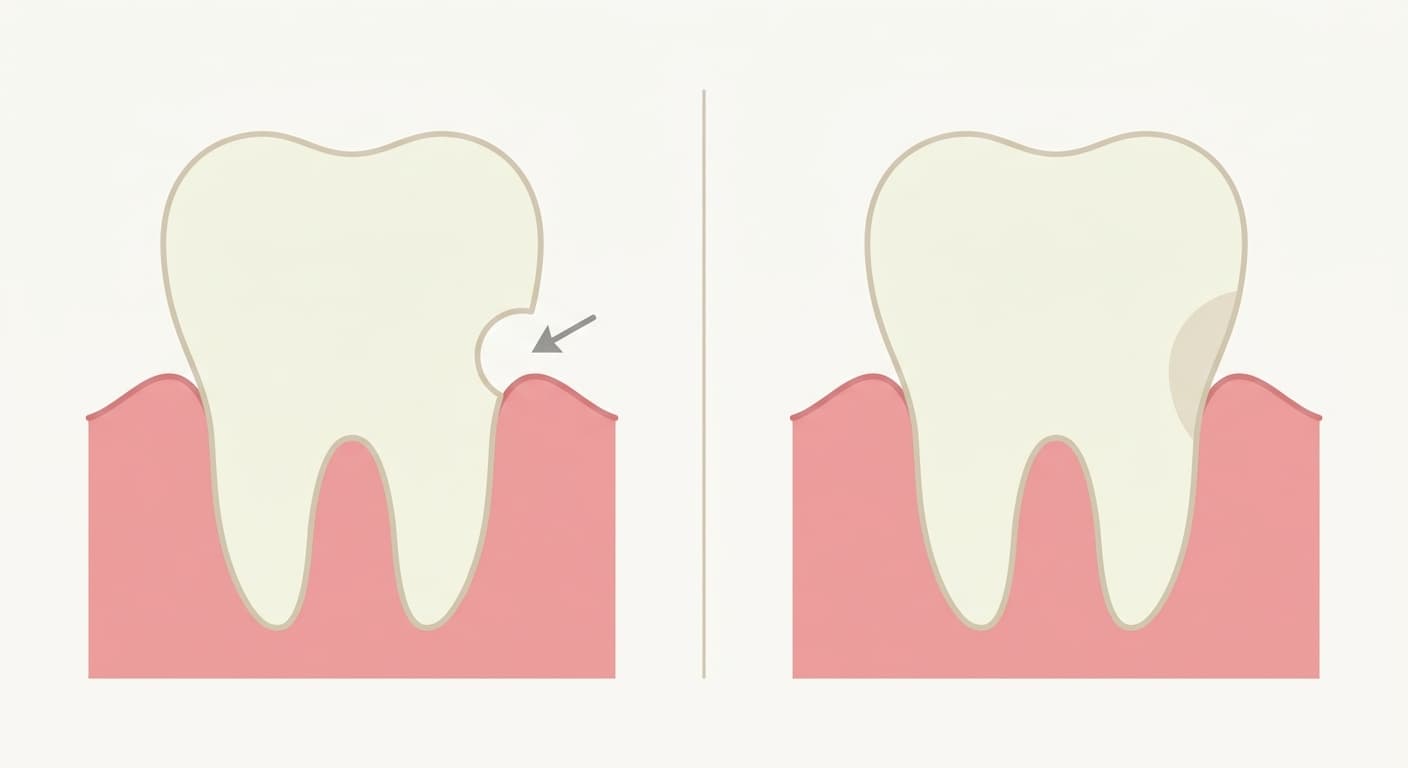
Applied treatments seal the dentinal tubules, the microscopic channels in dentin that has already been exposed, or reduce how much the nerve inside responds to stimulation. Filling treatments fill the actual gap left where tooth structure has worn away or been lost, with a restorative material, eliminating the defect itself. The two treatments target different things. Applied treatments leave the tooth structure as it is and only reduce the pathway through which pain is transmitted, while filling treatments fill in the missing structure and eliminate both that pathway and the defect together. When an applied treatment alone does not sufficiently relieve symptoms, or when the defect is clearly visible, treatment moves on to filling.
Why Is That?
Applied treatments block the path pain travels through
When the gums recede or the tooth surface wears down and the dentin beneath the enamel (the hard tissue covering the outside of the tooth) becomes exposed, that dentin is riddled with countless dentinal tubules, microscopic channels running from the tooth surface to the nerve. When the fluid inside these channels is pushed to move by cold stimuli, osmotic pressure, or mechanical pressure, that flow stimulates the nerve and produces a brief, sharp pain. This is called the hydrodynamic theory.
Applied desensitizing treatments target this pathway in two ways. One approach physically or chemically blocks the openings of the dentinal tubules so the fluid cannot move, and the other reduces how much the nerve itself responds to stimulation. Desensitizing agents containing sodium fluoride, arginine, or oxalate, desensitizing varnishes, and laser irradiation lean toward blocking the tubules, while toothpaste containing potassium salts leans toward dulling the nerve's response. Either way, these are treatments that block an existing pathway or calm the nerve, not treatments that fill in new tooth structure.
A similar principle is sometimes used as part of filling treatments as well. For example, in amalgam fillings, after the cavity is prepared and before the restorative material is placed, certain agents (such as glutaraldehyde and HEMA) are applied to the dentin to cross-link the proteins in the dentinal tubule fluid, forming plug-like structures inside the tubules. This method is used as a supplementary step to reduce the hypersensitivity that can temporarily appear right after a restoration, and it shows that applied treatments and filling treatments are not mutually exclusive.
Where tissue has been lost, it must be filled in
When an applied treatment is not effective enough, or when tooth structure itself has actually worn away and been lost, treatment moves on to filling. Defects that form near the gumline without decay arise from a combination of abrasion from toothbrushing, erosion from acid, and abfraction from eccentric chewing forces on the tooth, resulting in a rounded or wedge-shaped loss of tooth structure. Because multiple causes overlap to produce it, treatment is not fixed to a single approach either. Depending on the extent of the defect and the condition of the gums, the site may be restored by filling it with resin or a glass ionomer-based material, and treatment of the soft tissue near the gumline may be added if needed. If the defect is small and sensitivity is the only issue, an applied treatment may be enough, but if the defect is pronounced or symptoms continue even after an applied treatment, the site needs to be filled to cover the exposed dentinal tubules themselves. Which to choose between resin and glass ionomer for this kind of defect is itself a separate question that depends again on depth and gum condition, covered in more detail in When Is Resin Treatment Used for a Worn Area Near the Gumline? and Should a Worn Area at the Tooth's Neck Be Filled with Resin or Glass Ionomer?.
If sensitivity returns even after treatment
Whether you received an applied treatment or a filling, symptoms can return after some time. There are two things to check in that case. One is whether the original cause that wore down or cut into the tooth structure is still present. If toothbrushing habits, exposure to acidic foods, or chewing forces have not changed, tissue loss may keep progressing at the same site or on other teeth, exposing new dentin. The other is the condition of the filling material itself. Resin restorations undergo polymerization shrinkage, a volume reduction of about 2-5%, and as much as 7% in severe cases, as they harden, which can create a microscopic gap between the tooth and the material. Oral fluids or bacteria moving in and out through this gap is called microleakage, and if tubule fluid starts moving again through this gap, sensitivity can return, and if bacteria get in as well, it can lead to new decay beneath the restoration or marginal discoloration. So if sensitivity returns after treatment, a dentist needs to check both whether the causative habit has changed and whether the restoration's margin has opened up or chipped. If the gap at the margin is small, that area alone can be smoothed and reinforced, but if the gap is wide or decay has gotten in beneath it, the existing restoration needs to be removed and refilled. What to check when restoration damage is suspected is covered in more detail in What Should I Do If My Resin Filling or Inlay Seems to Have Come Off?.