
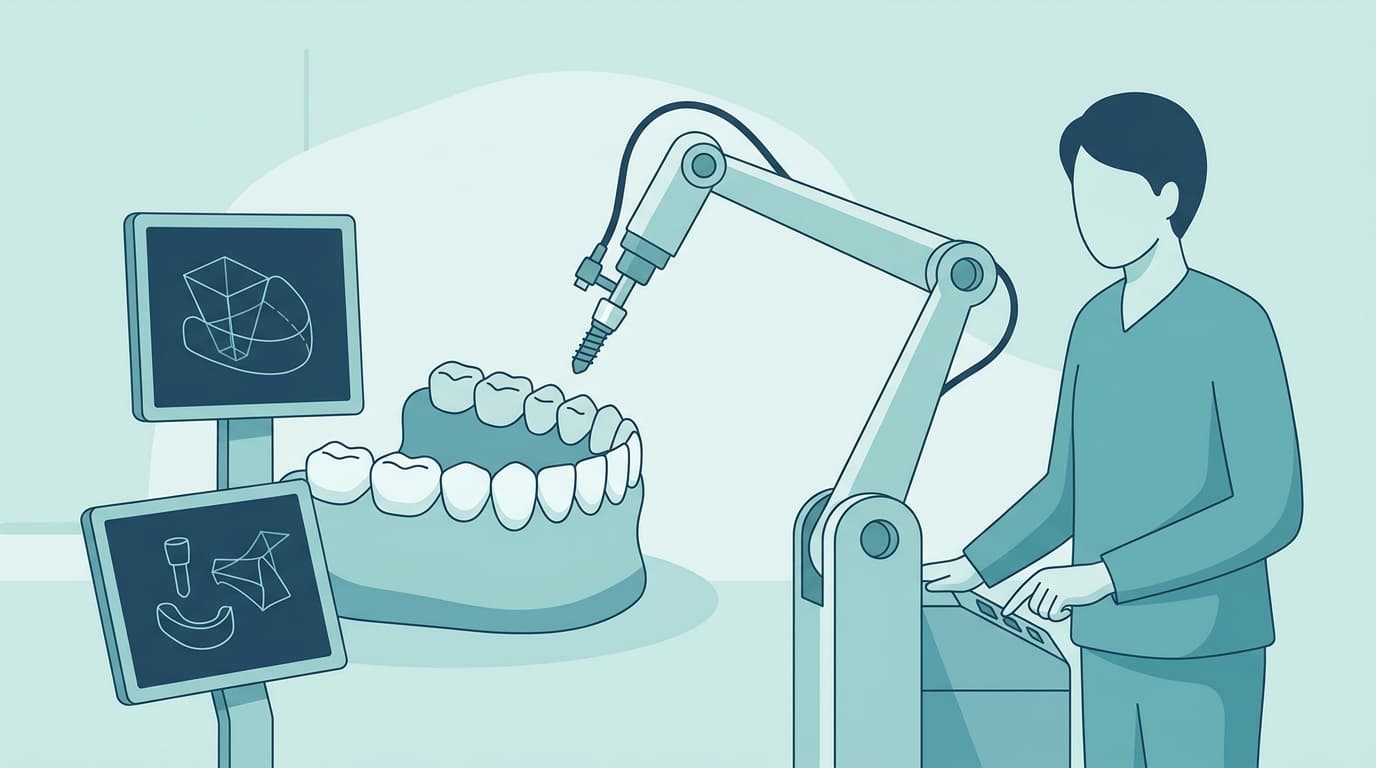
Implant placement once relied entirely on a surgeon's hand, but the field is increasingly moving toward a workflow where a computer plans the position in advance and a robotic arm carries it out. As how much more accurate guided implant and robotic surgery are than freehand placement has already shown, robotic systems produced slightly less error than static guides using printed templates or dynamic navigation viewed on a screen. But whether that accuracy is present from the very start, or whether the robot, like a person, needs practice to reach it, is a separate question. A study published in early 2026 answered it. When eleven dental trainees who had never placed an implant before used a robot to place implants, placement accuracy showed no difference between the first day and the last. What decreased with repetition was not accuracy but the time it took.
A Robotic Arm Places the Implant, Not a Hand's Feel
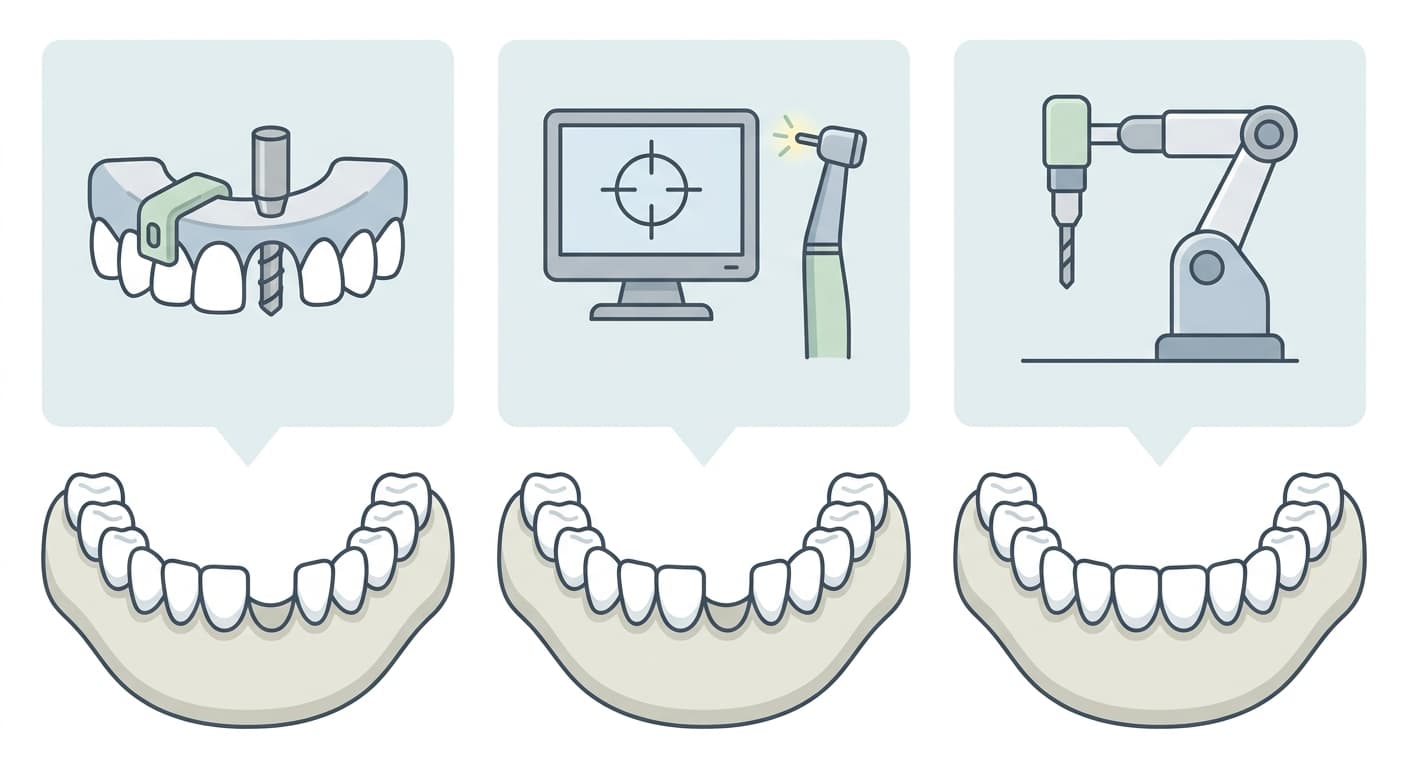
Computer-assisted implant surgery has evolved through three stages: static guides, which transfer the pre-planned drill path onto a 3D-printed template to fix the drilling direction; dynamic navigation, which shows the drill's position on a screen in real time; and robot-assisted surgery, in which a robotic arm holds and moves the drill itself.
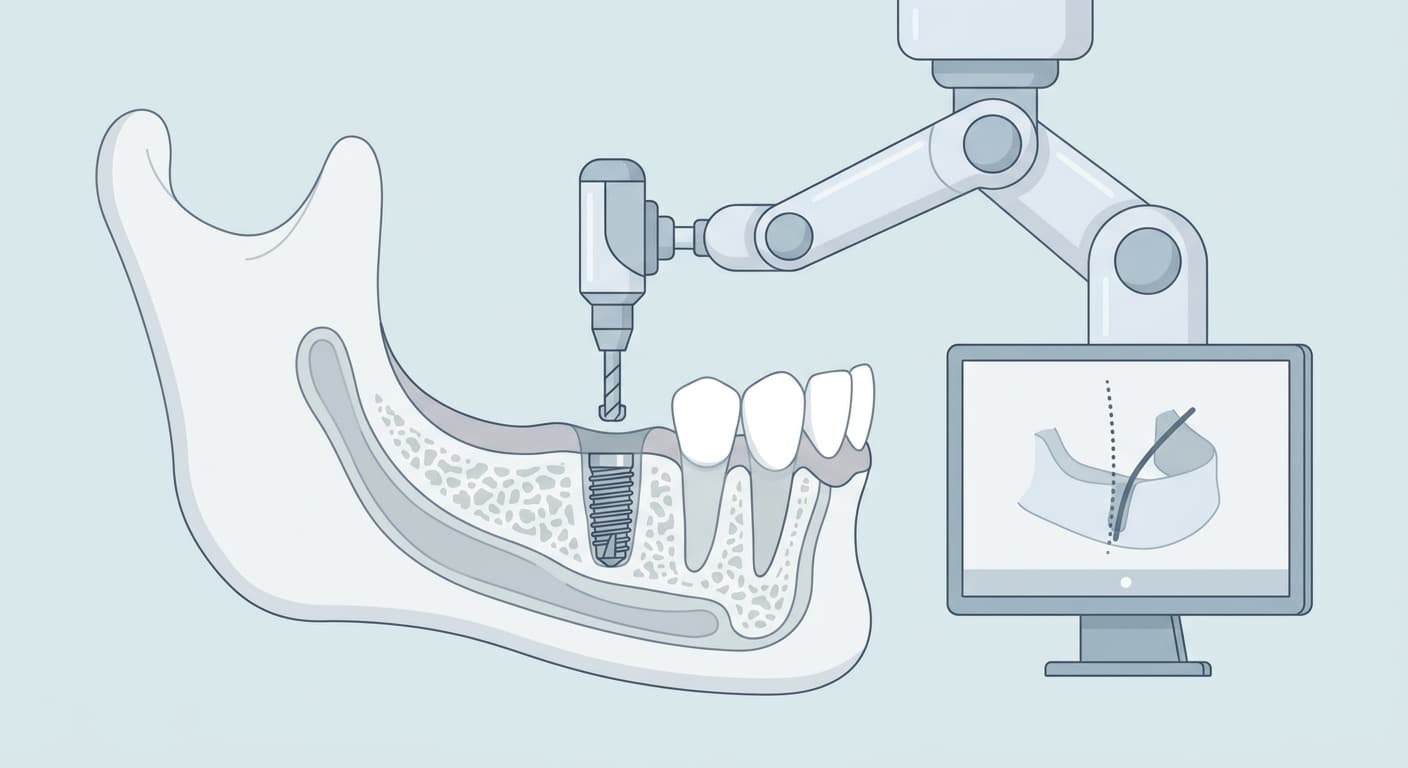
The robotic system used in this study, Beijing-based Yakebot, plans the implant position by overlaying a CBCT scan of the jawbone with the gum shape captured by a 3Shape Trios intraoral scanner. It then autonomously carries out everything from entering and exiting the mouth to shaping the site and placing the implant, using its robotic arm, an infrared tracking device, and a real-time display. The operator's role is to swap drill bits and approve each next step on the screen. Unlike dynamic navigation, which only tells the operator where to go while a human hand still holds the drill, the robot replaces the hand holding the drill with a machine.
Even Beginners Were Accurate From Day One
The researchers trained eleven dental trainees who had never placed an implant on how to use the robot, then had them place a total of 121 implants in 3D-printed jaw models, three per day over four days spaced three days apart. Comparing planned positions with actual placement, the mean error was 0.91mm at the entry point, 0.93mm at the apex, and 1.38 degrees in angulation. These figures showed no statistically significant difference between the first day and the fourth day, or between the first and third attempts within a single day. The total time, however, combining preparation and surgery, dropped markedly with repetition.
An earlier study by a different research team, using a semi-automatic robot with four young dentists, showed the same pattern. Surgery that took 33.26 minutes on the first attempt dropped to 30.47 minutes on the second, then did not decrease much further, while positional and angular error stayed similar regardless of how many attempts were made.
The Robot Handles Accuracy, the Operator Handles Speed
The researchers attributed this to the robot mechanically controlling hand tremor and fine positional adjustments. This contrasts with reports that dynamic navigation, where the operator holds the drill and adjusts position by hand while watching the screen, shows noticeably improving accuracy with repetition. In the robotic system, the work of producing accuracy has already shifted to the machine, meaning what the operator needs to master is not accuracy but the procedure itself: confirming the plan, swapping drill bits, and moving through each step. The preparation phase, governed by a fixed registration and calibration procedure, shortened only gradually, while the surgical phase, where the actual drilling happens, dropped quickly between the first and second days and did not shorten much further after that.
This experiment, however, was conducted on 3D-printed jaw models rather than real patients, over a short span of four days. The researchers themselves noted as limitations that the sample of eleven trainees was small and that the study could not capture the many variables of an actual clinic. Still, the fact that the same pattern appeared across two different robotic systems lends weight to the interpretation that, in robot-assisted implant surgery, what requires training is speed rather than accuracy.