
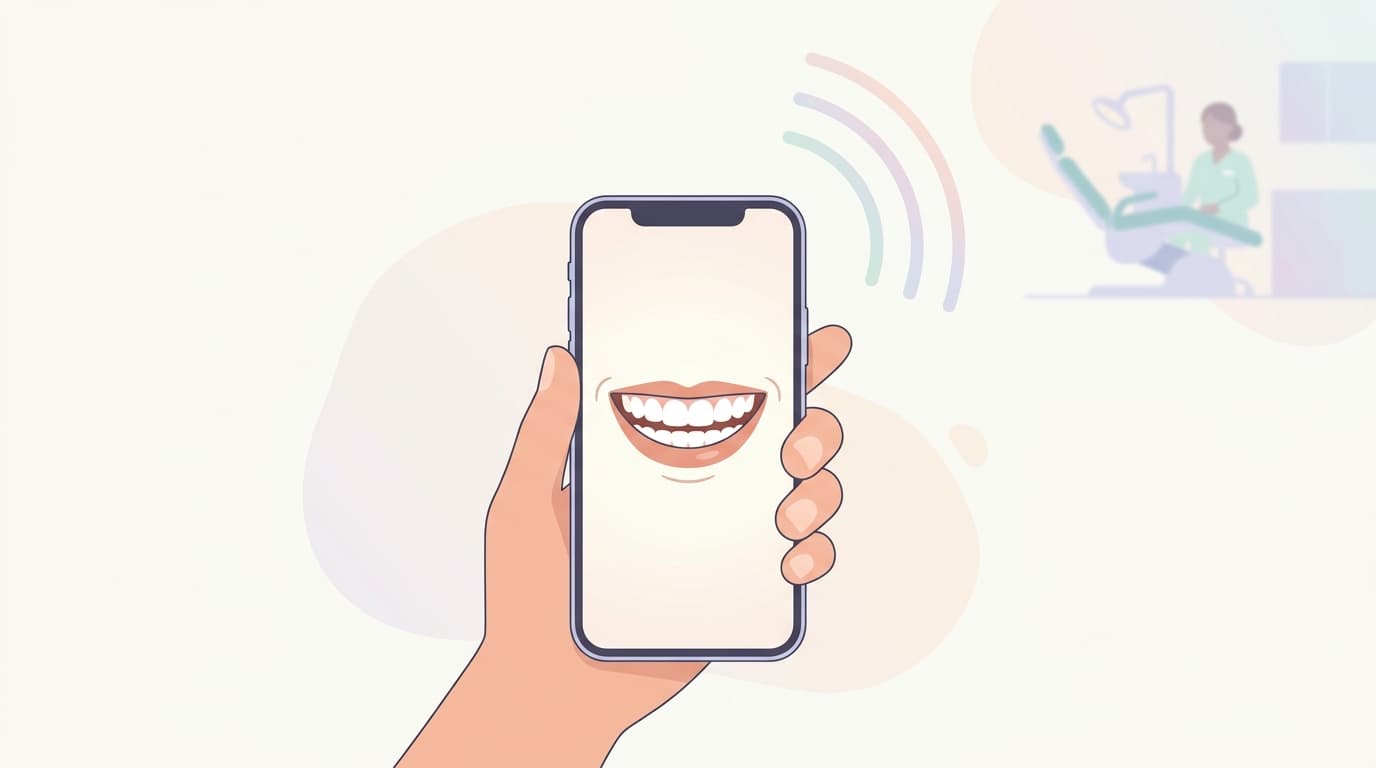
Consulting a dentist by sending only smartphone photos of your teeth, without visiting in person, is gradually becoming more common. It's already used for school dental screenings, pre-appointment triage, and preparing home visits for residents of care facilities who have difficulty traveling. Recent studies taken together show that photos alone can fairly accurately determine whether a cavity is present, but they don't fully replace an in-person exam.
How Photo-Based Consultations Differ
In a teledentistry photo consultation, a patient or caregiver sends photos of the inside of the mouth taken with a smartphone, and a dentist or dental hygienist reviews those photos directly with their own eyes. This differs from the approach covered in AI cavity diagnosis, where a machine first scans photos or X-rays and flags suspicious areas. Here, because a person is the one making the call, the dentist remains the decision-maker, but the limitation remains that the judgment must rely on a single image on a screen, without the ability to touch the tooth or tap it with an instrument.
So when accuracy is assessed, the benchmark is the outcome of an actual in-person exam of the same patient. Several studies have compared the two side by side, putting a number on how closely photo review's conclusions match those of an in-person exam.
How Accurately Does Photo Review Detect Cavities?
A meta-analysis pooling 18 studies found that photo review is very strong at correctly ruling out cavity-free teeth. Out of 100 healthy teeth, it correctly identified 95 to 99 as "no issue." Its ability to catch actual cavities, however, varied with how advanced the lesion was. For early cavities confined to the enamel (the tooth's hard outer layer), it caught only 74 out of 100, while for cavities that had reached the dentin, it caught 81 out of 100. In other words, the less visible an early lesion is, the more likely it is to be missed in a photo.
A study examining children's cavities from photos taken by parents found a similar pattern. When photos of the upper teeth were combined with a frontal shot, it detected 95 to 99 out of 100 visible cavities, but for the lower front teeth alone, it caught only about 67 out of 100. Because that area is easily obscured by the tongue or lips, judgment from a single photo appears to become less reliable there. The same study also confirmed that accuracy didn't drop significantly even when a parent, rather than a dentist, took the photos by following written instructions. This suggests that how and from what angle a photo is taken matters more than whether the person taking it is a professional or a layperson.
What Photos Miss
Photo review is especially weak when it comes to early demineralization that hasn't yet formed a cavity (a white spot where minerals have leached from the enamel surface) and soft-tissue findings such as gum changes. These changes are only distinguishable through touch or close examination from multiple angles, and subtle differences in color or texture are easy to lose in one or two photos. Areas that are hard to see with the naked eye, like the surfaces between teeth, also show clear limits when assessed from photos alone. Because a photo shows only the surface, it can't reveal whether a cavity has reached close to the nerve or whether there's inflammation at the root tip, so it cannot replace an X-ray or a physical tapping test.
Above all, a photo "looking fine" doesn't necessarily mean there's actually no problem. Because the chance of missing an early cavity is noticeably higher than with an in-person exam, it's not advisable to push back your regular checkup schedule just because a photo consult came back clear.
When It's Useful, and When to See a Dentist First
Where photo consultations actually help is not in confirming a final diagnosis, but in gauging whether you need to see a dentist right away or can wait. Several countries have reported using them as a first-pass screen before labor-intensive in-person school dental exams, or as a preliminary consultation for care-facility residents with limited mobility and patients in areas where frequent visits are difficult. They're also useful for gauging how urgent your situation is before booking an appointment.
That said, if you have severe pain or swelling in your face or gums, don't wait for a photo consult. Seek in-person care right away. If you do use a photo consult, the surest way to improve accuracy is to take photos in bright light from multiple angles and follow any photography instructions your dental office provides. And even if a photo review comes back "fine," it's worth remembering that this is a reference point for gauging when to schedule your next visit, not a final diagnosis.