

In recent years, a growing body of studies has examined whether fitting a child in the dental chair with a headset that shows a different world on screen actually reduces anxiety and pain. Recent meta-analyses pooling randomized controlled trials from multiple countries show a result that splits by age: in children, virtual reality (VR) clearly lowered both anxiety and pain, but in adults only pain decreased, while the effect on anxiety was not statistically confirmed. The same body of research also found that fully immersive headsets, which block the entire field of view, were more effective at lowering heart rate than devices that show content on a screen alone.
Put On a Headset, Step Into Another World
Virtual reality devices generally fall into two categories: immersive headsets worn on the head that block the entire field of view with a screen, and non-immersive devices that show content only on a tablet or smartphone screen. One 2026 pediatric dental trial used a Jio Dive headset with a smartphone inserted into it. Researchers attribute the anxiety- and pain-reducing effect of this approach to what is called 'limited attentional resources.' The idea is that the amount of sensory information a person can process at once is fixed, so filling a child's sight and hearing with a different scene inside the headset leaves correspondingly less attention available for the sensation of a needle or instrument.
The illustration below is a conceptual diagram of how this works; the proportions in the donut chart are not actual measured values.
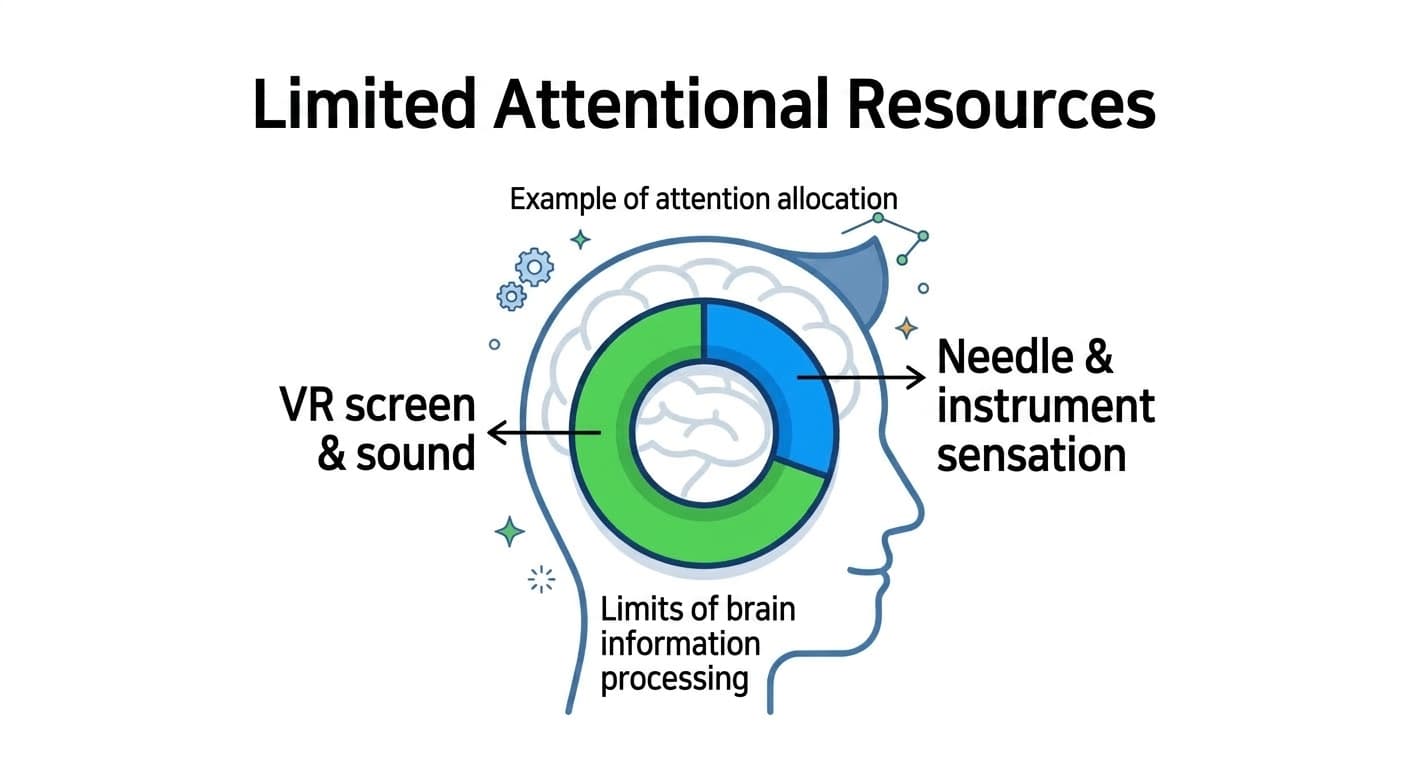
This differs from computer-controlled dental anesthesia, which reduces pain by controlling the pressure of the injection itself and thus the stimulus at the moment the drug enters the tissue; virtual reality instead works by diverting the child's attention away from that sensation.
In Children, Both Anxiety and Pain Decreased
A meta-analysis pooling twelve randomized controlled trials and 818 children found that anxiety scores were markedly lower among children who used virtual reality than among controls, with pain scores and heart rate also decreasing. Another meta-analysis likewise found significant improvement with virtual reality in both children's anxiety and pain. However, the variability between studies is large, and most published studies skew toward reporting a positive effect, so the true effect size may be smaller than these figures suggest.
In Adults, the Effect on Anxiety Is Still Unclear
A meta-analysis pooling data from both children and adults found that adult results differed from those of children. Pain decreased in adults as well, but the confidence interval for the improvement in anxiety scores included zero, so the difference did not reach statistical significance. These studies alone do not explain why this gap exists; the research team pointed to the wide variation in content across studies and the small number of adult-focused studies as likely causes, and called for further research.
Immersive vs. Non-Immersive: A Difference in Heart Rate Reduction
One review examined 37 studies covering 2,505 children and meta-analyzed data from 13 of those studies, totaling 819 children. Among several comparisons, immersive headsets produced a heart rate that averaged 8.12 beats per minute lower than non-immersive devices (95% CI: 1.56–14.69 bpm lower). Not all 819 children were part of this particular immersive-versus-non-immersive comparison.
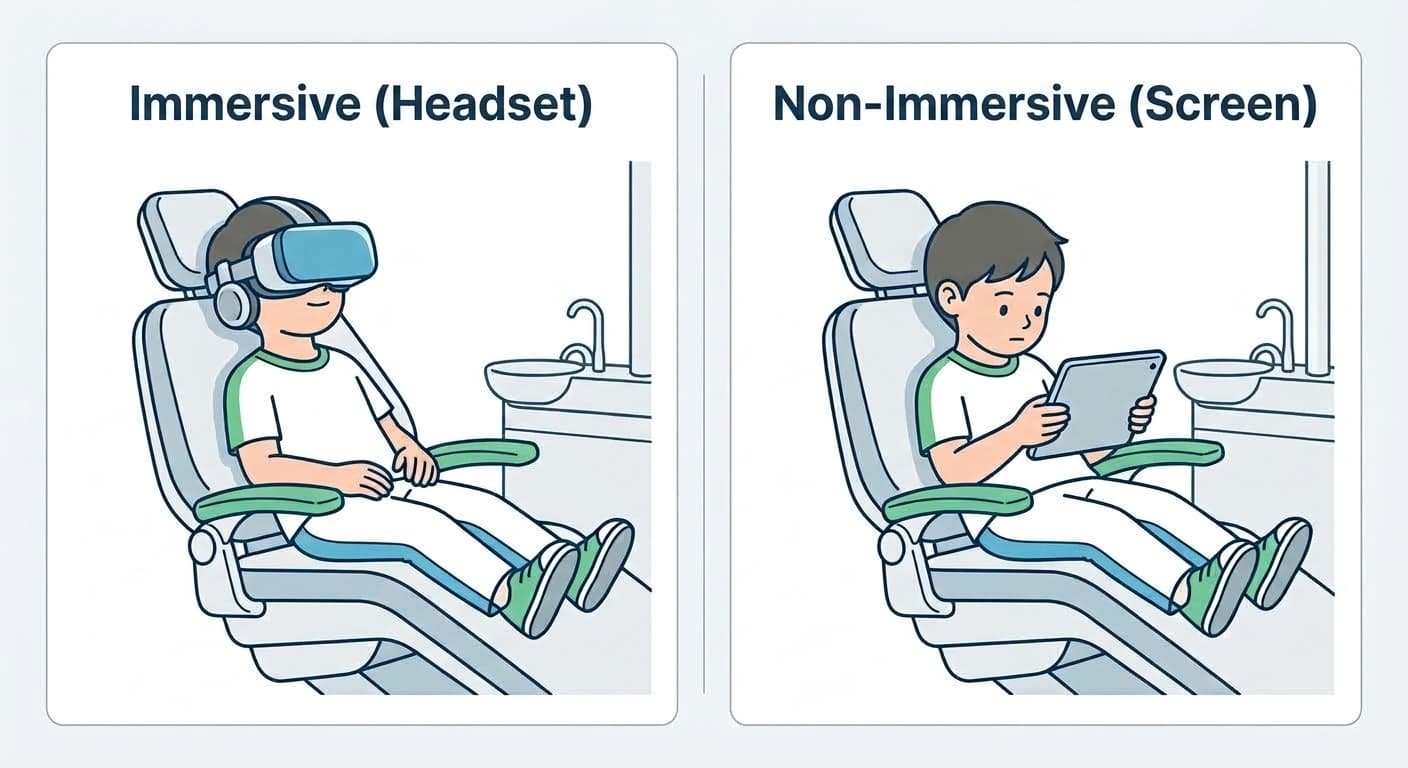
Compared with the traditional behavior-management technique in which the dentist shows and explains instruments beforehand (Tell-Show-Do), immersive VR also tended to produce a lower heart rate, though this difference did not reach statistical significance. Augmented reality (AR), which overlays graphics on the real background, still has too few studies to support a clear conclusion.
The Effect Also Appeared in Children with Autism Spectrum Disorder
In a crossover trial completed by nineteen children aged 8 to 15 with autism spectrum disorder who needed non-invasive dental treatment, salivary cortisol (a stress hormone) was lower during visits that used virtual reality, and the children's self-reported pain and anxiety scores also improved. Because it is a preliminary study with a small sample and a limited scope of treatment, the same results cannot be assumed to apply to all children with autism spectrum disorder or to invasive procedures. Taken together, the evidence so far shows that virtual reality is establishing itself as a tool for reducing both anxiety and pain in children's dental care, but the anxiety-reducing effect in adults still needs further research, and results should also be considered separately depending on the device type and the outcome measures used.