Question
During a dental checkup, I was told that one of my molars actually has a root tip that never finished forming, and that the pulp (nerve) inside it has already died. I'd never felt any sensitivity or pain, so I thought it was a perfectly healthy tooth; being told now that I need root canal treatment has caught me off guard. I'm an adult with fully grown teeth, so I'm wondering whether a tooth can still have an unformed root at this age, whether root canal treatment for a tooth like this is different from the usual procedure, and what problems could come up down the road.
Short Answer
What determines the treatment approach isn't age, but how far the root tip (apex) has developed and whether the pulp (nerve) is still alive. A tooth whose root tip stopped developing while still widely open (an immature permanent tooth) can keep that same shape even after you've become an adult. If the pulp in a tooth like this dies, it's difficult to finish root canal treatment the same way as an ordinary tooth whose root tip has already narrowed and closed, so a separate method for sealing the root tip has to be chosen. That said, not every tooth with an unformed root has a dead pulp; whether the pulp is alive and which method to use are determined through examination.
Why Is That?
Immature Permanent Teeth That Persist Into Adulthood
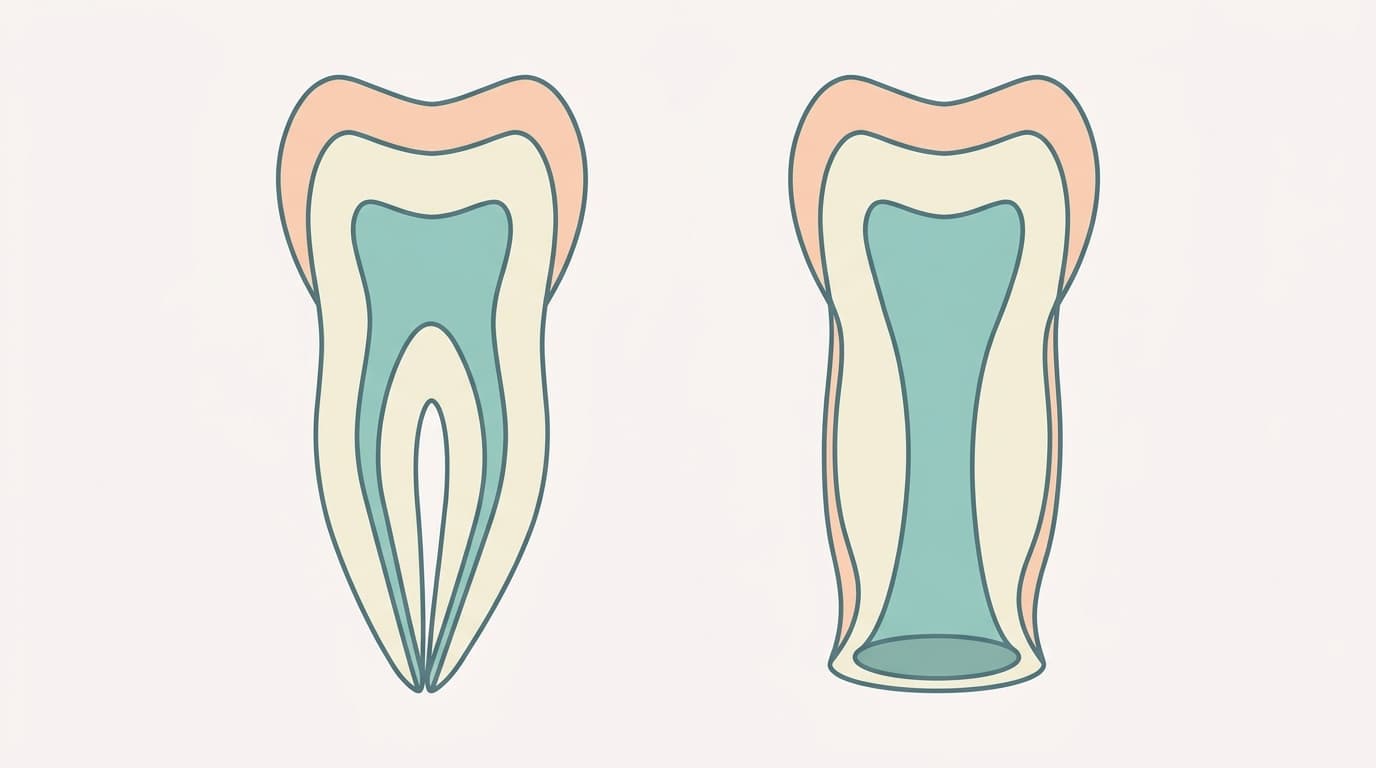
Permanent teeth keep developing their roots for several years even after they erupt through the gums. If the pulp dies before the root finishes forming, root growth stops right there, frozen in whatever shape it had at that moment. If you suffered a severe dental injury or left a deep cavity untreated for a long time as a child, that tooth may look fully grown on the outside while its root tip remains widely open, something that sometimes isn't discovered until adulthood. A widely open root tip means the opening through which nerves and blood vessels once passed is much larger than in a fully developed tooth, and the walls surrounding the root are still thin.
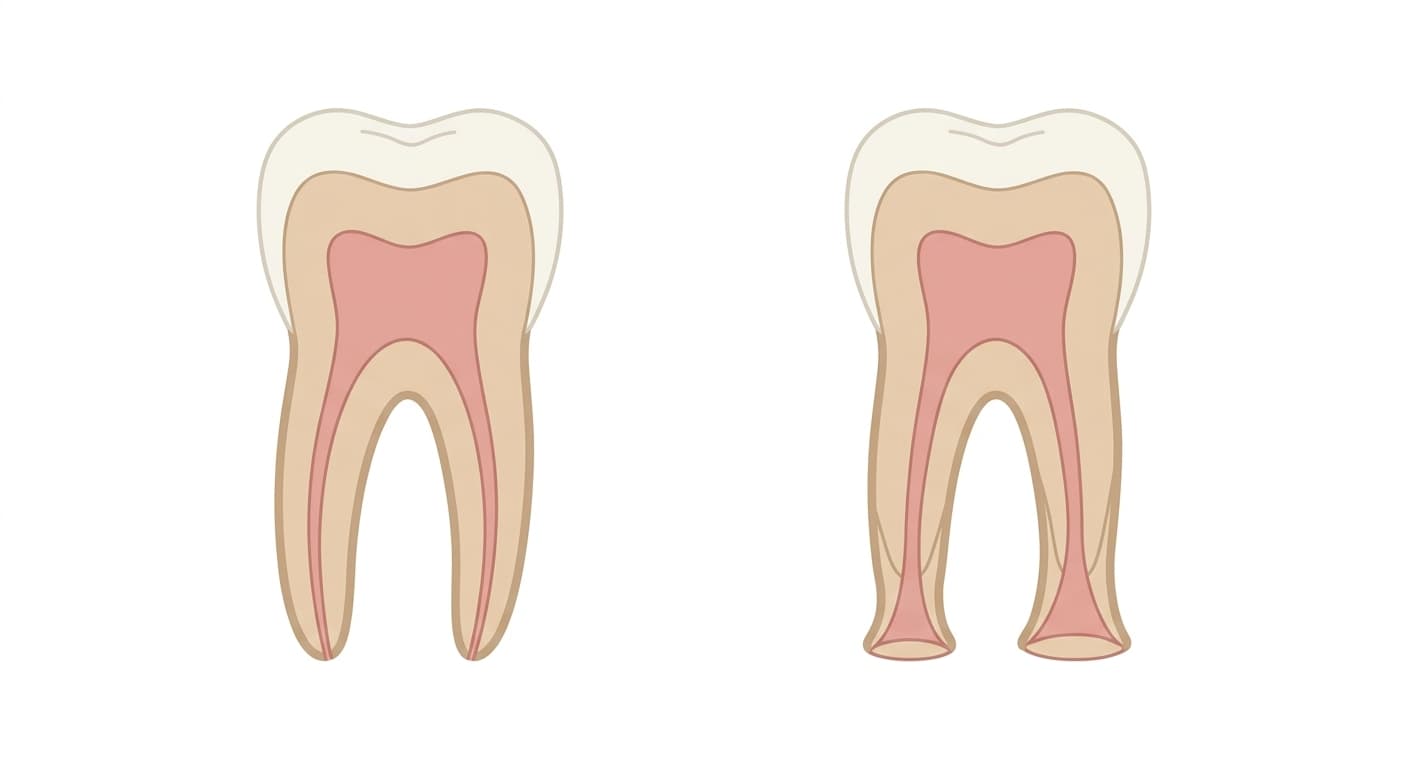
Changes that appear when the pulp of an immature permanent tooth dies start with the tooth darkening in color and continue on to root growth stopping right where it was.
Why There Was No Pain
Once the pulp has completely died, there's no living tissue left to transmit sensation, so it's common for the tooth not to react to cold or heat and to cause no noticeable pain. Even as an infection slowly spreads around the root tip, if a passage forms that lets pus gradually drain out (a fistula), the tooth can go on for a long time without swelling or pain. As covered in why gum abscesses form, an infection that progresses this slowly gives off almost no noticeable signs, unlike cases that suddenly swell up and hurt severely. But no pain isn't the same thing as recovering. Even with a dead pulp, bacteria keep growing and can gradually dissolve the bone around the root tip, so treatment is needed regardless of symptoms.
Why Root Canal Treatment Differs When the Root Tip Is Open
Standard root canal treatment assumes the root tip is narrowly closed, and works by cleaning out the canal and filling it completely with material. When the root tip is widely open, this conventional method is difficult to apply as-is. On top of that, the walls surrounding the root are still thin, making the tooth easy to fracture under chewing force. For this reason, a tooth like this is approached in one of two ways.
One way is to artificially create a hard barrier at the root tip and then seal over it with material (apexification). This can mean placing calcium hydroxide in the canal and replacing it every few months while waiting for a barrier to form, or filling the root tip area directly with a mineral-based cement material (MTA) to seal it in one step. This method closes off the root tip to keep the infection from spreading further, but the root doesn't grow any longer or thicker afterward.
The other way is to thoroughly disinfect the inside of the canal and then help the tooth refill itself with blood vessels and tissue through the wide opening at the root tip (regenerative endodontic treatment). If this method takes hold, living tissue grows in instead of a sealing material, leaving room for the root walls to thicken and the root to grow longer. That said, if no signs of this regeneration appear even after a certain period following treatment, the approach may be switched to closing off the root tip instead.
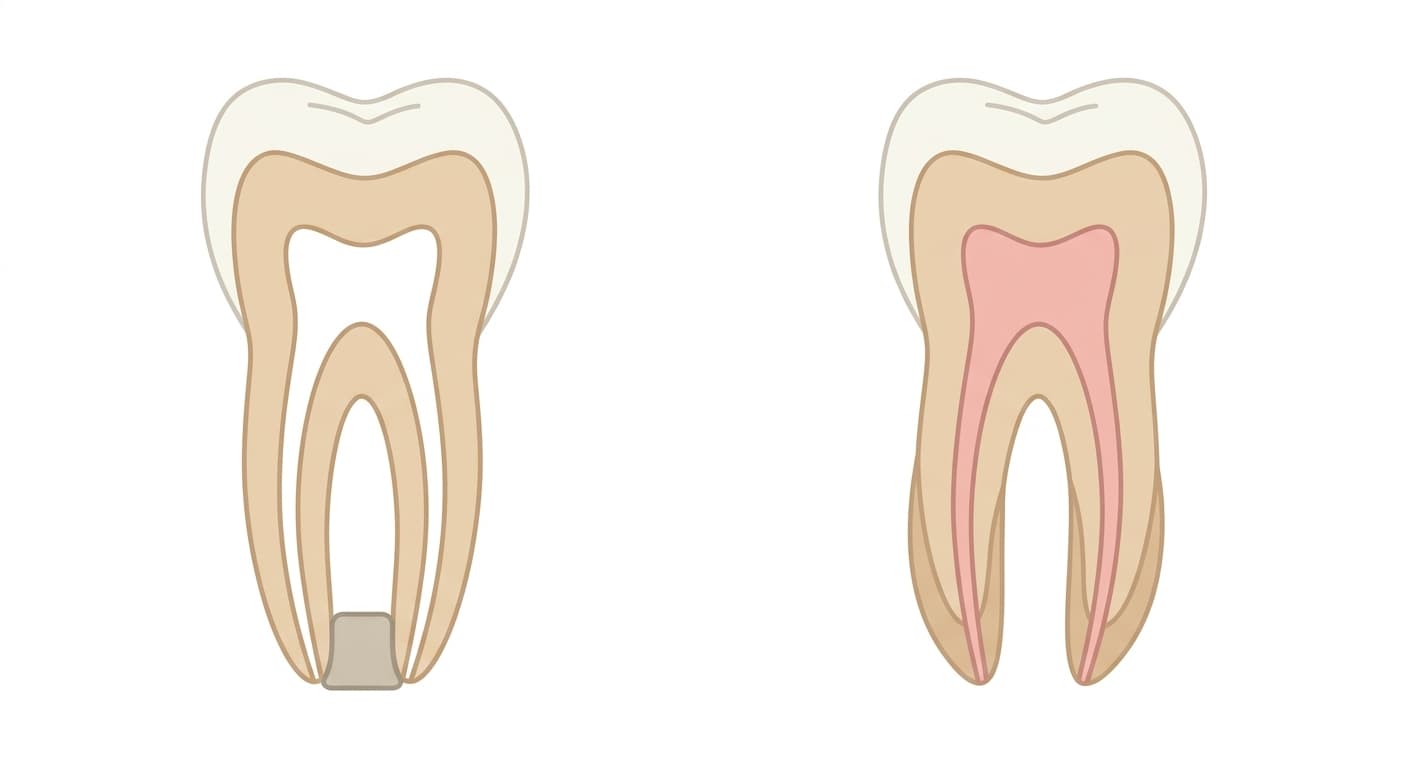
Which of the two methods is chosen is decided after actually examining how open the root tip is, how far the infection has spread, and how thick the remaining tooth walls are.
An Immature Root Doesn't Necessarily Mean the Pulp Has Died
Just because a tooth's root tip is still developing doesn't mean you can assume the pulp has died. Whether the pulp is alive is judged by looking at several tests together, such as its response to a cold stimulus (cold test) and its response to an electrical stimulus (electric pulp test), but in a tooth with an unformed root, the nerve fibers that transmit sensation haven't fully developed yet, so the electric pulp test result can come out different from the tooth's actual condition. For that reason, the result of a single test alone isn't used to conclude that the pulp is dead or alive; the condition of the bone around the root tip is also checked on a radiograph as part of the judgment. Even a tooth with an open root tip is approached in a completely different way if the pulp is still alive, so the current condition and the treatment method going forward are determined based on what's actually found during examination.