Question
Sometimes a dentist recommends fluoride varnish for a child even though there are no visible cavities, while another child of similar age is only told to come back for a regular checkup. If children of the same age receive different recommendations, I would like to know what determines whether professional fluoride varnish is actually needed.
Short Answer
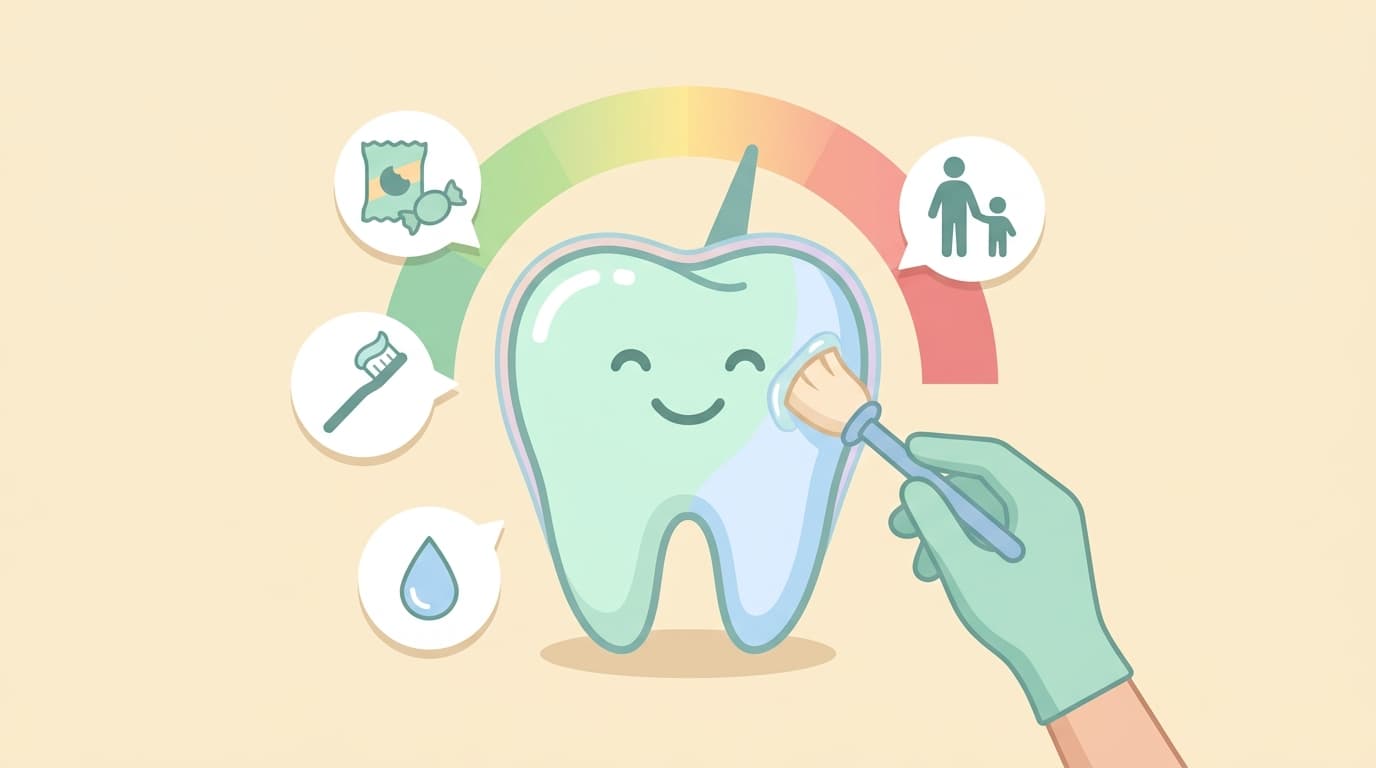
Whether professional fluoride varnish is needed is not decided solely by whether a cavity is visible right now, but by the result of assessing the child's overall caries (cavity) risk. Factors such as how often sugar is consumed, oral hygiene status, level of fluoride exposure, past cavity history, the caregiver's own cavity history, and salivary flow are combined to classify the child as low risk, moderate risk, or high risk (and, for young infants and toddlers, even very high risk). The higher the risk, the more often varnish application is recommended, and when the risk is low, the dentist may instead choose to simply monitor the child's condition through regular checkups.
Fluoride varnish application is a preventive treatment that applies high-concentration fluoride to the tooth surface to keep new cavities from forming or early lesions from progressing further. It is not itself a treatment that removes a cavity that has already formed. So the more accurate standard is not "there's no cavity, so it isn't needed" but rather "how many risk factors have accumulated for this child."
Why Is That?
What Determines Caries Risk?
The process of gauging the likelihood of dental caries (cavities) developing is called caries risk assessment. It weighs factors that increase disease risk (frequent sugar intake, bacterial plaque on the tooth surface, insufficient fluoride exposure, reduced salivary flow, and so on) against factors that protect against it (regular brushing, fluoride use, regular dental visits, and so on). Among these, the strongest predictive factor is considered to be past cavity history. A child with a recently formed white spot lesion, a newly opened cavity (a hole formed in the tooth surface by decay), or a history of restorations for cavities is assessed as having a higher likelihood of developing cavities in the future.
In children, the assessment form is also divided by age. There are separate forms for ages 0 to 5 and for age 6 and up, and for infants and toddlers, conditions that are hard for the child to manage on their own, such as the caregiver's cavity history or feeding habits, carry significant weight. In particular, early childhood caries, which occurs at 71 months of age or younger, is driven mainly by frequent feeding, especially nighttime feeding, and by transmission of cavity-causing bacteria from the caregiver, and it commonly spreads starting from the upper front teeth. A child assessed as already having an active lesion or a markedly reduced salivary flow is classified as very high risk and is considered to need a more aggressive prevention plan.
This risk assessment is used not only to decide whether fluoride varnish is needed, but also as a reference when deciding whether to treat a visible cavity now or to monitor it.
What Does Professional Fluoride Varnish Application Do?
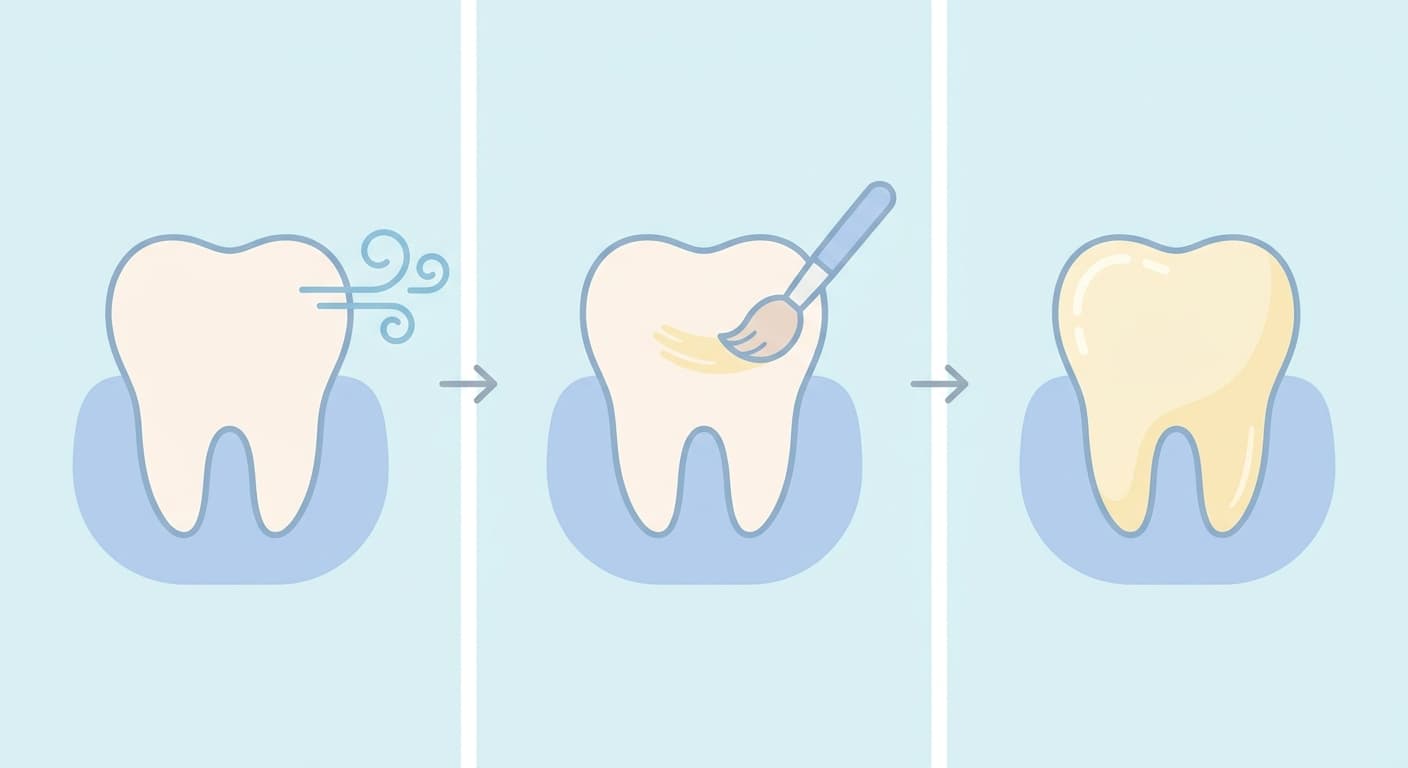
The fluoride varnish used in dental offices applies a thin layer of a fluoride preparation, such as 5% sodium fluoride (22,500 ppm F), that is far more concentrated than a toothpaste for home use. Once it touches the tooth, it reacts with saliva and hardens, forming a reservoir of calcium fluoride (a substance that clings to the tooth surface and releases fluoride slowly) on the surface of the enamel (the hard layer covering the outside of the tooth). From this reservoir, fluoride ions are gradually released and help the enamel refill with minerals. This is the mechanism by which the fluoride applied to the tooth surface assists the remineralization process, and the point that fluoride varnish application and remineralization are not exactly the same thing has been explained separately.
This treatment does not replace restorative treatment that fills an already open cavity. It is closer to a preventive and management measure that hardens an early lesion whose surface has not yet broken down, or that slows the progression of a healthy tooth surface toward decay.
How Often Is It Applied?
The application interval also changes according to risk level. A child classified as high caries risk is recommended to receive varnish every 3 months, and a moderate-risk child every 6 months. For children and adolescents overall, a 6-month interval is used as the default, with shorter intervals applied to children who have more accumulated risk factors. After application, it is recommended not to rinse the mouth for about 30 to 40 minutes so that the applied fluoride can remain on the tooth surface long enough, and to avoid chewing hard food or brushing for 4 to 6 hours.
How Is It Different From Fluoride Toothpaste Used at Home?
Fluoride toothpaste used daily at home and professional varnish applied at the dental office are complementary management methods that differ in concentration and how they are used. Because using fluoride toothpaste consistently twice a day is key, young children who easily swallow toothpaste are instructed to limit the amount to a grain-of-rice size for age 3 and under, and a pea size for age 3 and up. The reason the amount is limited is that persistently swallowing a large amount of fluoride while the teeth are forming can cause fluorosis, which leaves white spots or staining on the teeth, and the risk is known to increase particularly when a child aged 1 to 3 has a habit of frequently swallowing toothpaste.
Professional fluoride varnish application, on the other hand, is a treatment in which a set amount is applied and hardened only on the tooth surface at the dental office, so the risk from swallowing is low, and it is used as a supplementary measure added periodically for children at higher risk, separate from the toothpaste used every day. Both share the same goal of raising the rate at which the tooth regains minerals above the rate at which it loses them, but it helps to understand that the portion managed through daily habits and the portion reinforced periodically at the dental office are divided between the two.