Question
My gums hurt often and a tooth feels loose, and it's worrying me. When my gums feel weak and a tooth is loose at the same time, I wonder whether it's periodontitis (an inflammatory disease of the gums and the bone beneath them), and if so, what kind of treatment I would receive.
Short Answer
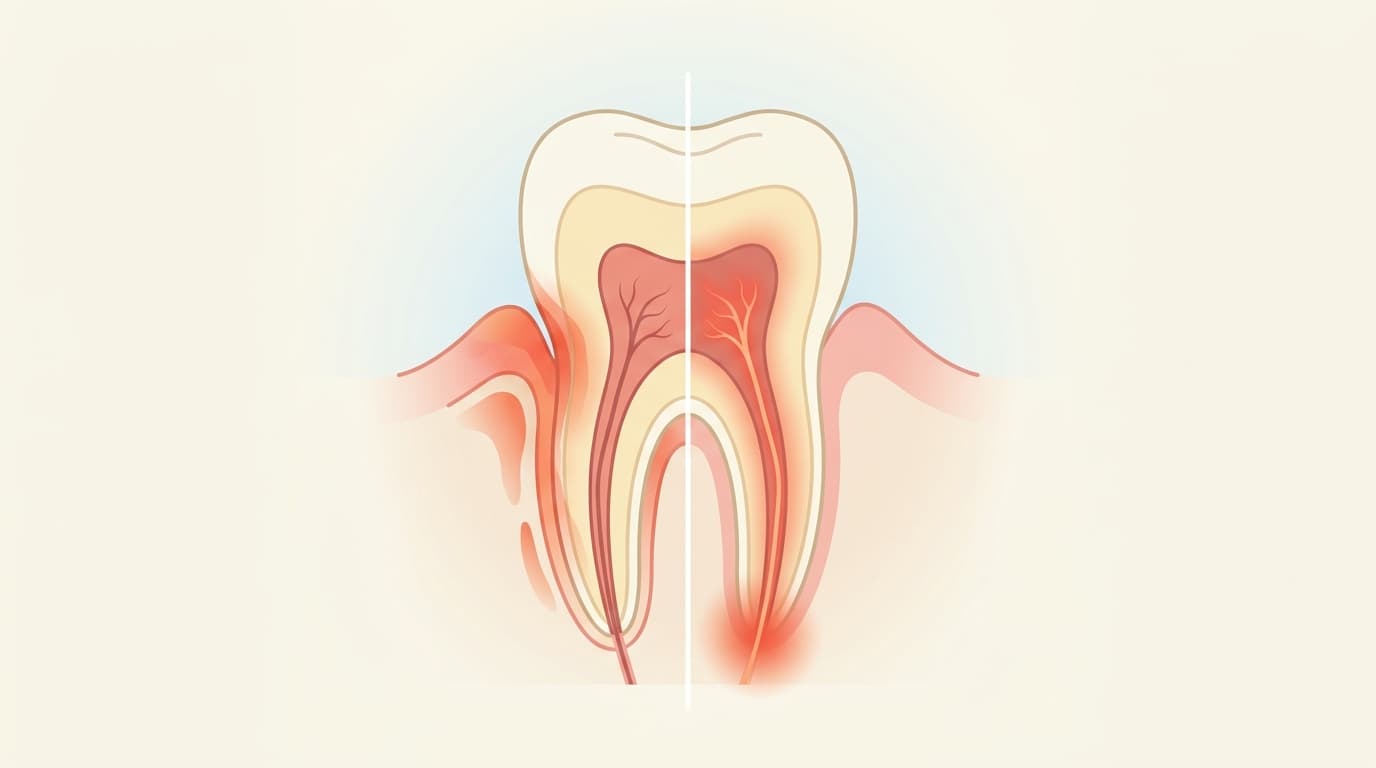
Gum pain and a loose tooth can be a problem that started in the gums and the bone beneath them, or conversely a problem that started in the nerve inside the tooth (the pulp) and spread toward the gums. Because treatment is directed differently in each case, the dentist determines the cause by looking together at a test that checks whether the nerve is still alive, a test that taps the tooth to check for inflammation around the root, the depth of the gum pocket, and an X-ray. Pain and looseness don't always lead to the same treatment, and the chance that the looseness will recover also differs depending on the cause.
Why Does This Happen?
When It Starts in the Gums and Bone
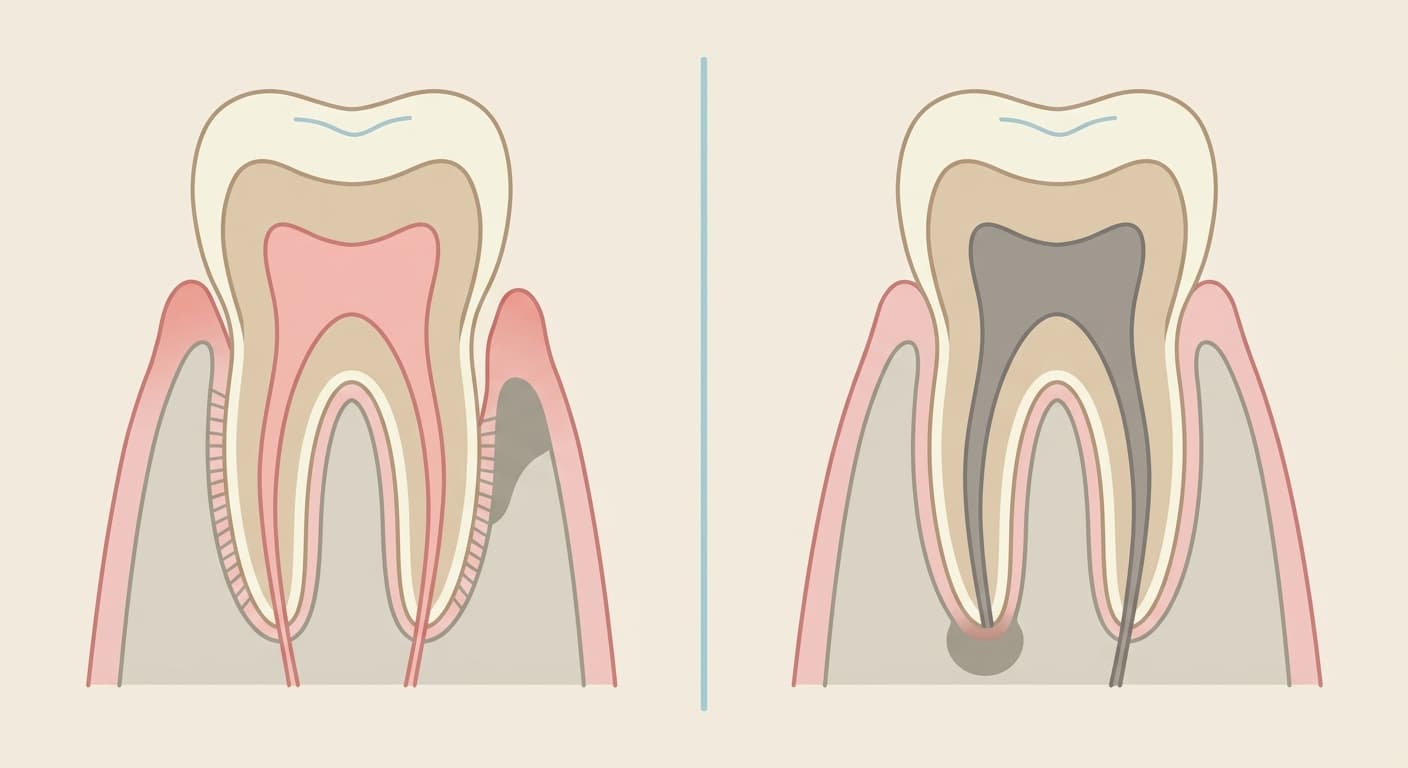
Periodontitis is a disease in which the bacterial film on the tooth surface irritates the gums, gradually breaking down the gum connective tissue and the alveolar bone (the bone that surrounds the tooth). As the inflammation progresses, the periodontal pocket (the gap between the tooth and the gum) grows deeper, creating an environment where bacteria increase inside it, and the periodontal ligament and alveolar bone that connect the tooth root to the bone are destroyed together, causing the tooth to become loose.
If the bacterial infection inside the periodontal pocket worsens rapidly, it can lead to a periodontal abscess (a state in which pus collects inside the pocket wall). A periodontal abscess shows bone destruction along the side of the tooth root, and the nerve vitality test usually comes back normal. It can look similar on the outside, with swollen gums, but it needs to be distinguished from an acute apical abscess (a pocket of pus that forms rapidly around the root tip after the tooth's nerve dies), which has a cause in the tooth's nerve. The method for telling the two abscesses apart is explained in more detail in the article on gum abscesses.
When It Starts in the Tooth's Nerve
When deep decay or trauma causes the nerve inside a tooth to die (pulp necrosis), the bacteria and breakdown products inside it can spread to the tissue around the root through the small opening at the root tip. The process of the pulp dying can sometimes proceed without pain, making it hard to notice in advance. If the infection spreads rapidly around the root tip, it becomes an acute apical abscess, which brings severe spontaneous pain along with a sense that the tooth is raised and loose, and the gums or surrounding tissue can swell. An important difference from the periodontal cause is that, in this case, the nerve has already died, so the nerve vitality test shows no response.
Here, too, what the looseness means differs from the periodontal cause. Severe looseness caused by extensive loss of bone and periodontal ligament from periodontal disease (moving more than 1mm, or even moving up and down) often has a poor prognosis. In contrast, when a tooth becomes loose because it is raised by an acute apical abscess, it can become firm again after the pus is drained and the source of infection is removed through root canal treatment. This means that even at the same degree of looseness, the chance of recovery differs depending on the cause.
When Both Are Present Together
The tooth's nerve and the periodontal tissue are connected not only through the small opening at the root tip, but also through small lateral canals on the side of the root, tiny tubules inside the dentin, and sometimes through cracks. Because of this, infection or inflammation in one tissue can spread to the other along these pathways, and this condition is called an endo-perio lesion.
Which side caused the problem first determines the priority of treatment. When a nerve problem occurs first and a gum defect develops secondarily, the gum tissue often recovers with root canal treatment alone. In contrast, when periodontal disease has progressed deeply and irritated the nerve through a lateral canal on the side of the root, or when a nerve problem and periodontal disease each started independently and later connected, both root canal treatment and periodontal treatment are needed, and the outcome depends on how much periodontal tissue has already been lost. In these combined cases, the approach is to perform root canal treatment first to remove the pulp-side cause, then re-evaluate several months later to decide whether additional gum treatment is needed. A crack in the tooth, as with a cracked tooth, can also create a new pathway between the nerve and the periodontal tissue and lead to a similar combined lesion.
What the Dentist Checks to Tell Them Apart
Whether the cause is periodontal, neural, or both is hard to tell from visible gum pain and looseness alone. The cause is determined by looking together at a test that passes a weak electric current through the nerve to check whether it is alive, a test that lightly taps the tooth to check for inflammation in the tissue around the root, a measurement of the periodontal pocket depth, and an X-ray showing where and how extensively the bone has been destroyed. Rather than drawing a conclusion from a single test result, these findings must be combined to determine which tissue is the cause and whether treatment should be root canal treatment, gum treatment, or both.