Question
When I started orthodontic treatment, my dentist showed me how to use an orthodontic toothbrush and dental floss. But being told that brushing alone isn't enough and that I also need to clean between my teeth separately feels like a burden. I wonder whether brushing thoroughly might make it unnecessary to worry about the spaces between my teeth.
Short Answer
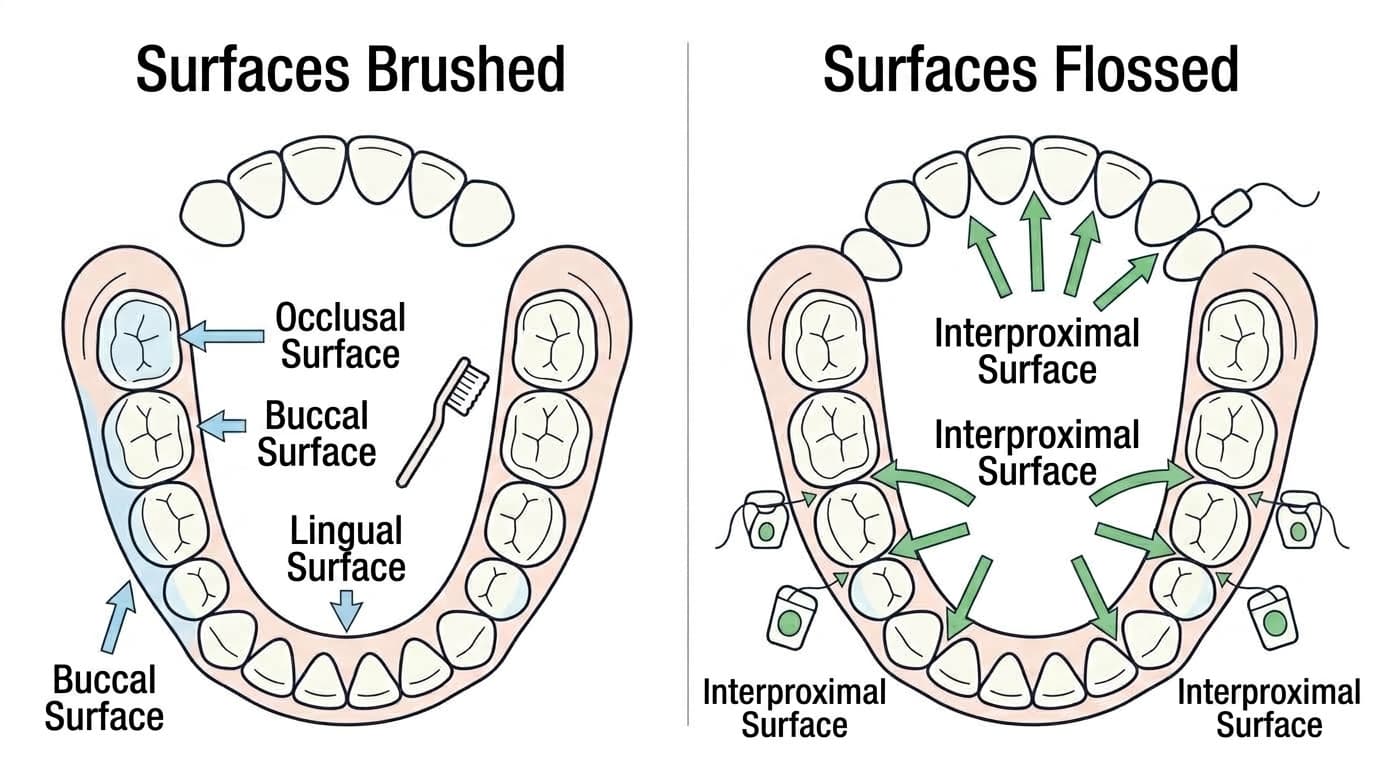
Brushing and interdental cleaning cover different surfaces. Whether you use an orthodontic toothbrush or a regular one, there are limits to which surfaces the bristles can physically reach and press against. The bristles can directly reach the chewing surface and the cheek-side and tongue-side surfaces, removing plaque (the bacterial film that builds up on tooth surfaces) from them. But the interproximal surfaces (where two teeth touch each other) sit in narrow gaps that bristles cannot enter in the first place, so they can only be cleaned with a tool like floss. What's more, during orthodontic treatment your teeth are classified as being in a period when cavities form more easily, which makes it even more important than usual not to skip interproximal care.
Why Is That?
There Are Surfaces the Toothbrush Simply Cannot Reach
Brushing is a method of cleaning the chewing surface (occlusal surface), the cheek-side surface (buccal surface), and the tongue-side surface (lingual surface) in turn. From elementary school age onward, the rolling technique is recommended, in which the bristles are rolled from the gums toward the teeth, and this motion is aimed at the three surfaces the bristles can directly press against. The interproximal surfaces where neighboring teeth touch, however, sit in narrow gaps that bristles cannot physically enter, unlike those three surfaces. So even if the chewing surface and the cheek-side and tongue-side surfaces are cleaned thoroughly, plaque on the interproximal surfaces can remain in place, and cleaning those surfaces requires using floss as well.
Plaque that remains in this gap can build up more thickly than it appears from the outside. In the interdental space (the empty space between teeth) below the contact point where two teeth touch, highly viscous plaque tends to accumulate, and if it is left unremoved for a long time, it can join with plaque on the cheek side to form a band that wraps around the tooth. This means that even if the visible cheek-side surface looks smooth, plaque can still remain on the interproximal side. Early-stage cavities that form in this area are difficult to detect visually, which is also why they are checked separately with bitewing radiographs.
Plaque has different properties right after it forms compared with after time has passed. At first, oxygen-loving bacteria settle in, but as the plaque thickens, the environment starts to become oxygen-free from the inside out, and acid-producing bacteria come to dominate. This matured plaque actively produces acid and begins to dissolve the minerals in the tooth surface. That is why the key to care is removing interproximal plaque regularly, rather than only occasionally, to interrupt this process before it can progress.
The Care Burden Genuinely Increases During Orthodontic Treatment
Teeth with orthodontic appliances attached are classified as high-risk for developing cavities. During this period, dentists sometimes additionally recommend methods that repeatedly supply low-concentration fluoride, such as a fluoride mouth rinse, which serves the same purpose of protecting teeth whose cavity risk has increased. You can read more about how the roles of plaque removal and fluoride are divided in the article on how rinsing and brushing play different roles after snacks.
The area around wires and brackets (the small devices attached to teeth) is more prone to retaining plaque than usual. If this plaque stays in place for a long time, minerals can leach out of the enamel (the hard outer layer of the tooth), producing white spot lesions, an early lesion that appears as a cloudy white area, and how often such lesions appear in patients with fixed orthodontic appliances is reported to vary widely across studies. Because this stage is still an early state in which the tooth surface has not yet broken down, consistently maintaining plaque control leaves room to halt or reverse its progress, but leaving it unaddressed can allow it to progress into an actual cavity (cavitation).
Cleaning between the teeth separately is not just an extra, bothersome step added during orthodontic treatment. It is the process that fills in the surfaces the toothbrush was never able to reach in the first place, and because this is a period of heightened cavity risk, that gap is difficult to leave unaddressed.