Question
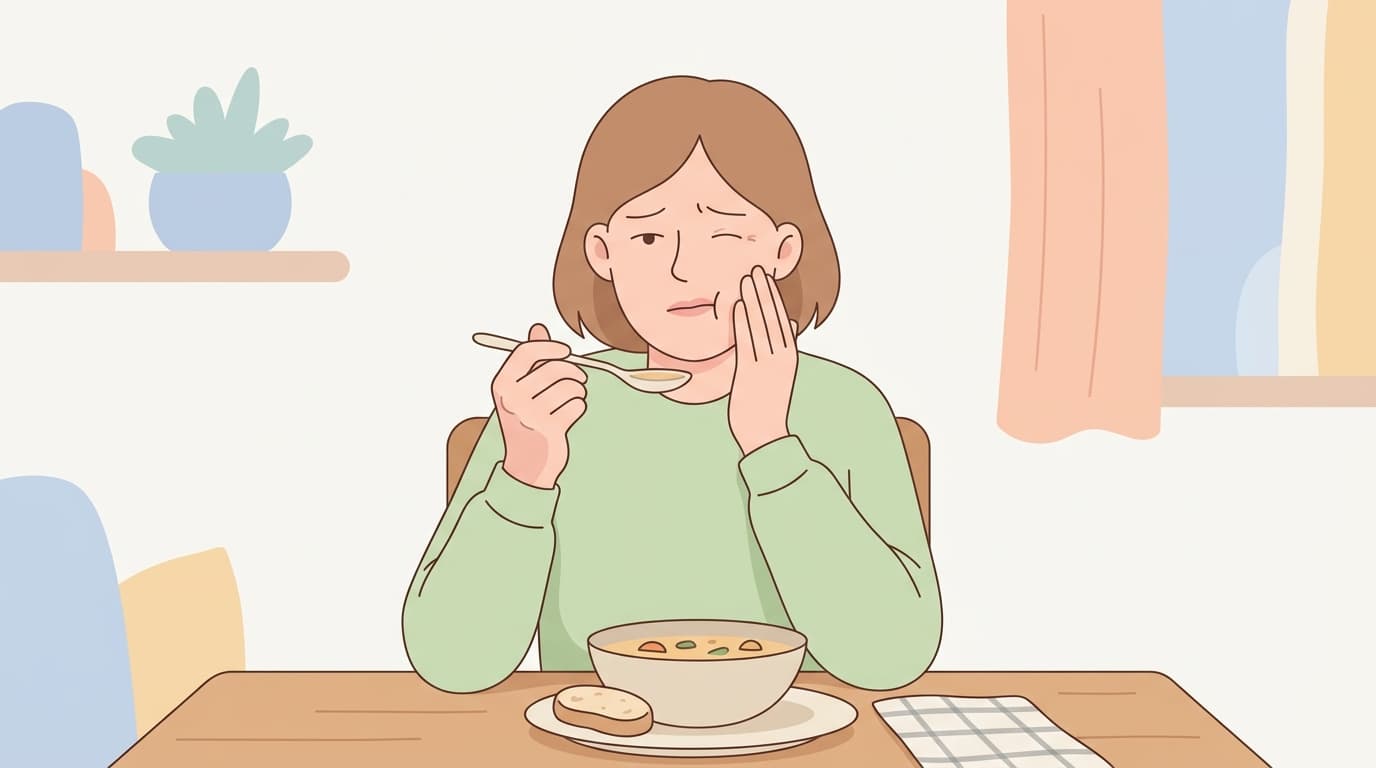
Food keeps getting stuck between certain teeth, and that spot feels sensitive. No cavity is visible from the outside, so many people wonder whether these symptoms alone mean they should suspect a cavity.
Short Answer
Food impaction and sensitivity at that spot can each arise from other causes as well, so these two symptoms alone cannot confirm a cavity. If the contact between two teeth has loosened, or if a sharp cusp on the opposing tooth pushes food into the space, food can become repeatedly impacted and the gum tissue can become inflamed even without a cavity. If the cavity started below the contact area, it is often hard to detect early on by sight or by feel, so it commonly needs to be confirmed separately with an X-ray. Only a dentist's direct examination can determine which one it is.
Why Does This Happen?
Recurring Food Impaction Can Be Caused by a Gap or a Bite Problem Between Teeth
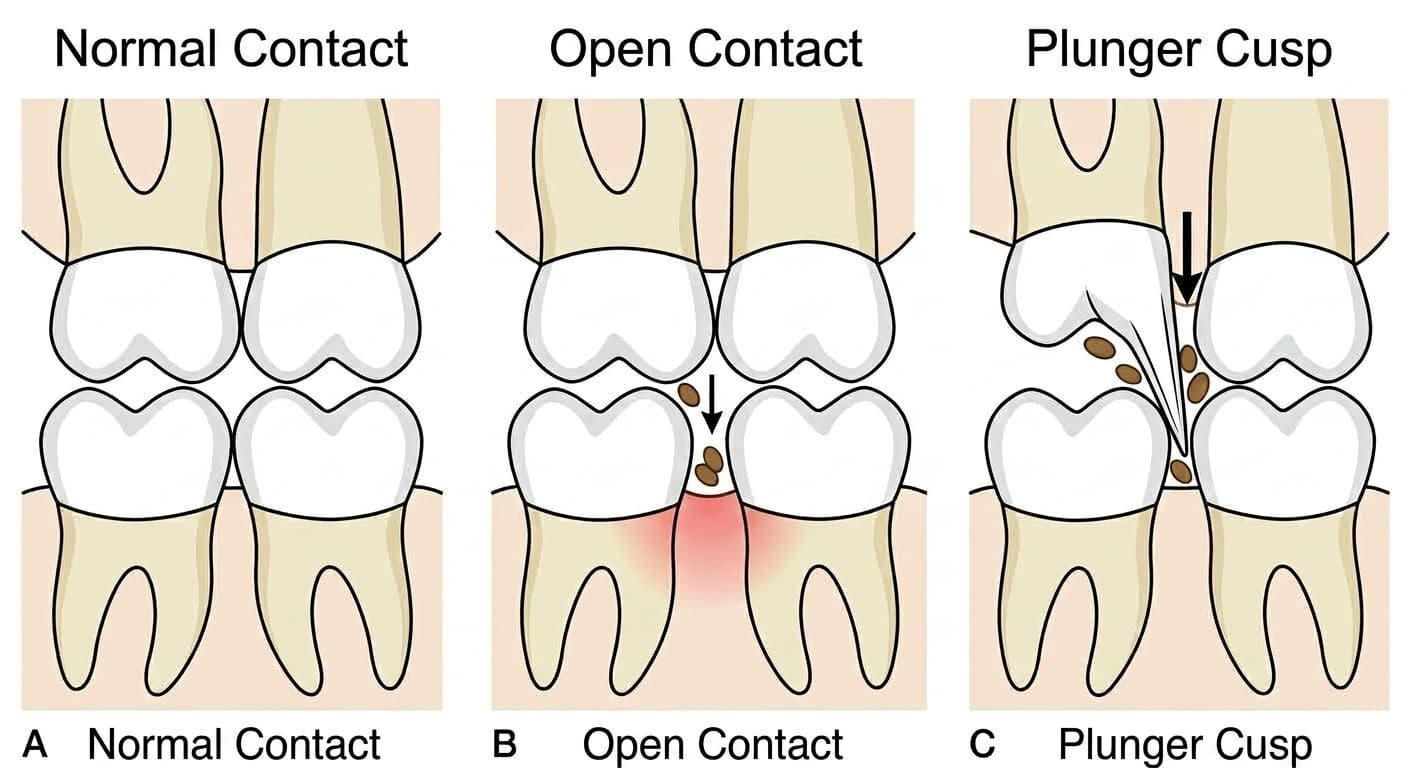
When the contact point between two teeth widens into a gap, this is called an open contact. When this gap is present, food impaction, where food is pushed into the space, increases noticeably. If this continues, the gum tissue between the teeth can become inflamed, which can also affect the depth and attachment of the periodontal tissue. However, if oral hygiene is being managed well, the gap itself often does not need to cause much concern. If the gap is large enough to be bothersome, the contact can sometimes be restored, as long as the restoration's margin does not project outward.
There are also cases where a single cusp (a pointed projection on the chewing surface) on the opposing tooth is abnormally tall and narrow, so that when biting down it drives straight into the boundary between two lower teeth or into a deep fossa (a hollowed-out area). Such a cusp is called a plunger cusp, and with every bite it drives food into the interproximal surface (the surface where two teeth touch each other) with strong vertical force. If this force is repeated, it can lead not only to food impaction but also to tooth fracture, restoration damage, or gum inflammation. In both cases, the recurring food impaction is not caused by a cavity but by the gap or bite relationship between the teeth itself.
Sensitivity Is Not Caused by Cavities Alone, Either
Sensitivity at the same spot does not automatically mean a cavity. When the gum recedes or the tooth surface wears down and exposes the dentin beneath the enamel, dentin hypersensitivity can occur, producing sharp, brief pain in response to temperature, osmotic stimuli, or even a touch from a fingertip. This happens because fluid inside the exposed dentinal tubules moves in response to the stimulus and irritates the nerve, a cause entirely separate from cavities.
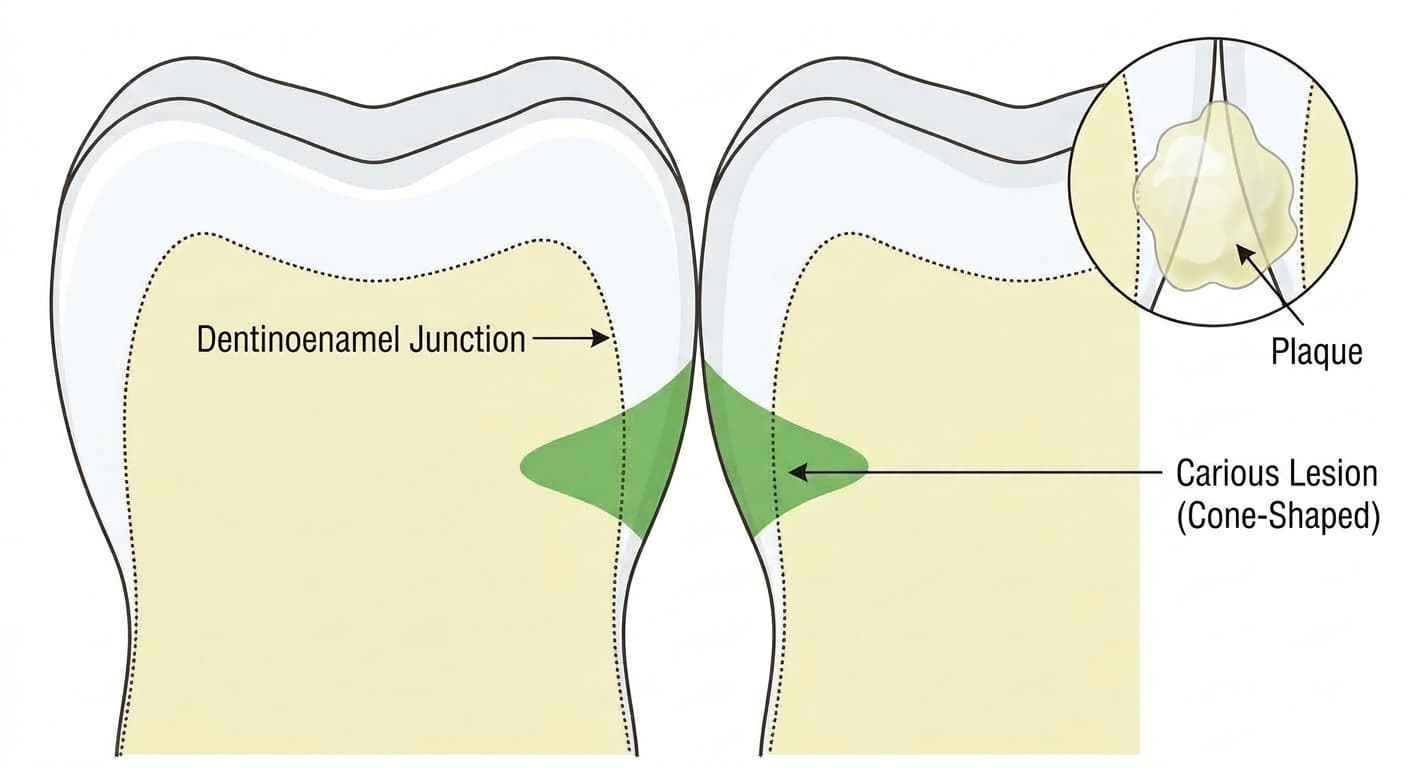
Of course, a cavity located below the contact area could actually be the cause. This kind of interproximal caries begins as plaque (the bacterial film that builds up on the tooth surface) accumulates on the smooth surface just below where two teeth touch, and it progresses in a cone shape that is wide at the outer enamel surface and narrows toward the inner dentino-enamel junction (the boundary where enamel meets dentin). Because of this pattern of progressing inward, the inside of the contact area where two teeth meet is difficult to detect early on, whether by sight or by feeling with the tip of a probe.
There Are Ways to Check Even When Nothing Is Visible
For this reason, interproximal caries is often confirmed with a bitewing radiograph. How a bitewing radiograph confirms this explains in detail how this examination finds a lesion below the contact area. If the radiograph still leaves the diagnosis unclear, an orthodontic separating band can be used to temporarily widen the space between the teeth so the contact surface can be checked directly by sight.
Recurring food impaction and sensitivity at that spot can stem from gum inflammation caused by a gap or bite problem between the teeth, from hypersensitivity due to exposed dentin, or from interproximal caries that is hard to see. Determining exactly which one it is requires an examination that includes an X-ray.