
Question
My toothache is so severe that I can't tell exactly which tooth is hurting. I can't even tell if it's in my upper or lower jaw, and the pain feels like it's spreading across several teeth, so I can't pinpoint the source myself. I'd like to know how dentists go about finding the affected tooth in a case like this.
Short Answer
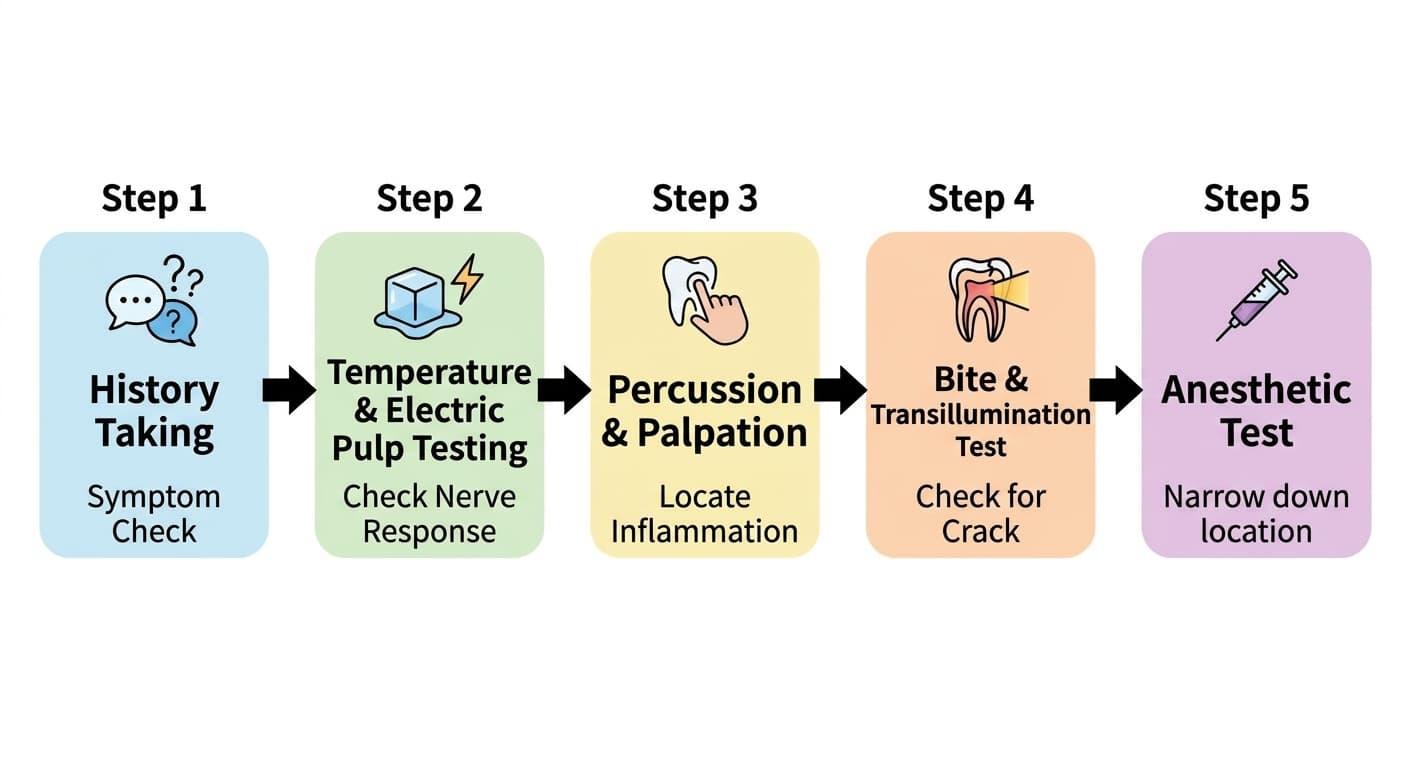
Dentists narrow down the source tooth by layering several tests in sequence, starting with history taking and moving through temperature testing, electric pulp testing, percussion, palpation, and bite and transillumination tests. When the pain may be referred pain, felt somewhere other than its actual source, these tests alone can make it hard to pinpoint the tooth, so an anesthetic test is also used: suspected areas are anesthetized one at a time to find the tooth where the pain disappears. No single test is used to reach a conclusion; the results of multiple tests are combined to make the judgment.
Why Is That?
History taking first maps out the character of the pain
The dentist first listens to the subjective symptoms the patient describes. They ask when the pain started, what triggers it, how long it lasts, and whether it has ever occurred spontaneously without any stimulus. These answers alone don't immediately confirm the source tooth, but they give a tentative direction for where to start the tests that follow.
Temperature testing and electric pulp testing check the state of the nerve
The cold test, applying a cold stimulus to the tooth surface for about 5 seconds and observing the response, and electric pulp testing (EPT), which passes a weak current through the tooth to check the nerve's response, both gauge whether the pulp (the tissue containing the tooth's nerve and blood vessels) is alive and in what condition. If pain lingers well after the stimulus is removed, it signals that the pulp's inflammation has progressed to irreversible pulpitis, a stage where it can no longer heal on its own; no response at all raises suspicion of pulp necrosis, where the nerve has died. However, electric pulp testing is less accurate on teeth with full crowns or metal restorations. For this reason, no diagnosis is made from a single test result alone; it is judged in comparison with neighboring healthy teeth and together with other tests.
Percussion and palpation check how far the inflammation has spread
Percussion involves lightly tapping the tooth, often with the handle of a dental mirror, to check whether the periodontal ligament (the tissue connecting the tooth root to the surrounding bone) is inflamed. If tapping produces unusually sharp pain, it raises suspicion that the pulp has died or that inflammation has spread to around the root tip. Palpation involves pressing a finger against the gum around the tooth root to check for swelling or a soft, spongy feel, and is used to gauge whether the infection has spread beyond the pulp into the surrounding tissue. This state, where inflammation has spread to the tissue around the root tip, is called apical periodontitis.
If pain is brief and only occurs while biting, a crack is also checked for
If no decay is visible and the X-ray looks normal, but biting causes a sharp, brief pain, the possibility of a cracked tooth, a fine crack in the tooth, is also checked. This uses a bite test, in which the patient bites down on one cusp at a time with a wooden stick or a dedicated instrument to find where the pain is reproduced, and a transillumination test, in which strong light is passed through the tooth to see whether the area around the crack line appears darkly shadowed. Early on, a crack may be confined to the dentin and go undetected by other tests, but once it extends into the pulp chamber, it can progress to spontaneous pain that occurs even without any stimulus.
If it still can't be narrowed down, an anesthetic test reduces the range
If the above tests still fail to pinpoint the source tooth, or if referred pain is suspected, felt somewhere other than the actual site, an anesthetic test is performed. Starting with the furthest-back tooth in the suspected area, each tooth is anesthetized in turn to see whether the pain disappears; if it doesn't, the process repeats moving forward to the next tooth.
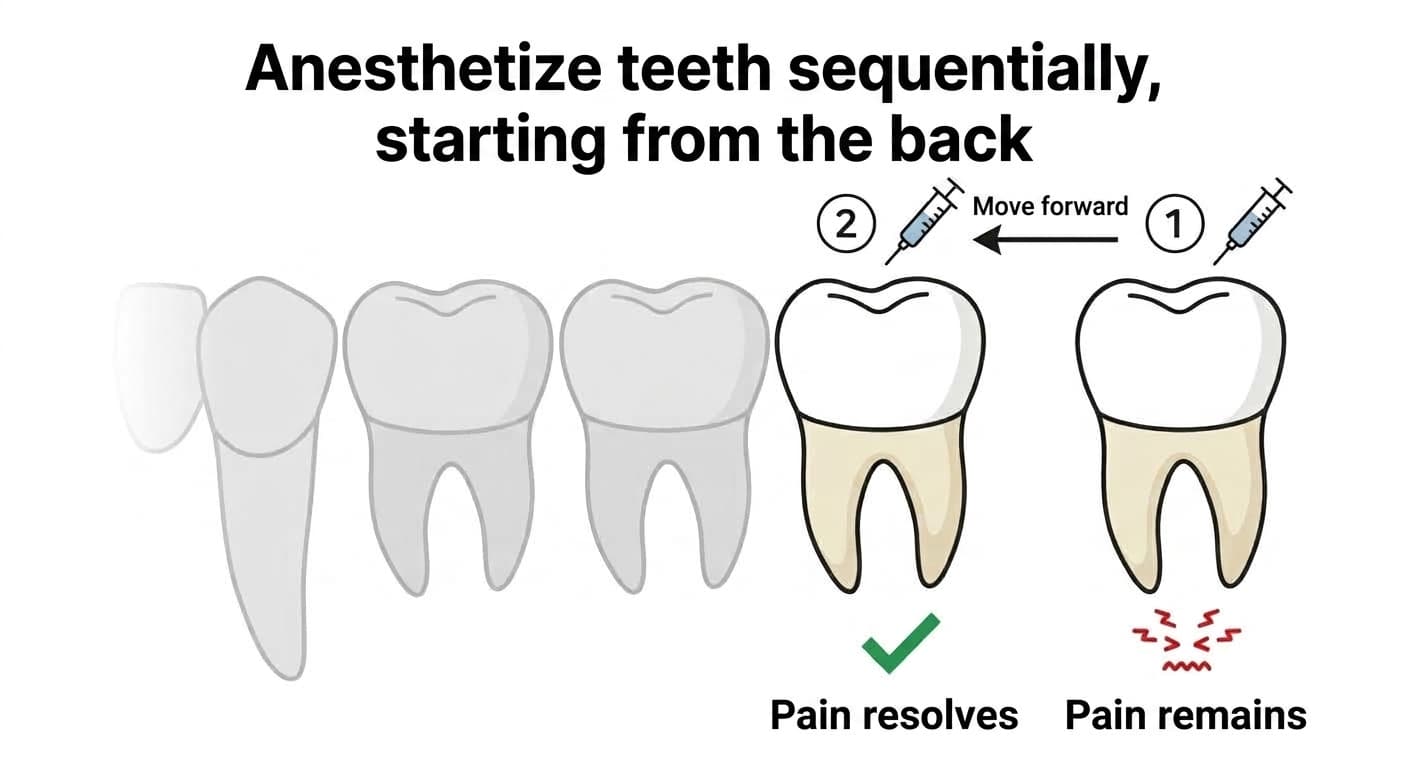
When it's unclear whether the upper or lower jaw is the source, an inferior alveolar nerve block can be used to anesthetize that entire side of the lower jaw at once, to determine whether a lower tooth is the cause. If the pain remains even after anesthetizing teeth in this sequence, a non-dental cause such as trigeminal neuralgia is suspected, and the patient is referred to the appropriate care.
The overall sequence of tests is summarized below.
If the character of the pain changes, you should be examined again
Even if the cause isn't clearly identified on the day of the exam, if the pain shifts to a constant throbbing, becomes severe enough to wake you at night, or is accompanied by gum swelling, this can signal that the inflammation has spread beyond the pulp to the tissue around the root tip. If any of these changes occur, even if the initial exam didn't reach a conclusion, it's best to be seen again for a fresh round of percussion, palpation, and X-ray testing.