
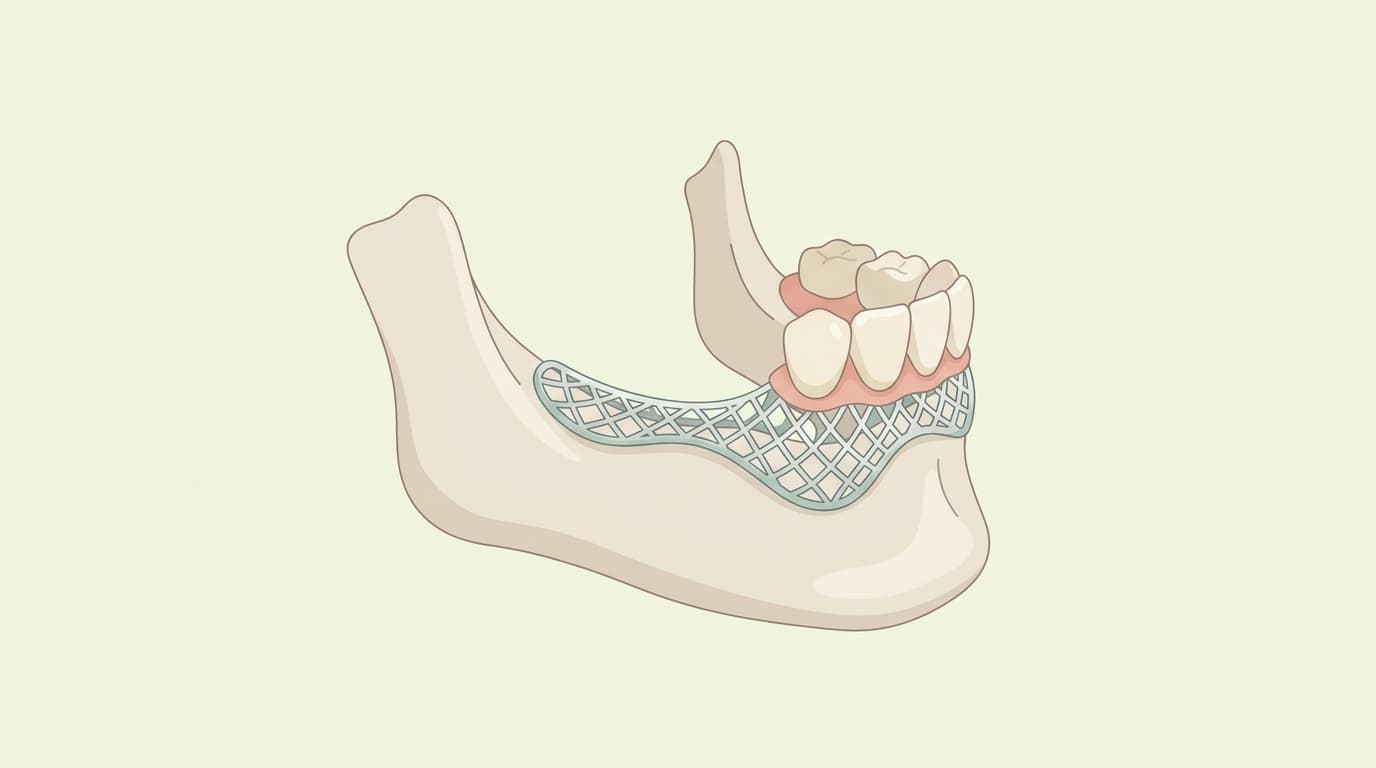
For jaws where the alveolar bone (the bone inside the gum) has shrunk severely, there was no good way to place a standard implant. The only options were to graft bone first to build up thickness, or, if even that was not possible, to fall back on a removable denture. In recent years, subperiosteal implants have filled this gap: a titanium frame 3D-printed to match the exact shape of the jawbone captured on CT is placed on the bone surface. Meta-analyses pooling clinical studies through 2026 show survival rates above 90% in the short term, but rates that fall to around half in the long term.
Placed on the Bone, Not Inside It
The implants commonly used in dentistry drive a screw-shaped titanium post into the jawbone and wait for osseointegration, the process by which bone grows around and fuses to the post. For this to work, enough thick bone has to remain to hold the post. Jaws left untreated for a long time after tooth loss, or jaws where gum disease has dissolved much of the bone, do not have that thickness.
Subperiosteal implants go the opposite way. Instead of digging into the bone, a thin titanium frame is fitted to sit on the bone surface, beneath the periosteum. The patient's CT scan is reconstructed in 3D, and a CAD design tracing the exact contours of the remaining bone is produced using 3D printing (direct metal laser sintering), which melts and fuses metal powder layer by layer. The frame is fixed to the bone surface with a few screws, and artificial teeth are mounted on top.
The concept itself is not new. Older subperiosteal implants, made by taking a hand impression and casting the frame, were designed only to be fixed in place rather than to bond with bone, and they fell out of use as their long-term outcomes proved poor. In 2017, a research team led by Maurice Mommaerts in Belgium reimplemented the concept using 3D printing and named it AMSJI (Additively Manufactured Subperiosteal Jaw Implant). As CT imaging and design software grew more precise afterward, other research teams followed.
Skipping Bone Grafts and Zygomatic Implants
For jaws with insufficient alveolar bone, using standard implants meant either grafting bone to build up thickness or using long implants that anchor into the zygomatic bone behind the upper jaw. Both carry a heavy burden. Grafted bone can resorb or detach, and the site where the bone was harvested is left with its own damage. Zygomatic implants involve surgery that extends up near the eye, and rare but serious complications such as orbital cellulitis (inflammation around the eye) or double vision have been reported.
Subperiosteal implants skip these procedures. Because they simply sit on the remaining bone surface rather than adding new bone, the surgery is completed in a single session, and immediate loading, placing a temporary prosthesis the same day, is possible. The accuracy comparisons covered in guided and robotic implant surgery, which plans implant placement precisely with a computer beforehand assume there is bone left to place an implant into. For patients who had almost no bone left and had to fall back on dentures, subperiosteal implants have become an option for regaining fixed teeth.
Good in the Short Term, but Diverging in the Upper Jaw Over Time
Outcomes vary with follow-up length. A systematic review published in 2024 pooled 13 studies and 227 implants, following them for an average of 21 months, and found that 97.8% were still functioning. A meta-analysis published in 2026 reported that when follow-up was narrowed to within three years, the survival rate was a similar 97.8%, but when the entire period was combined it dropped to 92.4%, and one study with six years of follow-up saw it fall as low as 54.1%. In Poland, of 10 lower-jaw subperiosteal implants followed for up to 12 years, only 7 (70%) remained in place, while 3 were removed after bone resorption or granulation tissue growth.
Problems tend to cluster in the upper jaw. In another meta-analysis pooling 368 implants, soft-tissue dehiscence, where the gum splits open and the frame is exposed, appeared in 28.6% of cases overall, and the risk of this dehiscence leading to complete implant loss was 3.8 times higher in the upper jaw than the lower jaw. Why the upper jaw fails more often is not yet clear. The research team suggested that differences in severity between the patient groups who received upper- and lower-jaw implants may have played a role. The risk of failure did not rise evenly over time; it jumped in two step-like increases, around 35 months and 70 months after surgery.
Whether It Truly Bonds to Bone Is Only Now Being Confirmed
Subperiosteal implants were originally designed only to be fixed in place with screws, not to bond with bone. But in 2026, a research team at the University of Sassari in Italy reopened three cases with loosened fixation screws and observed that the frame's arms were partially or fully covered by new bone growth over the jawbone. This is the first direct evidence suggesting the implant may bond with bone (osseointegrate) the way standard implants do, but with only three cases observed, this alone cannot confirm that osseointegration occurs.
Comparisons between manufacturing methods are also ongoing. A randomized controlled trial that directly compared milling, which carves the frame from a block of titanium, with 3D printing, which builds it up from metal powder, found no difference between the two methods in survival rate, bone loss, or placement accuracy. Which method is used has come down to a clinic's equipment and the operator's skill.
Subperiosteal implants are not becoming a replacement for standard implants, but rather establishing themselves as the remaining option when neither bone grafts nor zygomatic implants can be used. Their short-term outcomes are stable, but whether that stability holds beyond a few years, especially in the upper jaw, remains a question that still needs watching.