
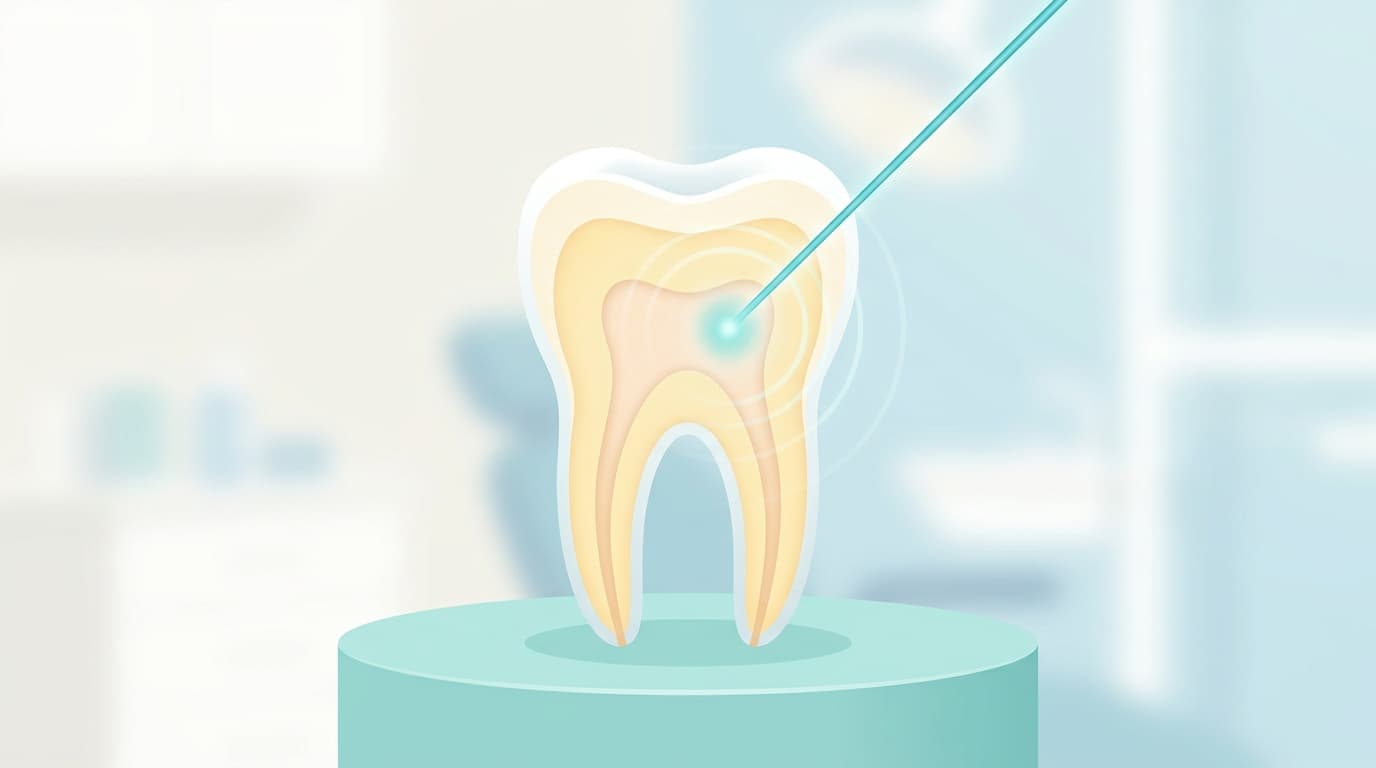
Removing cavities with a laser instead of a dental drill (handpiece) is already used in many dental clinics. The erbium YAG (Er
) laser, a dental laser that emits a wavelength strongly absorbed by water and the mineral content of teeth, is known to be less painful than a drill and to require less anesthesia, but the fact that it takes several times longer has been a drawback. In an experiment published in 2026, a research team changed how the laser was fired, namely the duration of each pulse (pulse length) and the number of pulses per second (repetition rate), and found combinations that could increase speed while keeping the preservation of healthy tooth structure similar to that of a drill.How Does a Laser Selectively Remove Only the Decay?
Er
lasers use a wavelength that is strongly absorbed by water and hydroxyapatite (the mineral that makes up teeth). Tissue softened by decay holds more water than healthy tooth structure, so it absorbs more laser energy, and the moisture inside the tissue instantly boils and blasts the tissue away like a tiny explosion. Unlike a drill, which grinds with a rotating blade, this method selectively bursts water-rich spots, so it disturbs healthy tissue relatively less and does not generate frictional heat.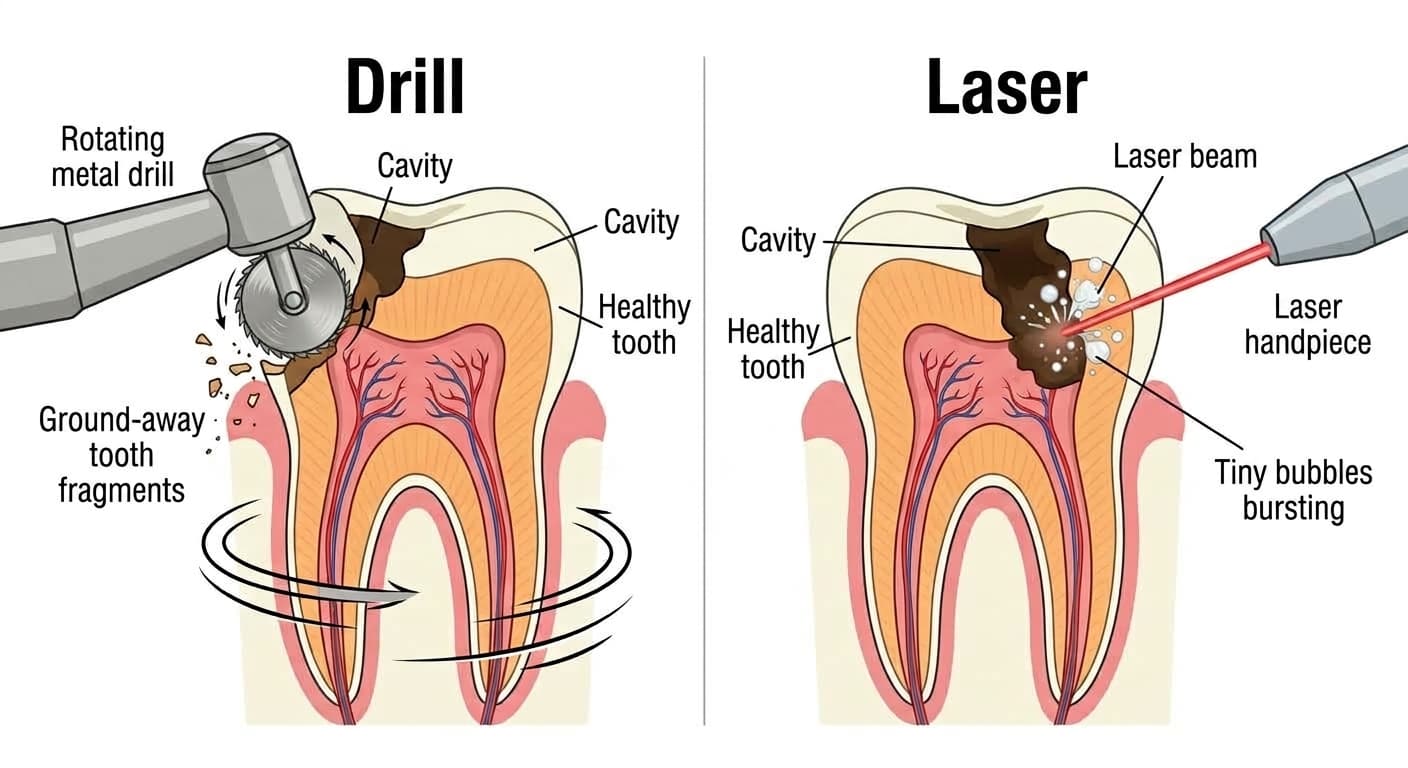
Cavity removal isn't the only use for dental lasers. Lasers that treat peri-implantitis are used to reduce bacteria inside the gums, and low-level lasers that reduce orthodontic pain only stimulate tissue with light without cutting it. What this study addresses is specifically the use of lasers to directly remove decayed tissue.
Comparing to the Drill: Precision and Speed Diverged
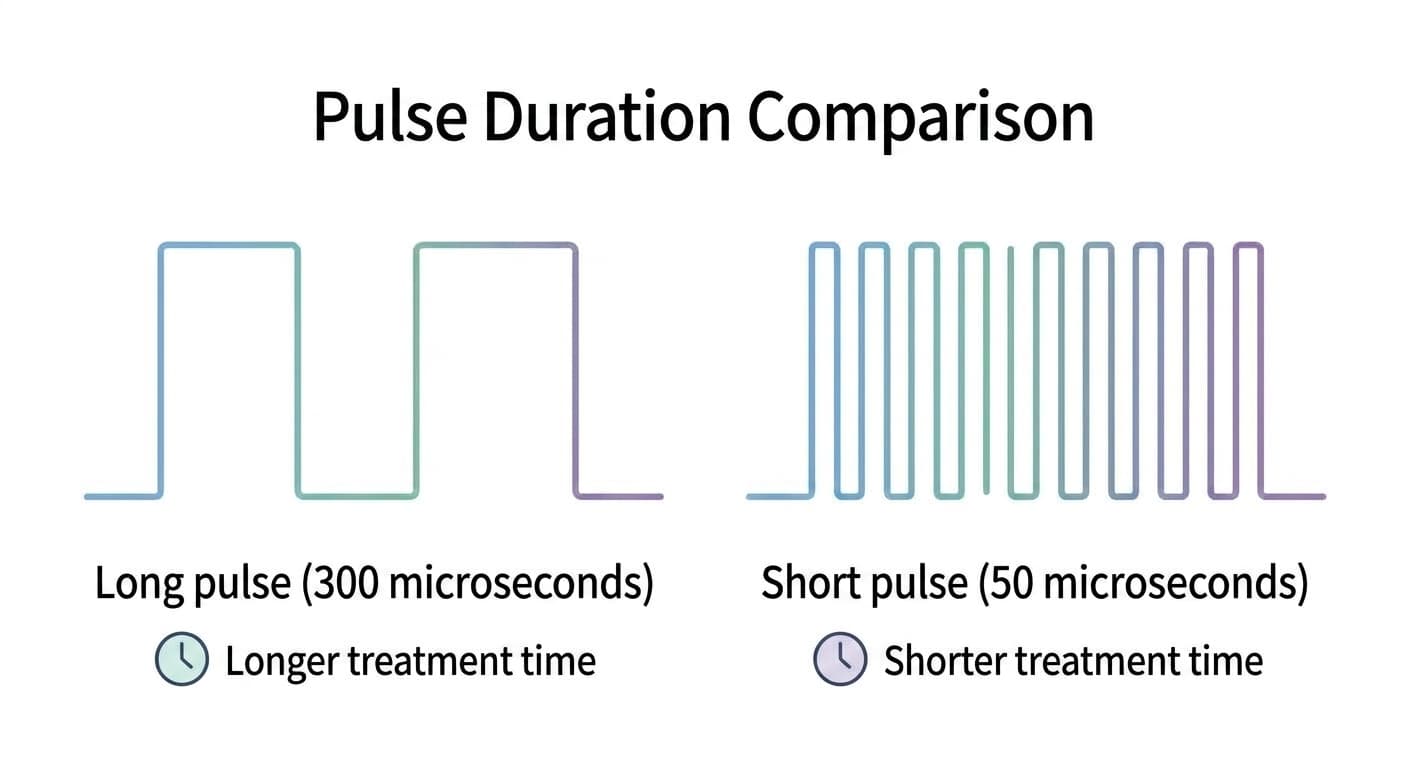
The research team compared laser and drill using two types of samples: tooth fragments with artificially demineralized decay and teeth with actual cavities. In the artificial teeth, the most conservative laser setting, firing long pulses (300 microseconds) at 20 pulses per second, reduced healthy tooth loss to one-eighth of what the drill caused. With settings that used shorter pulses and more pulses per second, that gap narrowed. In teeth with real cavities, there was no difference in healthy tooth loss left by the laser and the drill. However, the laser still took 2.6 to 3.3 times longer than the drill.
What Determined Speed Was Pulse Length
Testing various laser settings showed that simply raising the repetition rate from 20 to 40 pulses per second did not significantly cut treatment time. What did significantly cut the time was pulse length. Reducing the pulse from 300 microseconds to 50 microseconds while also raising the repetition rate shortened treatment time by about 35 percent, without increasing healthy tooth loss. This setting also lowered the minimum energy needed to start removing decayed tissue (the threshold energy). In about 7 out of 10 teeth, the threshold energy dropped by 5 to 10 millijoules, and in some cases by as much as 20 millijoules.
The energy the research team used was 60 to 70 millijoules, far lower than the 150 to 250 millijoules commonly used in clinical practice. Earlier studies reported that energy levels of 100 millijoules or less had no effect on the survival of pulp cells (the tissue containing the tooth's nerves and blood vessels), but survival dropped sharply at 200 millijoules or above. The significance of this result is that speed can be gained using low energy even for deep cavities close to the nerve.
This study did not create a new laser; it confirmed that speed and tissue preservation depend on what settings an already-used laser is fired with. Even with optimized settings, the laser still takes more than twice as long as the drill. As a result, the division of labor seems likely to continue: the laser used as a supplementary tool to reduce pain and the need for anesthesia when refining deep cavities close to the nerve, while the drill handles quickly clearing away large areas of decay.