
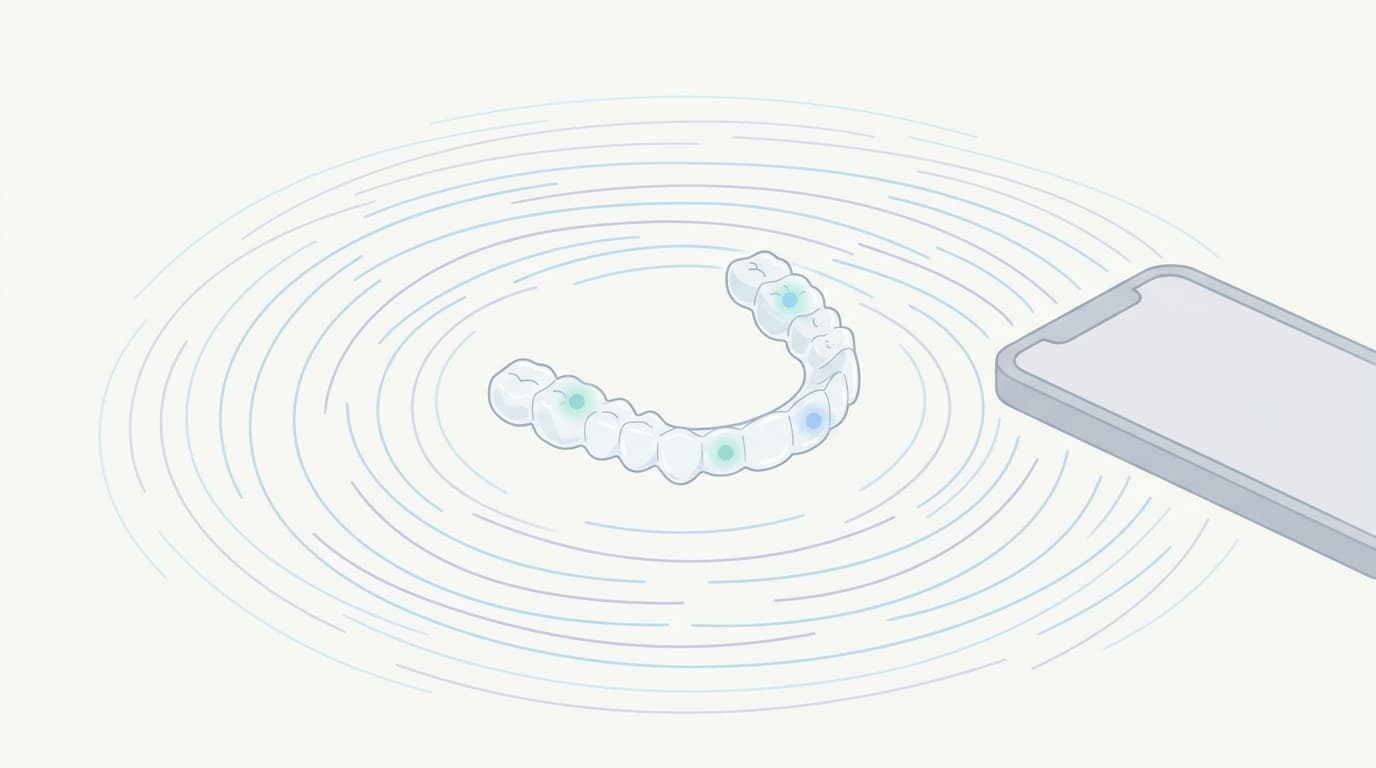
A clear aligner has been developed with pressure sensors built directly into its biting surface. Sensors attached at eight tooth sites analyze the signals generated during chewing using artificial intelligence to identify the type of malocclusion, and even distinguish in real time habits that worsen malocclusion, such as thumb sucking and teeth grinding. Developed by a research team at West China Hospital of Stomatology, Sichuan University in China and published in 2024, this device differs from previous occlusal force sensors in that it generates its own electricity from the bite force itself, without a separate battery.
In Do Teeth Move as Planned with Clear Aligners?, we looked at how treatment outcomes are checked afterward through scanning. This device is different in that it captures, in the moment, what forces are passing through the aligner while treatment is underway.
Turning Bite Force into Electricity Without a Battery
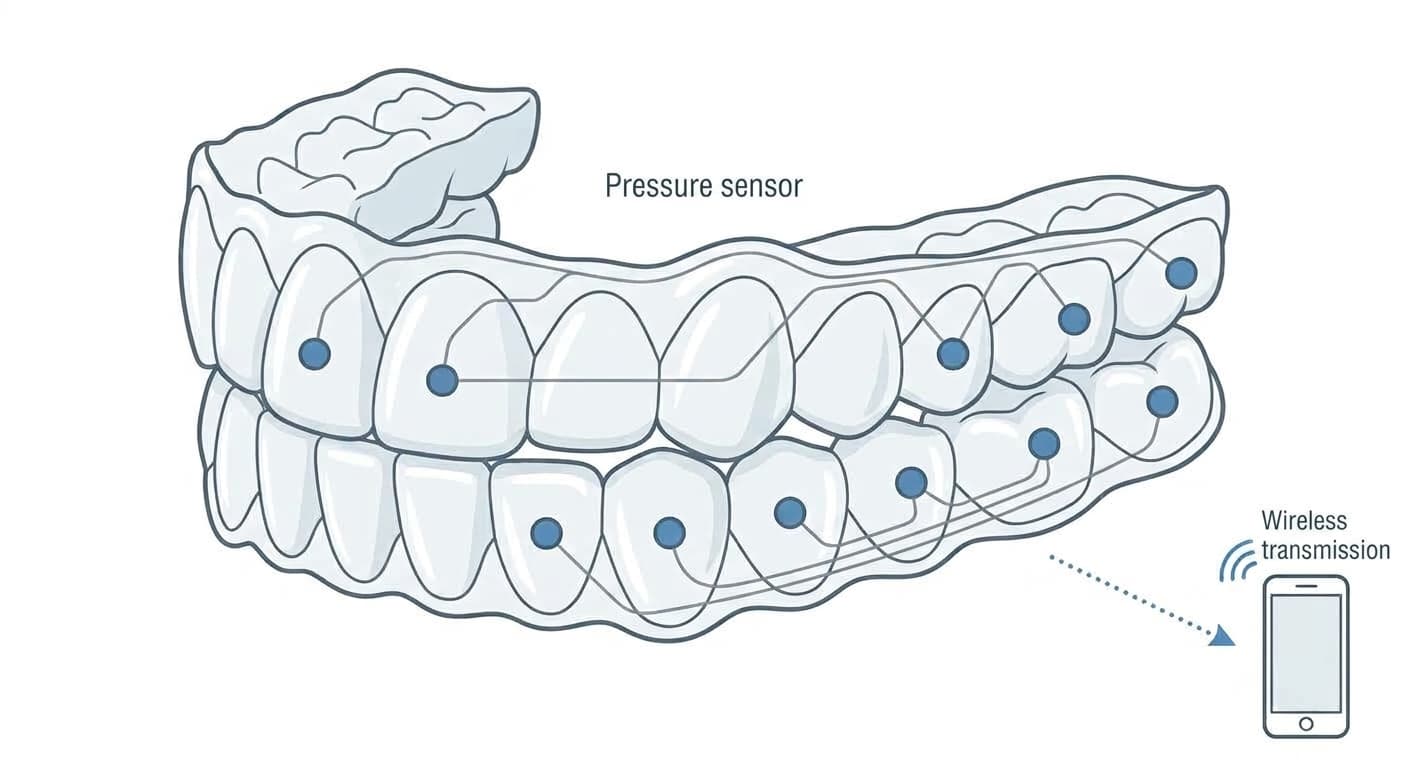
Most existing occlusal force sensors use piezoresistive or capacitive methods, both of which require an external power supply. Embedding wires and batteries together in a device placed inside the mouth is difficult, which has been an obstacle to miniaturization. This device avoids that problem by embedding thin nanofiber membranes made of piezoelectric material (a material that generates its own electricity when subjected to pressure) at eight points on the aligner's biting surface. Electrical signals from a total of sixteen points, one each at the incisor, premolar, and molar positions of the upper and lower jaws, record the strength, location, and timing of contact each time the teeth touch, and are transmitted wirelessly to a smartphone via Bluetooth.
The Balance of Molar Signals Reveals the Type of Malocclusion
Malocclusion is commonly classified into Class I, Class II, and Class III based on where the upper and lower first molars meet, with two more categories added: open bite, where the upper and lower front teeth do not touch, and mandibular deviation, where the jaw is shifted to one side, for five categories in total. Until now, identifying this classification required taking radiographs and visually matching plaster dental models. The research team clamped dental models from malocclusion patients into a machine to reproduce their biting states, and trained an AI on the signals captured by the sensors. When signals from all sixteen upper and lower points were fed in together, accuracy exceeded 95%, and the categories were far more clearly distinguished than when only upper or only lower jaw signals were used. In Class II malocclusion, the signal from the lower incisors was weaker than that from the upper incisors, while in Class III the pattern was reversed. The very location where force concentrated became the basis for diagnosis.
However, these results were obtained not from patients actually chewing and speaking while wearing the aligner, but from signals reproduced by clamping dental models in a machine. Whether the same accuracy holds in the actual mouth environment, wet with saliva and subject to temperature changes, has not yet been confirmed.
The Signal Remains Whether You Bite Your Lip or Grind Your Teeth
Habits such as thumb sucking, lip biting, and teeth grinding have long been cited as causes that disrupt the force balance of the growing jaw and dentition, worsening malocclusion. The problem is that such habits have so far been confirmed by relying on observation by caregivers or the patients themselves. Testing with this device attached showed a clear difference: pressure signals appeared only near the front teeth during thumb sucking or lip biting, while during teeth grinding the signals from the left and right molars alternately grew stronger.
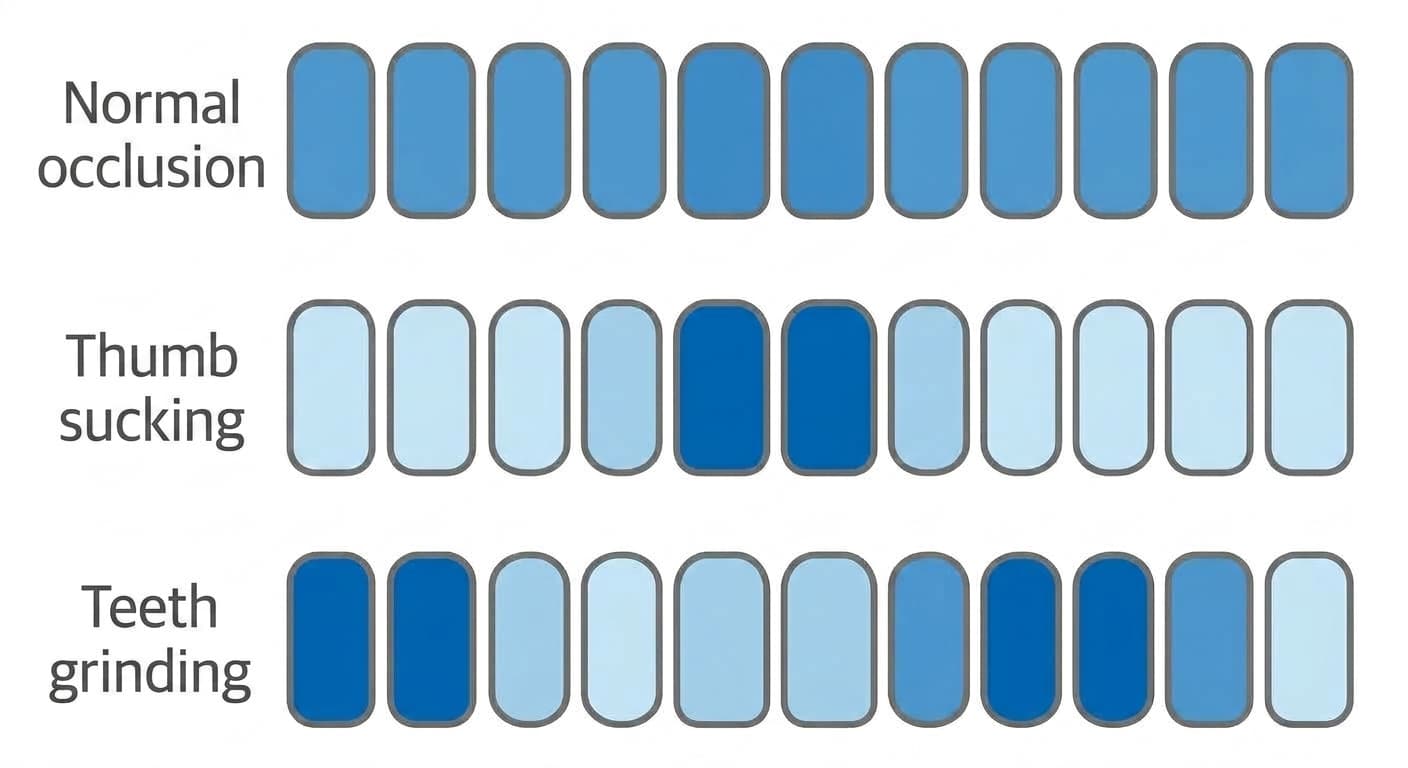
Because the device continuously transmits signals while worn, it can capture the exact moment a habit occurs. However, this test was conducted only on a small number of healthy adults, and whether the same signal differences hold in patients undergoing orthodontic treatment still needs to be confirmed. Where the smart retainer that only measured wear time addressed compliance after orthodontic treatment ends, this device targets a different point: bite force and habits themselves during ongoing treatment.
Embedding piezoelectric sensors in the aligner to wirelessly measure bite force is an attempt to shift malocclusion diagnosis, previously reliant on radiographs and plaster models, toward real-time signals captured during wear. Both the malocclusion classification and habit detection are still laboratory-stage results, and re-validating them on patients actually wearing the device in clinical practice remains the next task.