Question
It has been several years since getting a crown on a front tooth, and recently, looking in the mirror, the crown's color seems different from before, or the margin where the crown meets the gum looks different than it used to. The question is whether it's fine to leave it as is, or whether the crown needs to be replaced.
Short Answer
The fact that the color or margin looks different doesn't by itself determine whether the crown needs replacing. What matters is why the change happened. If the gum has simply receded naturally and revealed a margin that was previously hidden, the crown itself may be unchanged, and in many cases watching it is enough. On the other hand, if a gap has opened at the margin where the crown meets the tooth, or a ledge-like overhang has formed, letting plaque build up there and new caries start, the affected area will only grow if left alone, so it needs to be checked at a dental office. If the defect is confined to a small area, trimming or repairing just that spot may resolve it; if it covers a wide area or gum inflammation is also progressing, the crown may need to be removed and remade. Which of these applies is hard to tell by sight alone, so it requires looking at the margin, the gum, and a radiograph together.
Why Does This Happen?
When Gum Recession Reveals the Margin
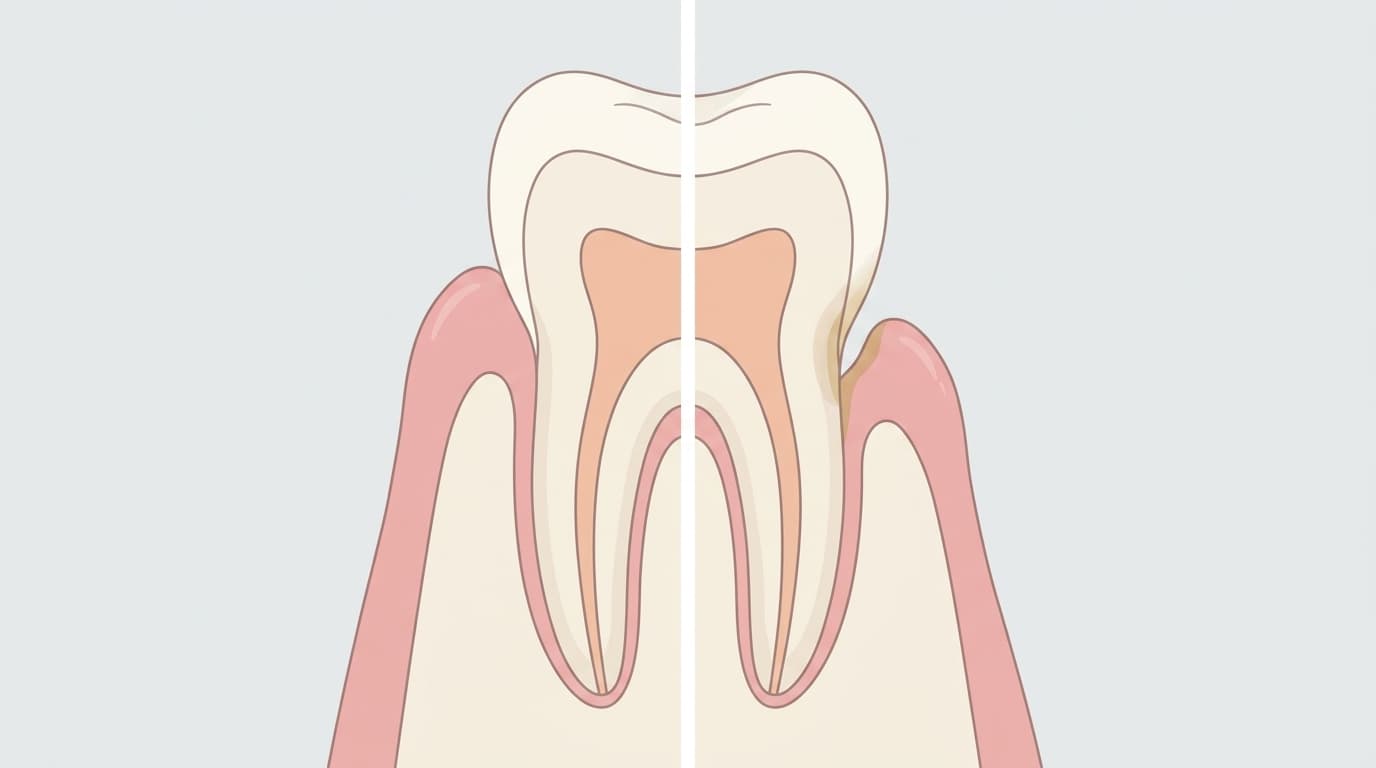
The margin where the crown meets the tooth is often designed to sit just beneath the gum line. Over time, however, if the gum itself recedes toward the root (a change called gingival recession), the margin that was once covered becomes visible. This is a common change with age, and it tends to occur more readily with heavy-handed brushing, a thin gum and bone biotype, or gums weakened by periodontitis.
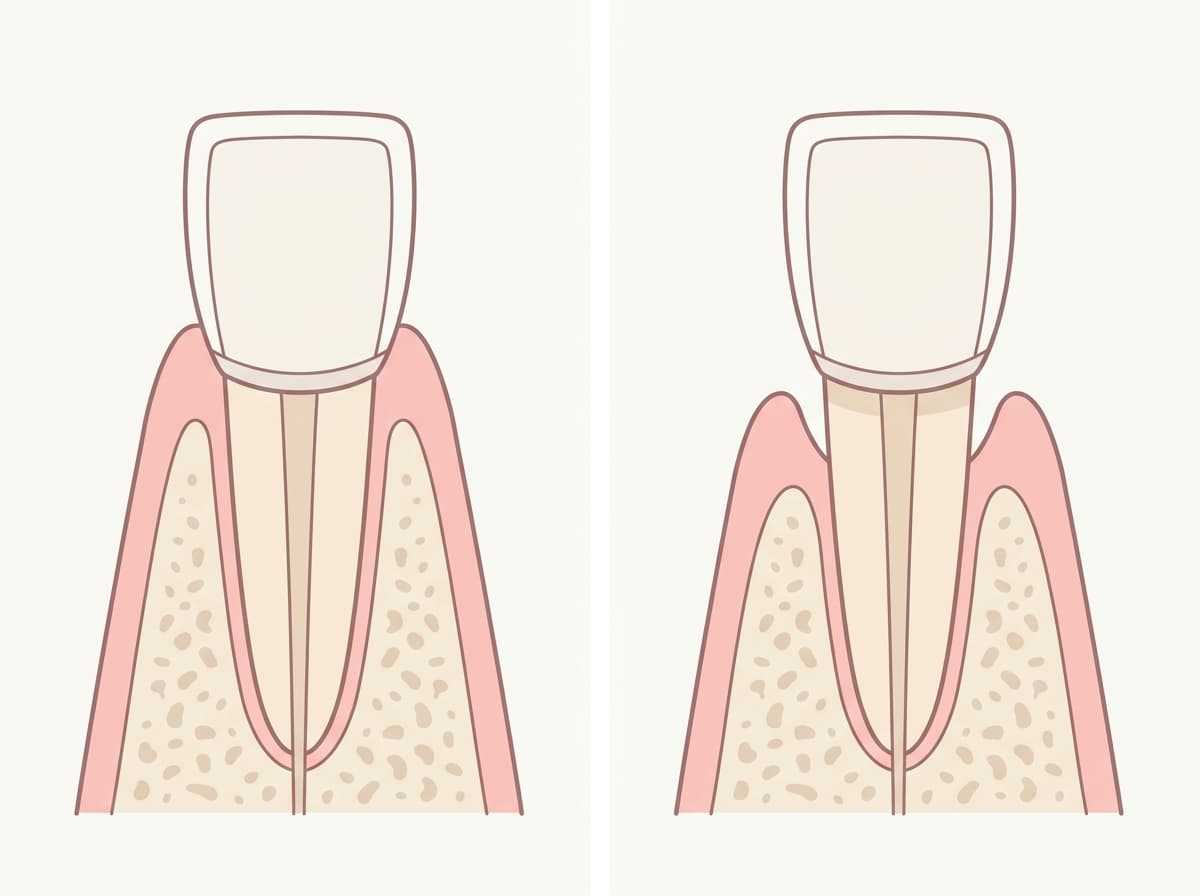
The problem arises when the crown margin extends too far below the gum, encroaching on the minimum attachment space the gum needs to stay attached to the tooth, known as the biologic width. When this happens, the area stays irritated and inflamed; in people with thin gum tissue this tends to show up as recession, while in people with thick gum tissue it tends to show up instead as a deepening of the gap between gum and tooth (a periodontal pocket), which makes the two hard to tell apart by appearance alone. In this situation, rather than simply watching, the margin position itself may need to be reestablished.
When a Defect Develops at the Crown Margin Itself
Even a crown made with great precision leaves a microscopic gap at the margin between the crown and the tooth, known as a marginal gap. A certain amount of this gap is considered normal, but over time, as the cement gradually dissolves, the gap can widen. As it deepens, plaque can build up inside it where a toothbrush can't reach, sometimes appearing as a dark or chalky-white discoloration.
A defect can also form in the shape of the margin itself. The margin may protrude beyond the contour of the tooth (an overhanging margin), or, conversely, it may be finished short, leaving a step or an open gap. Dentists check for this by running the tip of a probe along the margin to feel for a catch. Either way, it can be noticed when floss catches or tears, and it creates a spot where plaque accumulates, continuously irritating the gum and creating conditions where caries can easily develop beneath it.
Caries Can Start Again at That Spot
If plaque builds up around the margin for a long time, new caries can start at that spot (this is called secondary caries). It develops as plaque accumulates around a marginal gap, an overhang, or a defective area, and it can sometimes be noticed as a chalky-white discoloration of the surrounding enamel. However, surface discoloration alone makes it hard to tell whether the caries is active or arrested. Dentists make this determination by probing the area and checking beneath the margin with a bitewing radiograph.
When Local Repair Is Enough and When Full Replacement Is Needed
How this is handled depends on what the exam finds. When the defect is small and localized, such as an overhanging margin, simply reshaping that area or repairing a narrow section may be enough to keep the existing crown. On the other hand, if the marginal gap extends over a wide area, if secondary caries beneath it has progressed significantly, or if the crown margin is encroaching on the gum's attachment space and causing recurring inflammation, the decision tends to favor removing and remaking the crown.
One thing worth knowing is that replacing a crown requires cutting and removing the existing one, and this process can require further shaping of the tooth itself. Because replacement involves more treatment to the tooth than a local repair, it's important to first check the extent of the defect and the condition of the gum to determine whether replacement is actually necessary. When the attachment space has been encroached upon, a procedure called crown lengthening, which surgically lowers the gum and bone slightly to increase the exposed length of the tooth, may need to be done before replacement.
A similar question, such as when a laminate veneer chips or the gum recedes, is judged by the same framework: looking at the extent of the defect together with the condition of the gum to decide between local repair and full replacement.