Question
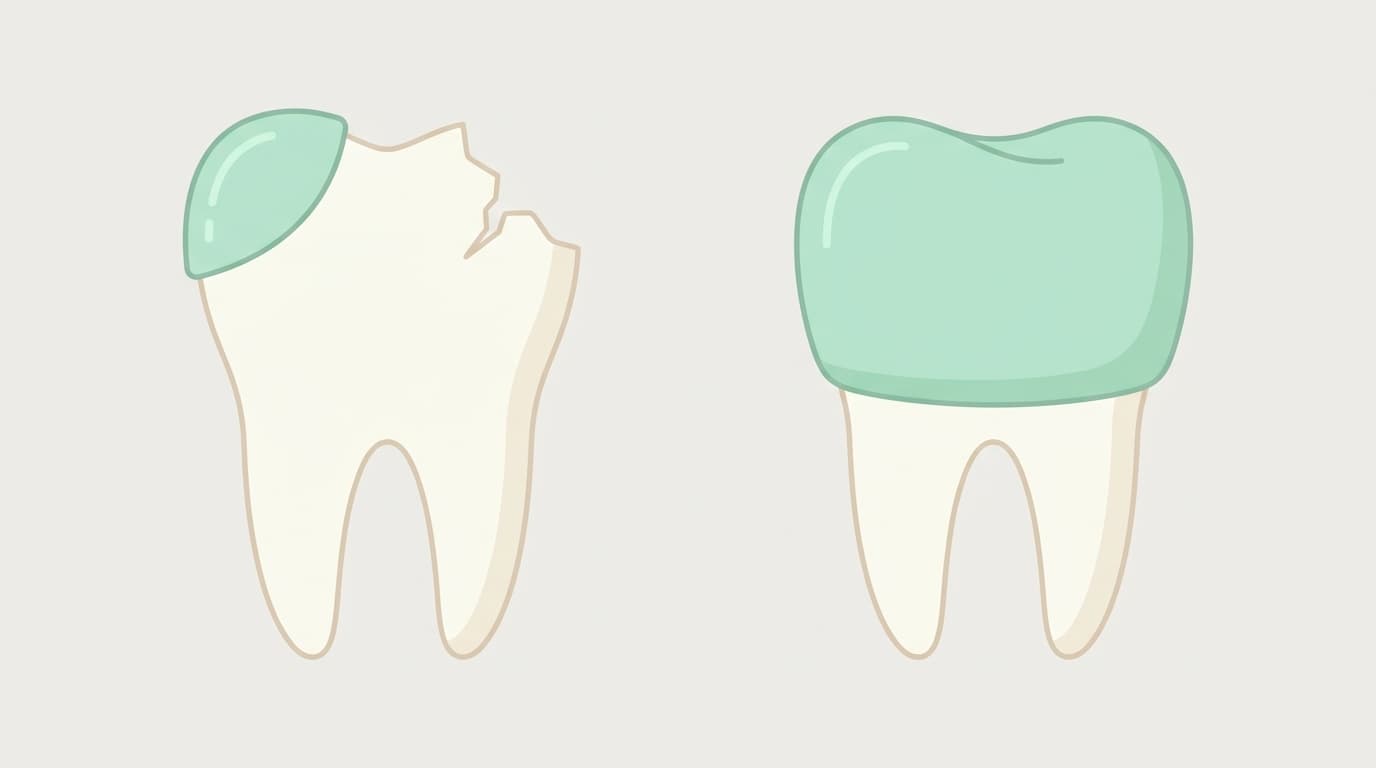
One of my molars broke, and when I went to the dentist, I was told that both an onlay and a crown were options. I understand that both methods cover the chewing surface to protect the tooth, but I'd like to know what criteria are used to choose between the two.
Short Answer
If the broken area is limited to about one cusp (the pointed projection on the chewing surface) and enough of the remaining tooth wall, particularly the enamel, is intact, an onlay can conservatively cover just that cusp. On the other hand, if the fracture is extensive enough to weaken several cusps together, or if the walls have become too thin to leave enough surface for bonding, a crown that encases the entire tooth may be the more stable choice in terms of resistance form and retention form. Whether the bite (how the upper and lower teeth come together) leaves enough space for the required thickness of restorative material must also be considered, so the exact choice is made only after the dentist examines the broken area and the remaining tooth structure in person.
Why Is That?
Onlays and Crowns Cover Different Amounts of Tooth Structure
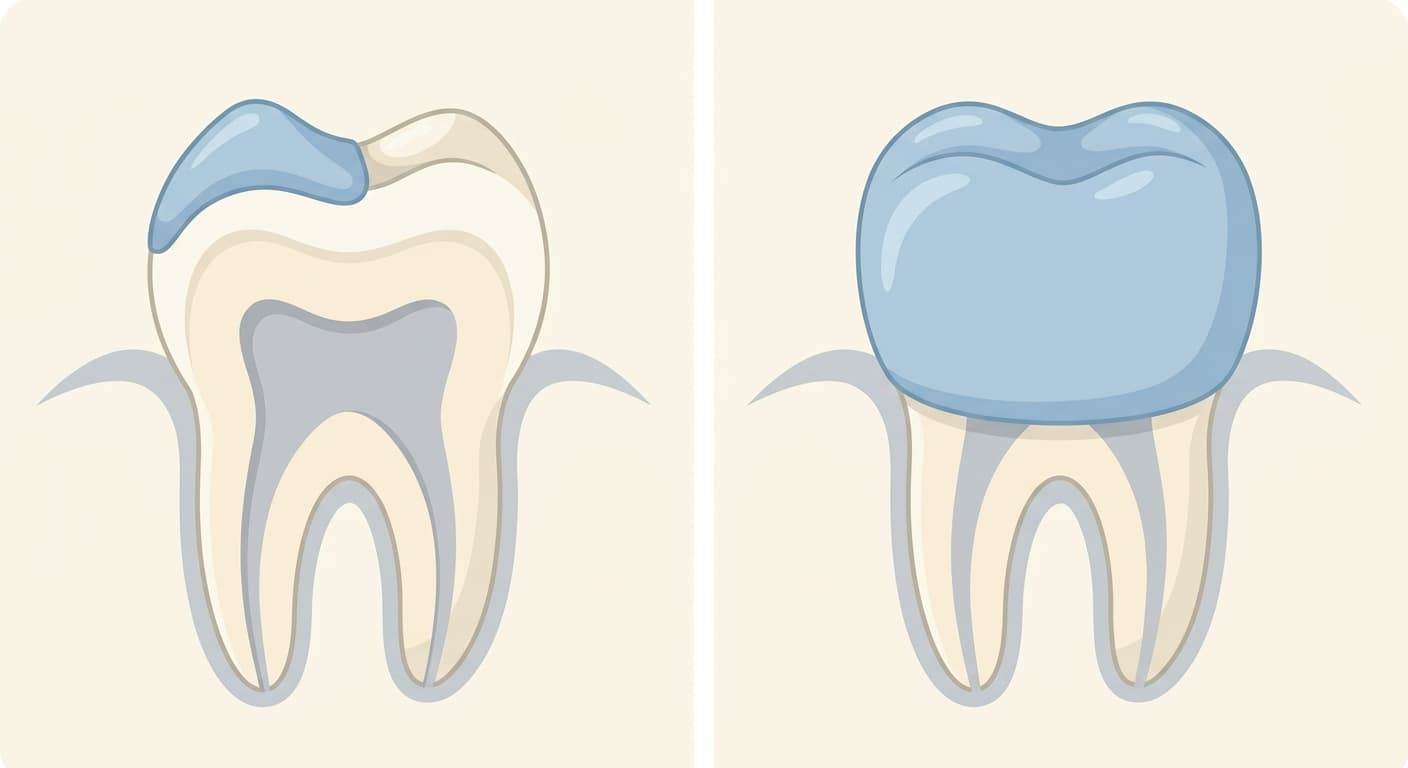
An onlay is a restoration that provides cuspal coverage (covering and protecting) for one or more cusps. Rather than reducing the entire crown (the part of the tooth above the gumline), only the weakened cusp area is removed and the restoration is then bonded in place, so relatively more healthy tooth structure can be preserved. Because the margin (the border between the restoration and the tooth) can be placed above the gumline, it also tends to be easier to maintain.
A crown (full-coverage crown) is a restoration that encases the entire remaining structure of a damaged or weakened tooth to restore its shape and function. It is also the most basic and widely used restoration type in fixed prosthodontic treatment. Unlike an onlay, which relies on bonding, a crown surrounds the tooth structure on all sides, which can make it more stable in terms of resistance form (the structure that withstands chewing force) and retention form (the structure that keeps the restoration from coming loose).
Even with the same degree of cuspal damage, an onlay conservatively treats only that area, while a crown treats the entire tooth. Because of this difference, the choice cannot simply be decided outright; it depends on the extent of the damage.
Fracture Extent Is the First Criterion
If the damage to the chewing surface is half or less of the intercuspal distance, there is no need to reduce and cover the cusps. If it falls between one-half and two-thirds, it is a borderline range where cuspal protection may be worth considering, and if it exceeds two-thirds, the remaining cusps need to be reduced and covered with a restoration to achieve a resistance form that can withstand chewing force.
This criterion marks the line for whether the cusps need to be covered at all; the next step determines whether an onlay covering only part of the cusps is enough, or whether the entire tooth needs to be encased. If the break is limited to a single cusp and the remaining walls are intact, an onlay can provide coverage for just that cusp. But if the break is extensive enough to weaken several cusps together, or if it has severed the wall that once crossed the middle of the tooth, there is not enough wall left for an onlay to rely on, and the decision shifts toward a crown that encases the entire tooth.
The Amount of Remaining Tooth Structure, Especially Enamel, Also Matters
Because a ceramic onlay relies on bonding for its retention, it is indicated only when at least 1.5mm of enamel remains available for bonding. At the cusp area, the cavity is shaped to secure roughly 2mm of structural thickness so the restoration can withstand chewing force. If the fracture is deep enough that most of the enamel has been lost and the underlying dentin or an area close to the gumline is exposed, there is not enough surface left for bonding, which takes the case outside the indications for an onlay and tilts the decision toward a crown that encases the whole tooth.
Bite Space Also Determines the Restoration Choice
Whether it is an onlay or a crown, the tooth must be reduced enough to create adequate occlusal space, or the restorative material can fracture under chewing force. A porcelain onlay needs at least 1.5mm of clearance in every chewing direction to prevent fracture. An all-ceramic crown likewise requires at least 1.5mm of reduction at the non-functional cusps (the cusps that bear less chewing force) and 2.0mm at the functional cusps (the cusps where chewing force concentrates).
If the cusps have already broken down so much that the remaining height is insufficient, there may not even be enough room for an onlay to rely on. In such cases, the decision naturally shifts toward a crown, which lowers and reshapes the entire tooth before encasing it.
Depending on the Cause of the Damage, There Is More to Consider
If the cusp was damaged along with deepening tooth decay, How Do You Choose Between Resin, Inlay, and Crown for Treating Cavities? covers restoration methods by extent of damage in more detail. If a molar that has already had root canal treatment breaks, cuspal protection tends to be recommended more actively because a significant portion of the internal tooth structure is already gone. This standard is explained in Does a Molar Always Need to Be Covered with a Crown After Root Canal Treatment?. If the break followed repeated brief, sharp pain while chewing, a crack may have already been progressing beforehand, as with a cracked tooth (tooth crack), so the depth and location of the crack should be checked as well.