
Question
I noticed a small, hard white fragment had come off the chewing surface of a molar. I had a sealant treatment (filling the grooves of the molar) done in the past, so I'm not sure whether this piece is part of that material coming loose, or whether it was tartar (hardened material on the tooth surface) that was already there. If it was the sealant, I'm worried that the cavity-prevention effect it provided may be gone now.
Short Answer
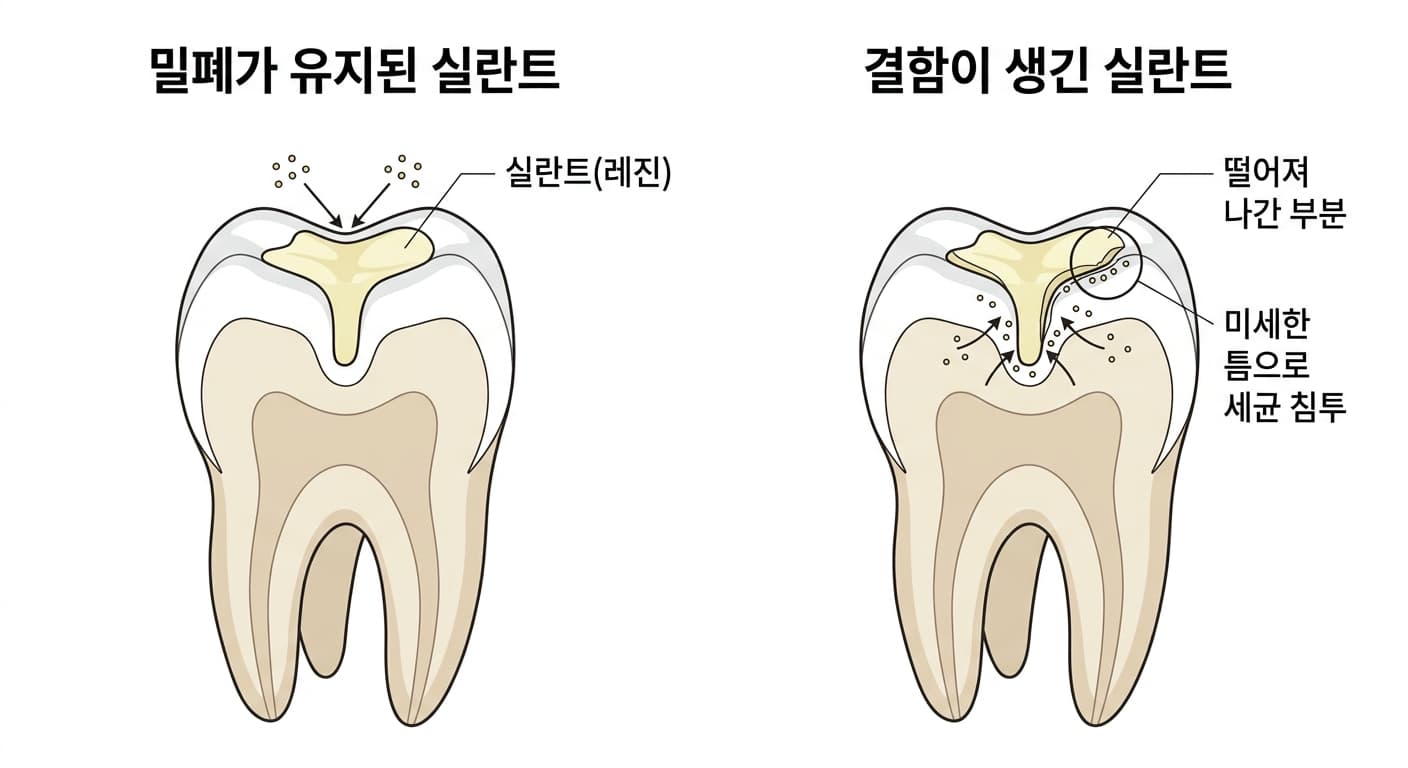
A single fragment that came out of the mouth isn't enough on its own to tell whether it was sealant or tartar, or how large an area came off. A sealant is a material that fills the narrow, deep grooves on a molar's chewing surface to block any gap where bacteria could get in. If that seal breaks even in one spot, bacteria and acid can pass back through that spot. Regardless of whether the fragment was actually sealant, if it felt like part of the chewing-surface material had come loose, it's safer to have a dentist look at that spot directly. On examination, there may turn out to be no problem at all, or only that one spot may need to be touched up.
Why Is That?
What the Sealant Was Blocking
Molars and premolars have grooves (pits and fissures) on their chewing surfaces that are cut so narrow and deep they're barely visible. Toothbrush bristles can't fully reach the bottom of these grooves, so food debris and bacteria tend to linger there for a long time. That's why the chewing surface is considered one of the sites most prone to dental caries. A sealant (pit and fissure sealant) is a preventive treatment that fills these grooves with a low-viscosity resin material that flows in easily, then hardens it with light, physically eliminating the space where bacteria could take hold. This differs from fluoride application in how it prevents decay, since it fills in narrow grooves that brushing or fluoride alone can't reach.
Why a Fragment Alone Doesn't Tell the Whole Story
When a sealant is placed, the tooth surface is first etched with acid to roughen it, and then the material is flowed on. If even a small amount of saliva or moisture gets mixed in during this step (incomplete moisture control), the material won't bond properly to the tooth surface. This can show up in two different ways: sometimes it later comes off as a single piece, and sometimes the surface looks unchanged while an invisible microscopic gap (microleakage) remains. In other words, a fragment coming off can be a sign that something went wrong at that spot, but conversely, not seeing a fragment doesn't mean the seal is completely intact either.
There is also more than one type of sealant material. Besides the resin material that is etched and then hardened, in situations where moisture control is difficult, another material that continuously releases fluoride is sometimes used as a temporary measure, and this material is known to have a higher failure rate than resin. Looking only at the hard white fragment that came out of the mouth, there's no way to tell what material it was, or whether other grooves in the molar came off along with it. This is something only a dental examination can sort out.
Why It Needs to Be Checked Again
If a defect develops on the sealant surface, bacteria can penetrate that spot again and start a new cavity. Decay that forms this way, at a site where the seal has broken, is called secondary caries. This is why it's recommended that a sealant continue to be monitored to make sure it's still intact even after it's been placed. Whether a defect actually exists is something a dental examination determines, and follow-up steps can be decided based on that result.
A sealant isn't a material that lasts permanently after a single placement; it's a material that can partially wear down or come off over time. If you've noticed a fragment has come off, having it examined directly is the way to know exactly what's going on.